
www.aero-defence.tech
16
'26
Written on Modified on
3D vision automates aviation sealant application
AKEOPLUS and MVTec deploy a robot cell to precisely dispense two-component sealants on large aerospace parts.
www.mvtec.com
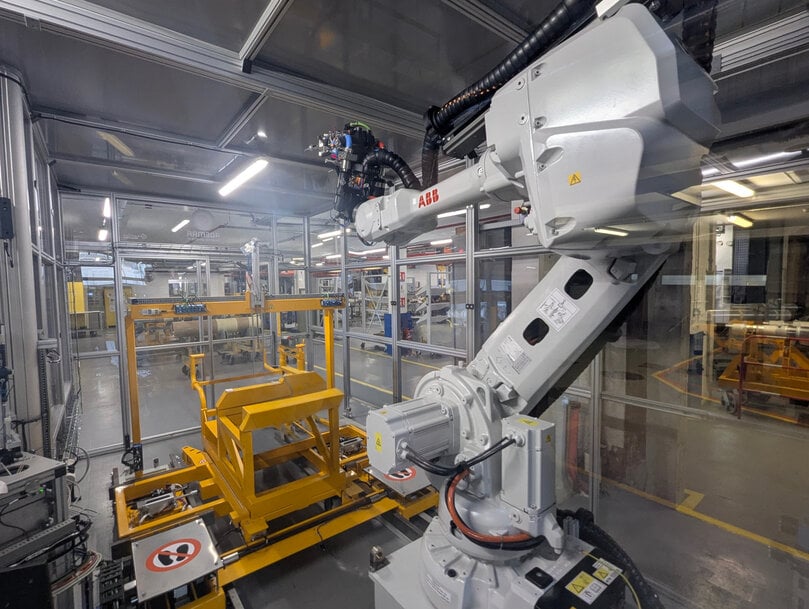
AKEOPLUS has developed an automated robot cell for the aviation industry to apply two-component sealants and primers to large, painted metal components. Utilizing a six-axis robot and a 3D profilometer guided by MVTec HALCON machine vision software, the system achieves a dispensing accuracy of ±0.2 mm across a highly expansive 2,000 x 2,000 x 2,000 mm workspace. This automation replaces a physically demanding and time-critical manual process, protecting workers from hazardous chemical exposure while ensuring reproducible sealant beads despite manufacturing tolerances.
Overcoming variable positioning with 3D vision
The application targets bronze and stainless steel bearings embedded within large aviation structures. Because these components are subject to inherent manufacturing deviations and cannot be positioned identically every time, mechanical probing was ruled out to avoid extending cycle times and unnecessary surface contact. Instead, the robot scans predefined areas using a 3D profilometer. The MVTec HALCON software processes this visual data into point clouds, determining the exact six degrees of freedom for each bearing. This processing allows the control system to dynamically adjust the robot's programmed bead paths to the exact physical location of the target area, completely compensating for variable part placement.
Fully automated dispensing workflow
The entire operational sequence is executed autonomously. Following an initial setup and line-purging phase, a positioner roughly aligns the large component. After the 3D scanning phase is complete, the robot automatically switches to a swab tool to apply an invisible primer. It then exchanges tooling again to dispense the two-component sealant, actively adjusting its travel speed to control the exact thickness of the bead. To prevent the fast-curing sealant from polymerizing within the mixing system during idle periods, the robot automatically moves to a flushing station to clear the lines between component cycles.
Additional Context: Polysulfide sealants and zero-datum tooling
This section details technical specifications and competitive benchmarking not included in the original product announcement.
In aerospace manufacturing, aerodynamic and environmental sealing (often using polysulfide or polyurethane compounds) is critical to prevent moisture ingress, galvanic corrosion, and pressurization leaks. Manually applying these sealants requires highly skilled operators and typically involves a strict pot-life of roughly two hours before the mixed material cross-links and hardens. Automating this process with a 3D-guided six-axis arm not only mitigates the severe toxicological risks associated with prolonged exposure to sealant off-gassing but also optimizes material consumption. Furthermore, by dynamically calculating spatial offsets via advanced point-cloud algorithms, the robotic cell entirely eliminates the need for massive, high-precision mechanical hard-tooling (jigs) that are traditionally required to lock aerospace structures into an absolute zero-datum coordinate system for blind robotic processing.
Edited by an industrial journalist, Lekshman Ramdas, with AI assistance.
www.mvtec.com
