
www.aero-defence.tech
21
'26
Written on Modified on
Direct Current Grid Integration for Zero-Emission Vessels
Porrima Inc. partnered with Danfoss Drives and UVE to integrate multi-source renewable energy systems for reliable long-distance maritime propulsion.
www.danfoss.com
Application areas: Marine electrical propulsion, onboard power distribution, hybrid vessel retrofits.
Industry sectors: Maritime transport, sustainable tourism, shipbuilding.
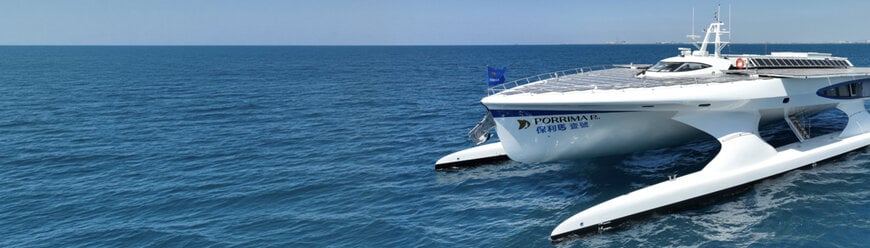
Porrima Inc., a Taiwanese maritime company, operates a zero-emission vessel that previously completed a round-the-world voyage without fossil fuels. To transition the ship from an experimental demonstration platform into a practical tourist vessel capable of reliable long-distance operation, the company initiated a comprehensive retrofit project. The objective was to combine solar panels, lithium batteries, hydrogen fuel cells, shore power connections, propulsion motors, and vessel control systems into a unified onboard power network.
Technical and Spatial Integration Challenges
The primary engineering challenge involved coordinating power sources from different manufacturers with varying electrical interfaces, voltage specifications, and control requirements. Rather than operating as isolated subsystems, these components needed to function as a single, stable energy architecture at sea. Additionally, the retrofit had to accommodate the strict physical constraints of an existing hull. Limited installation space, an unconventional interior layout, and iterative design modifications during the project demanded a modular and compact equipment footprint alongside high system flexibility.
Liquid-Cooled Common Direct Current Bus Architecture
To resolve these operational and spatial constraints, Danfoss Drives and local system integration partner UVE engineered a marine-dedicated common direct current (DC) bus architecture. The system utilizes DC/AC grid converters, DC/DC converters, and DC/AC inverter motor drives connected to a regulated 750 VDC bus. This central DC grid continuously balances power inputs from the solar arrays, battery banks, fuel cells, and shore power, distributing energy efficiently to the propulsion motors despite fluctuating load and generation profiles.
Most of the power conversion equipment utilizes liquid-cooled technology. In marine environments with restricted machinery spaces, liquid cooling provides higher power density and more effective thermal management than air-cooled alternatives, allowing the converters to fit within the vessel's existing compartments. The modular nature of the drives also allowed engineers to adapt the physical layout as spatial requirements evolved during the retrofit.
Full-Lifecycle Engineering and Sea Trials
The project scope extended beyond component supply to encompass complete system integration. Danfoss Drives and UVE conducted operational profile evaluations, designed the system architecture, recommended third-party hardware, and verified electrical interfaces. Prior to onboard installation, critical subsystems—including the hydrogen fuel cells and propulsion motors—underwent validation testing to confirm compatibility with the 750 VDC grid. UVE coordinated multiple hardware suppliers and managed commissioning through to final sea trials.
S.K. Chou, CEO of Porrima Inc., stated that Danfoss Drives managed the design and execution of the multi-source renewable energy ecosystem, achieving high energy efficiency and grid stability through its modular inverter technology.
Operational Results and Redundancy
In June 2026, the refitted vessel validated its long-distance capabilities during a 200 km cross-border voyage across the Bashi Channel from Orchid Island, Taiwan, to the Batanes archipelago in the Philippines. Cruising at approximately 5 knots while escorting a traditional Tao planked boat, the ship automatically optimized power draw across its solar generation, battery storage, and hydrogen fuel cell systems under varying sea states.
To ensure maritime safety during extended voyages, the electrical architecture incorporates full redundancy across all critical propulsion systems, allowing continuous navigation even if an individual subsystem experiences a fault. The regulated 750 VDC bus maintains voltage stability regardless of intermittent solar irradiance, battery state-of-charge fluctuations, or fuel cell load transitions.
Edited by Sucithra Mani, Induportals editor – adapted by AI.
www.danfoss.com
