
www.aero-defence.tech
01
'25
Written on Modified on
Boeing Delivers Second ViaSat-3 Satellite to Launch Site
Built on the 702MP+ platform, ViaSat-3 F2 integrates high-power generation, all-electric propulsion, and Viasat’s advanced payload to add over 1Tbps global broadband capacity.
www.boeing.com
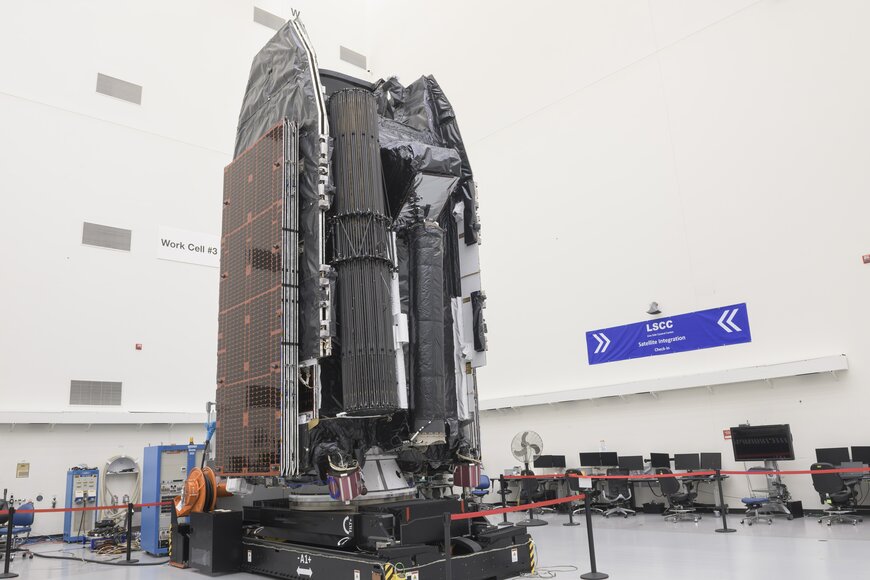
ViaSat-3 F2 satellite in El Segundo, California, Boeing satellite factory, ahead of containerization and shipment. (Boeing photo by Erik Isakson)
Boeing has delivered ViaSat‑3 F2, the second spacecraft in Viasat’s next‑generation, ultra‑high‑capacity constellation. The Boeing 702MP+ platform, optimized for high power and all‑electric propulsion, was integrated with Viasat’s payload at Boeing’s satellite factory in California and is proceeding towards launch in the second half of October, aboard a United Launch Alliance Atlas rocket.
“Our goal is to enable missions with reliability and timely delivery,” said Michelle Parker, vice president, Boeing Space Mission Systems. “With ViaSat‑3 F2, we leveraged proven 702 heritage, advanced power systems and all‑electric propulsion to enable high-speed connectivity for users who rely on it.”
As the second of three ViaSat-3 satellites, F2 marks another step toward Viasat’s flexible global network designed to connect users on land, at sea, and in the air. ViaSat-3 features a highly flexible payload designed by Viasat to add 1Tbps capacity to the operator’s global network.
“ViaSat‑3 F2 is the next important step in our roadmap to meet the increasing demand for resilient, global satellite communications from commercial mobility and defense customers,” said David Abrahamian, vice president, Space Systems, Viasat.
The Boeing‑built 702MP+ features an efficient all‑electric propulsion, structural enhancements to host Viasat’s advanced payload, and high‑power generation and storage to support sustained high‑throughput operations.
The satellite incorporates advanced solar array technology from Boeing subsidiary Spectrolab and benefits from Boeing’s decades of geostationary mission success, including more than 60 702-class spacecraft built for commercial and government customers.
Boeing and Viasat teams will support launch operations in Florida as part of the companies’ long‑standing collaboration across satellite programs.
www.boeing.com
Boeing has delivered ViaSat‑3 F2, the second spacecraft in Viasat’s next‑generation, ultra‑high‑capacity constellation. The Boeing 702MP+ platform, optimized for high power and all‑electric propulsion, was integrated with Viasat’s payload at Boeing’s satellite factory in California and is proceeding towards launch in the second half of October, aboard a United Launch Alliance Atlas rocket.
“Our goal is to enable missions with reliability and timely delivery,” said Michelle Parker, vice president, Boeing Space Mission Systems. “With ViaSat‑3 F2, we leveraged proven 702 heritage, advanced power systems and all‑electric propulsion to enable high-speed connectivity for users who rely on it.”
As the second of three ViaSat-3 satellites, F2 marks another step toward Viasat’s flexible global network designed to connect users on land, at sea, and in the air. ViaSat-3 features a highly flexible payload designed by Viasat to add 1Tbps capacity to the operator’s global network.
“ViaSat‑3 F2 is the next important step in our roadmap to meet the increasing demand for resilient, global satellite communications from commercial mobility and defense customers,” said David Abrahamian, vice president, Space Systems, Viasat.
The Boeing‑built 702MP+ features an efficient all‑electric propulsion, structural enhancements to host Viasat’s advanced payload, and high‑power generation and storage to support sustained high‑throughput operations.
The satellite incorporates advanced solar array technology from Boeing subsidiary Spectrolab and benefits from Boeing’s decades of geostationary mission success, including more than 60 702-class spacecraft built for commercial and government customers.
Boeing and Viasat teams will support launch operations in Florida as part of the companies’ long‑standing collaboration across satellite programs.
www.boeing.com
