
www.aero-defence.tech
25
'25
Written on Modified on
Anduril Demonstrates Connected Defense on NATO’s Eastern Flank
Anduril's Lattice platform rapidly connected Allied radars and acoustic sensors into a unified, real-time network, proving a faster, smarter digital deterrence against evolving aerial threats on the border.
www.anduril.com
The U.S. Army Europe and Africa, working closely with NATO Allies, is developing the Eastern Flank Deterrence Line (EFDL), which includes a distributed mission command architecture designed to integrate national and Allied sensors, shooters, and unmanned systems into a shared live-data network.
Rather than a fixed formation or location, the EFDL functions as a digital shield stretching across NATO’s eastern border. A radar in Estonia, for example, could detect incoming aircraft and instantly share that data with air-defense batteries in Latvia or command centers in Poland. Each nation remains responsible for defending its own territory, but through the EFDL, their systems contribute to a collective deterrence posture.
In early November, Anduril joined the U.S. Army’s 10th Army Air and Missile Defense Command (AAMDC) and the Estonian Defense Forces in Tallinn, Estonia, for exercise Digital Shield 1.0, one of the first major event to put the EFDL concept into practice. Over five days, Anduril engineers worked alongside U.S. and Estonian units to connect previously separate sensors, radars, and command and control systems into a single distributed network—the kind of digital infrastructure the EFDL will rely on across Europe.
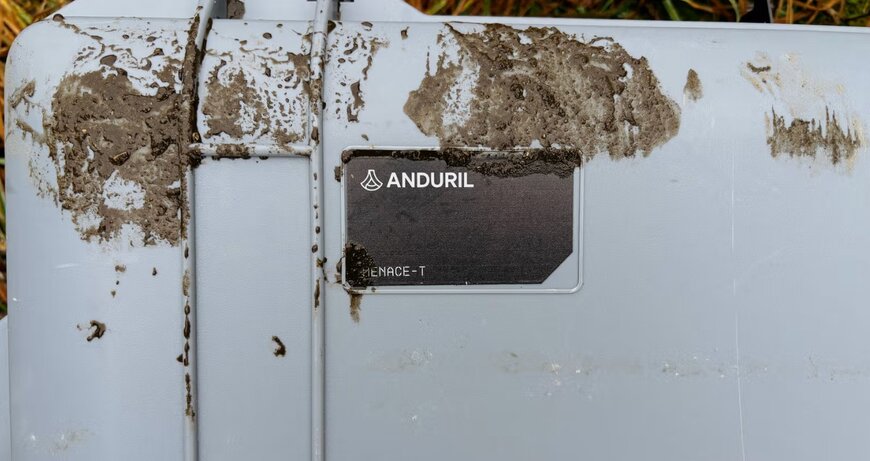
Within 48 hours of arrival, the team set up multiple Menace-T tactical compute and communication kits and established Lattice nodes running in the cloud. Together, these nodes created a resilient network that kept data moving, even when connections were jammed, weak, or cut off, a critical capability for any fight along NATO’s eastern flank.
Multiple Allied sensors were integrated into one live operating picture:
Rather than a fixed formation or location, the EFDL functions as a digital shield stretching across NATO’s eastern border. A radar in Estonia, for example, could detect incoming aircraft and instantly share that data with air-defense batteries in Latvia or command centers in Poland. Each nation remains responsible for defending its own territory, but through the EFDL, their systems contribute to a collective deterrence posture.
In early November, Anduril joined the U.S. Army’s 10th Army Air and Missile Defense Command (AAMDC) and the Estonian Defense Forces in Tallinn, Estonia, for exercise Digital Shield 1.0, one of the first major event to put the EFDL concept into practice. Over five days, Anduril engineers worked alongside U.S. and Estonian units to connect previously separate sensors, radars, and command and control systems into a single distributed network—the kind of digital infrastructure the EFDL will rely on across Europe.
Within 48 hours of arrival, the team set up multiple Menace-T tactical compute and communication kits and established Lattice nodes running in the cloud. Together, these nodes created a resilient network that kept data moving, even when connections were jammed, weak, or cut off, a critical capability for any fight along NATO’s eastern flank.
Multiple Allied sensors were integrated into one live operating picture:
- The Estonian Defence Forces’ AN/TPQ-50 radar, used for detecting and tracking rocket, artillery, and mortar fire, and the Giraffe AMB radar, which provides short- to medium-range air-defense coverage.
- Sky Fortress, a Ukrainian-developed acoustic sensor network that detects and classifies drones by sound.
- Dowding, a commercial UAS-tracking feed developed by Edgesource and used by U.S. Army Europe and Africa, providing additional real-time detections from commercial and military sensors.
By connecting these systems through Lattice, Anduril enabled real-time data fusion across previously separate radar, acoustic, and commercial networks. Feeds that once operated independently were synchronized and shared instantly across U.S. and Estonian command nodes, allowing operators at radar sites, the Estonian Control and Reporting Centre, and U.S Army Europe’s G-3 Operational Data Team to see the same tracks simultaneoulsy, distinguishing drones from birds, validating detections, and coordinating faster responses.
Work that traditionally takes months of integration and certification was completed in days, proving how digital speed and interoperability can outpace an adversary’s ability to mass.
The modern air threat is defined by mass and tempo—swarms of low-cost drones and missiles that can overwhelm static defenses. Digital Shield 1.0 demonstrated a response built on speed, interoperability, and repeatability.
Future iterations will expand integrations, introduce automated data fusion and layered effects, and deepen participation across the Alliance. The lesson from Digital Shield 1.0 is clear—deterrence on NATO’s eastern flank will depend not just on forward presence, but on shared data, connected systems, and the ability to move faster than the threat.
www.anduril.com
Work that traditionally takes months of integration and certification was completed in days, proving how digital speed and interoperability can outpace an adversary’s ability to mass.
The modern air threat is defined by mass and tempo—swarms of low-cost drones and missiles that can overwhelm static defenses. Digital Shield 1.0 demonstrated a response built on speed, interoperability, and repeatability.
Future iterations will expand integrations, introduce automated data fusion and layered effects, and deepen participation across the Alliance. The lesson from Digital Shield 1.0 is clear—deterrence on NATO’s eastern flank will depend not just on forward presence, but on shared data, connected systems, and the ability to move faster than the threat.
www.anduril.com
