
www.aero-defence.tech
10
'25
Written on Modified on
Boeing Advances Autonomous Air-to-Air Engagement
A coordinated test with the Royal Australian Air Force shows how an autonomous MQ-28 can integrate with crewed aircraft to conduct a live missile engagement.
www.boeing.com
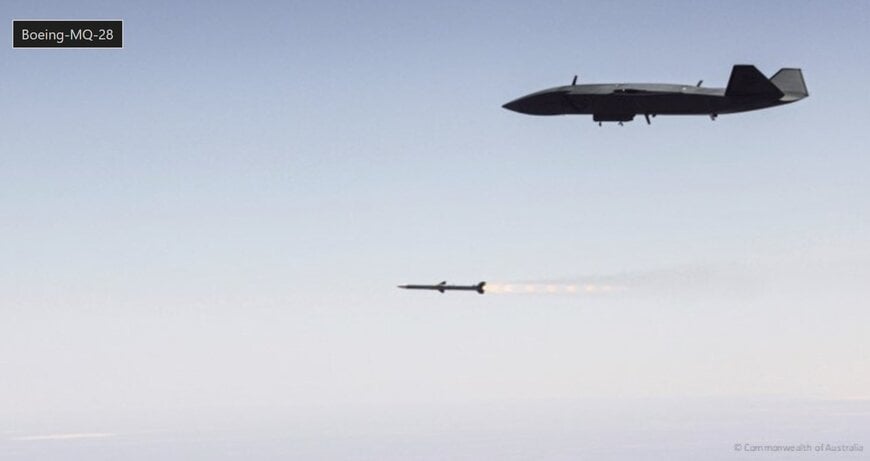
An MQ-28 Ghost Bat fires an AIM-120 missile to successfully demonstrate a force-integrated air-to-air autonomous weapon engagement. (Boeing)
Autonomous aircraft for air-to-air missions are becoming increasingly relevant in force-mix concepts that pair uncrewed systems with crewed fighters and command-and-control platforms. In this context, Boeing and the Royal Australian Air Force demonstrated how an autonomous platform can contribute to situational awareness, data sharing and weapons employment in contested airspace.
Coordinated Multi-Aircraft Test
During a live demonstration, an MQ-28 Collaborative Combat Aircraft worked alongside a RAAF E-7A Wedgetail and an F/A-18F Super Hornet to intercept and destroy a fighter-class target drone. All aircraft departed from separate locations. Once airborne, control of the MQ-28 was transferred to an E-7A operator to maintain safety and engagement oversight. The F/A-18F then flew in formation with the uncrewed aircraft to expand sensor coverage and track the target. Targeting data was shared across all three platforms using established datalinks suitable for real-time air combat coordination.
Validated Autonomous Weapon Engagement
After receiving tracking information from the Super Hornet, the MQ-28 repositioned autonomously and awaited authorization from the E-7A operator. It then launched a Raytheon AIM-120 AMRAAM, successfully destroying the target. This marks the first documented instance of an autonomous aircraft completing an air-to-air engagement with this class of missile, demonstrating that the MQ-28’s mission systems, datalink integration and autonomy stack meet operationally relevant performance levels.
Mission Autonomy and Integration Architecture
Boeing’s autonomy framework used in this test is based on open standards and government-owned architectures, enabling interoperability with fourth-, fifth- and projected sixth-generation aircraft. According to Boeing, the supporting hardware, software and mission systems were integrated and validated within an eight-month development cycle. While the timeline is ambitious, it remains plausible given the MQ-28’s modular design and use of a digital engineering ecosystem.
Collaborative Defence Development
The exercise was conducted jointly by Boeing, the Royal Australian Air Force, the U.S. Air Force and several industry partners. It reflects growing interest in collaborative combat aircraft (CCA) as complementary assets capable of increasing operational mass, distributing sensing tasks and reducing crewed-aircraft risk during high-demand missions.
www.boeing.com
Autonomous aircraft for air-to-air missions are becoming increasingly relevant in force-mix concepts that pair uncrewed systems with crewed fighters and command-and-control platforms. In this context, Boeing and the Royal Australian Air Force demonstrated how an autonomous platform can contribute to situational awareness, data sharing and weapons employment in contested airspace.
Coordinated Multi-Aircraft Test
During a live demonstration, an MQ-28 Collaborative Combat Aircraft worked alongside a RAAF E-7A Wedgetail and an F/A-18F Super Hornet to intercept and destroy a fighter-class target drone. All aircraft departed from separate locations. Once airborne, control of the MQ-28 was transferred to an E-7A operator to maintain safety and engagement oversight. The F/A-18F then flew in formation with the uncrewed aircraft to expand sensor coverage and track the target. Targeting data was shared across all three platforms using established datalinks suitable for real-time air combat coordination.
Validated Autonomous Weapon Engagement
After receiving tracking information from the Super Hornet, the MQ-28 repositioned autonomously and awaited authorization from the E-7A operator. It then launched a Raytheon AIM-120 AMRAAM, successfully destroying the target. This marks the first documented instance of an autonomous aircraft completing an air-to-air engagement with this class of missile, demonstrating that the MQ-28’s mission systems, datalink integration and autonomy stack meet operationally relevant performance levels.
Mission Autonomy and Integration Architecture
Boeing’s autonomy framework used in this test is based on open standards and government-owned architectures, enabling interoperability with fourth-, fifth- and projected sixth-generation aircraft. According to Boeing, the supporting hardware, software and mission systems were integrated and validated within an eight-month development cycle. While the timeline is ambitious, it remains plausible given the MQ-28’s modular design and use of a digital engineering ecosystem.
Collaborative Defence Development
The exercise was conducted jointly by Boeing, the Royal Australian Air Force, the U.S. Air Force and several industry partners. It reflects growing interest in collaborative combat aircraft (CCA) as complementary assets capable of increasing operational mass, distributing sensing tasks and reducing crewed-aircraft risk during high-demand missions.
www.boeing.com
