
www.aero-defence.tech
17
'25
Written on Modified on
L3Harris Delivers 12-kW Electric Thrusters for NASA’s Lunar Gateway
The delivered AEPS units will enable lunar orbit insertion and station-keeping while supporting long-duration missions under NASA’s Artemis program.
www.l3harris.com
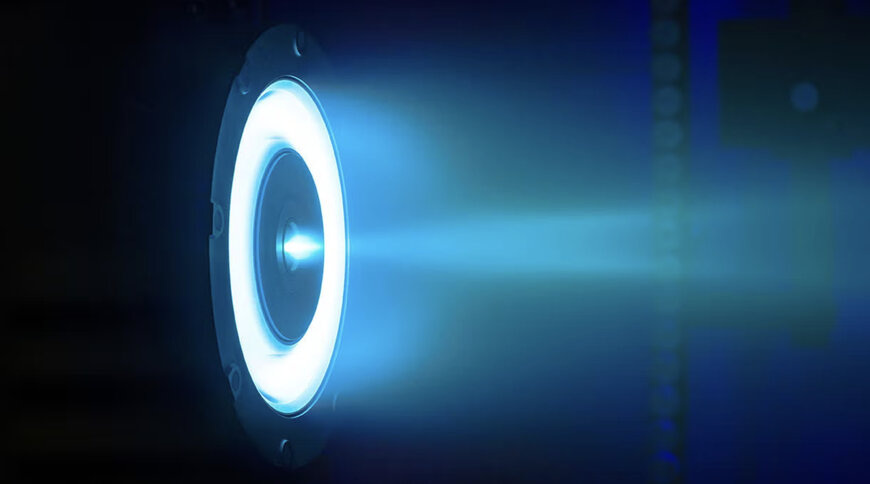
Three 12-kilowatt Advanced Electric Propulsion System thrusters, supplied by L3Harris Technologies, form the core of Gateway’s propulsion system. Pictured is Flight Module 1 testing at NASA’s Glenn Research Center. (Credit: NASA Glenn Research Center).
L3Harris has completed testing and delivery of three 12-kilowatt Advanced Electric Propulsion System (AEPS) thrusters for the Power and Propulsion Element (PPE) of NASA’s Lunar Gateway station. The thrusters will form the most powerful electric propulsion system yet deployed in space.
The AEPS units will allow the Gateway to reach and maintain its orbit around the Moon, providing critical propulsion capability for Artemis IV astronaut missions traveling between lunar orbit and the Moon’s surface. Electric propulsion offers substantially higher fuel efficiency than conventional chemical systems, making it well-suited for sustained operations in deep space.
“Electric thrusters offer significantly higher fuel efficiency over conventional chemical propulsion systems, making them ideal for Gateway and other long-duration missions,” said Kristin Houston, President, Space Propulsion and Power Systems at Aerojet Rocketdyne, L3Harris. She noted that pairing AEPS with nuclear power sources could enable future missions such as robotic exploration of Jupiter’s moons or transporting large cargo spacecraft to Mars.
Before delivery, the thrusters underwent hot-fire testing at NASA’s Glenn Research Center in Cleveland, Ohio, following vibration testing at L3Harris’ facility in Redmond. The test campaign confirmed performance, durability, and readiness for integration into the PPE.
With this milestone, the Lunar Gateway program advances toward establishing a permanent human-tended outpost in lunar orbit while supporting future exploration missions deeper into the solar system.
www.l3harris.com
L3Harris has completed testing and delivery of three 12-kilowatt Advanced Electric Propulsion System (AEPS) thrusters for the Power and Propulsion Element (PPE) of NASA’s Lunar Gateway station. The thrusters will form the most powerful electric propulsion system yet deployed in space.
The AEPS units will allow the Gateway to reach and maintain its orbit around the Moon, providing critical propulsion capability for Artemis IV astronaut missions traveling between lunar orbit and the Moon’s surface. Electric propulsion offers substantially higher fuel efficiency than conventional chemical systems, making it well-suited for sustained operations in deep space.
“Electric thrusters offer significantly higher fuel efficiency over conventional chemical propulsion systems, making them ideal for Gateway and other long-duration missions,” said Kristin Houston, President, Space Propulsion and Power Systems at Aerojet Rocketdyne, L3Harris. She noted that pairing AEPS with nuclear power sources could enable future missions such as robotic exploration of Jupiter’s moons or transporting large cargo spacecraft to Mars.
Before delivery, the thrusters underwent hot-fire testing at NASA’s Glenn Research Center in Cleveland, Ohio, following vibration testing at L3Harris’ facility in Redmond. The test campaign confirmed performance, durability, and readiness for integration into the PPE.
With this milestone, the Lunar Gateway program advances toward establishing a permanent human-tended outpost in lunar orbit while supporting future exploration missions deeper into the solar system.
www.l3harris.com
