
www.aero-defence.tech
09
'26
Written on Modified on
Digital Engineering Advances Missile Defense Target Testing
Northrop Grumman validates a redesigned ICBM target vehicle using digital twin and immersive engineering methods to support future U.S. missile defense flight tests.
www.northropgrumman.com
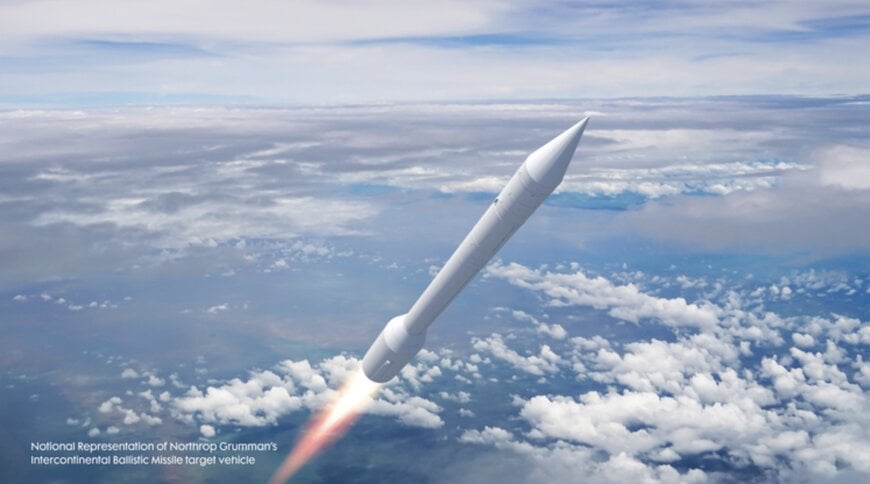
Northrop Grumman has completed the first successful launch of its redesigned intercontinental ballistic missile (ICBM) target vehicle, demonstrating a new, digitally engineered capability for U.S. missile defense test missions. The launch validates both the upgraded target architecture and the use of digital engineering methods to improve test readiness, safety and execution efficiency.
Modernized target for missile defense testing
ICBM target vehicles are threat-representative ballistic missiles used by the Missile Defense Agency (MDA) to evaluate the performance of systems such as Aegis Ballistic Missile Defense and Ground-based Midcourse Defense. The redesigned target incorporates a decommissioned Peacekeeper SR119 solid rocket motor as its first stage and a Peacekeeper second-stage motor supplied through the U.S. Space Force’s Rocket Systems Launch Program.
This configuration increases achievable range, apogee and payload capacity compared with previous targets, enabling more realistic simulation of long-range ballistic missile threats. The vehicle is also designed to support advanced front-end payloads, allowing future tests to represent increasingly complex threat profiles.
Digital twin and immersive engineering in development and integration
A key technical differentiator of the redesigned target program is the use of an integrated digital engineering environment. Northrop Grumman developed a continuously synchronized digital twin of the target vehicle, providing a high-fidelity virtual representation used throughout design, manufacturing, integration and test phases.
The digital twin supported configuration control and early validation of interfaces, reducing rework during physical assembly. Virtual reality “pathfinder” simulations were used to rehearse factory integration and stacking operations prior to hardware handling, enabling engineers to identify clearance, tooling and sequencing issues before execution. According to the program data, this approach contributed to a 25% reduction in field execution time during Pathfinder operations.
Augmented reality tools were also applied during interstage integration, overlaying digital assembly instructions onto physical hardware. This reduced mechanical assembly time while improving accuracy and repeatability in complex integration steps.
Performance validation and operational continuity
The maiden launch met all performance objectives for the missile defense test event, confirming the redesigned target’s flight characteristics and structural integrity. The reuse of Peacekeeper motors supports long-term sustainability by leveraging existing strategic assets while extending the operational life of the ICBM target inventory.
Since 2011, Northrop Grumman has delivered 27 ICBM target vehicles and supported 12 successful launches for U.S. missile defense testing. The redesigned target builds on this record while introducing a digital development framework intended to improve responsiveness and adaptability as missile defense requirements evolve.
Implications for future missile defense programs
The successful launch demonstrates how digital twins, virtual reality and augmented reality can be applied beyond spacecraft and aircraft programs into missile and defense test systems. For missile defense agencies, the approach offers a pathway to faster test vehicle integration, reduced risk during handling and assembly, and greater confidence that test articles accurately represent emerging threat systems.
As missile defense testing increasingly demands higher fidelity targets with flexible payload options, digitally engineered target vehicles such as this one are positioned to play a central role in validating next-generation defensive architectures.
www.northropgrumman.com
