
www.aero-defence.tech
15
'26
Written on Modified on
NH90 Helmet Display Upgrade for Degraded Visibility Operations
Thales and NAHEMA coordinate with NHIndustries and Safran to enhance the TopOwl Digital Display helmet for NH90 helicopters operated by Spain.
www.thalesgroup.com
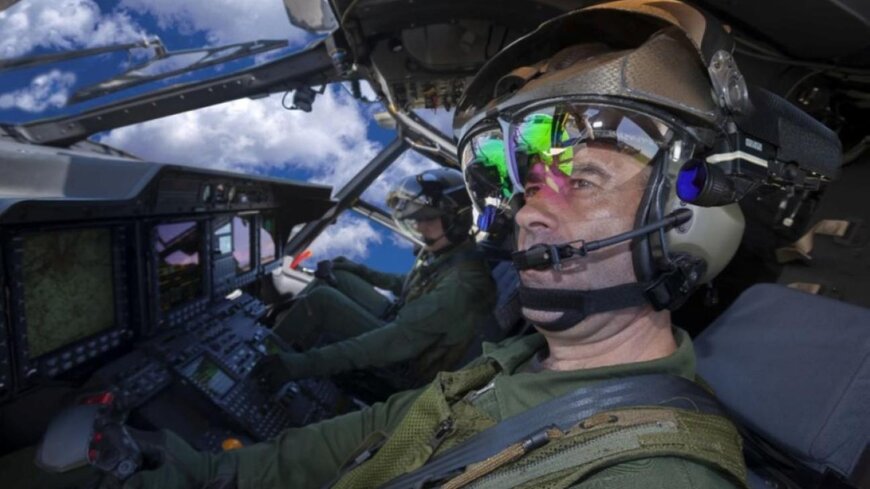
A cooperative programme led by Thales under a contract awarded by NATO Helicopter Management Agency is upgrading the TopOwl Digital Display (DD) helmet to improve pilot situational awareness and flight safety on the NH90 helicopter.
Context of the Cooperation
The contract follows an order of 31 NH90 helicopters by the Spanish Ministry of Defence and is executed in cooperation with NHIndustries and Safran. The programme is conducted in support of the French Direction Générale de l'Armement and the Spanish DGAM. The cooperation addresses operational challenges linked to helicopter operations in degraded visual environments, where sensor fusion, latency management, and pilot workload are critical safety factors.
Technical Solution and Responsibilities
Thales is responsible for the development and integration of advanced display and processing functions for the TopOwl DD helmet. The system combines high-definition mission camera feeds, including Safran’s Eurofl’Eye electro-optical sensor, with flight and navigation data to generate a synthetic and augmented view of the external environment.
Safran contributes sensor technologies, while NHIndustries ensures compatibility with NH90 avionics architectures and cockpit interfaces. The helmet uses conformal optics and digital image processing to overlay spatial cues and alerts within the pilot’s line of sight, enabling continuous head-tracked symbology in accordance with military airworthiness and human-machine interface standards.
Deployment and Integration
The upgraded TopOwl DD helmet is being developed for integration into the NH90 fleet operated by Spain. Implementation includes system validation on representative platforms and compatibility checks with existing mission systems. Thales manages system engineering and qualification, while NHIndustries supports aircraft-level integration and Safran provides sensor optimisation and interface support.
Applications and Operational Use
The solution targets military rotorcraft operations in low-visibility conditions such as dust, fog, snow, or night operations without external lighting. Typical use cases include low-altitude flight, approach and landing in confined areas, and tactical missions requiring stable situational awareness. By digitally fusing sensor inputs, the helmet reduces reliance on external visual references and lowers pilot cognitive load.
Expected Impact
While no performance figures are disclosed, the technical approach improves safety margins through earlier obstacle perception, consistent spatial orientation cues, and reduced transition time between instrument and external visual references. The cooperation demonstrates how integrated avionics, sensor systems, and human-machine interfaces can enhance operational robustness in modern military aviation.
www.thalesgroup.com
