
www.aero-defence.tech
30
'26
Written on Modified on
Active Rotor Technology from DLR Quiets Helicopter Flights
DLR demonstrates in-flight blade twisting to significantly reduce helicopter noise and vibration, paving the way for quieter urban air mobility.
www.dlr.de
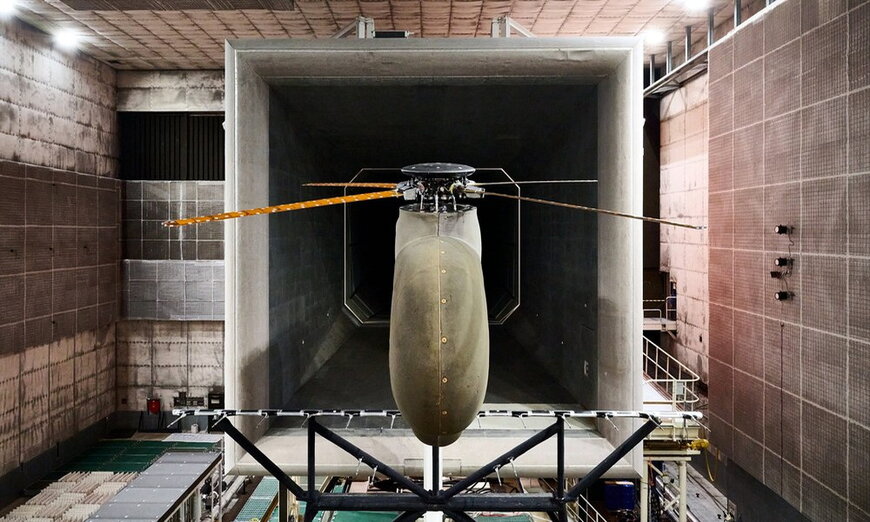
Researchers at the German Aerospace Center (DLR) and international partners have demonstrated a novel rotor concept—active twisting of helicopter rotor blades—that measurably reduces noise and vibration while increasing aerodynamic efficiency. The technology, tested in a large low-speed wind tunnel, addresses persistent challenges in rotorcraft aerodynamics that conventional mechanical solutions have struggled to overcome.
Addressing Helicopter Noise and Vibration Challenges
Helicopters play essential roles in rescue, transport and military operations, but their rotor systems inherently generate high levels of noise and vibration, particularly during landing approaches and in hover. Traditional methods to mitigate these effects—including blade geometry optimization and active pitch control at the blade root—offer some benefits but add mechanical complexity and weight, and they are difficult to integrate into operational rotorcraft.
The active twist approach explored in the Smart Twisting Active Rotor (STAR) project sidesteps many of these limitations by embedding piezoceramic actuators into the blade surfaces. When a controlled electrical voltage is applied, these actuators induce elastic twist deformation along the blade without the need for additional mechanical linkages. This creates adaptive blade behaviour that can respond dynamically to aerodynamic conditions throughout a rotor revolution.
How Active Twisting Works
The active twist system integrates numerous sensors and piezoceramic actuation elements within each blade. Applying direct current produces static changes in blade twist, while alternating currents generate higher-frequency dynamic adjustments. This mechanism behaves similarly to an artificial muscle, altering blade twist continuously to suit specific flight regimes and load conditions without traditional hinges or swashplates.
Because the active scheme eliminates discrete mechanical parts for twist control, it remains relatively insensitive to the large centrifugal forces inherent to rotor operation. This contrasts with many historical adaptive rotor concepts that relied on complex, heavy mechanical systems, hindering practical use.
Wind Tunnel Validation and Performance Gains
At the culmination of extensive preparatory simulation and design work, DLR and its partners conducted a three-week wind tunnel measurement campaign at the German-Dutch Wind Tunnels’ large low-speed facility in late 2025. A four-metre diameter rotor with four actively twistable blades was tested under conditions simulating landing descent and other operational flight states.
Acoustic and vibration measurements showed reductions of up to seven decibels during simulated landing descent. In perceptual terms, this represents more than a 50 % decrease in perceived noise levels. At the same time, overall vibration levels dropped by more than half, and rotor aerodynamic efficiency improved under high load conditions. Comprehensive datasets—including blade motion, deformation, surface pressures and flow field characteristics—facilitate validation of predictive models and broaden the applicability of results.
Broader Implications and Future Application
The active twisting rotor concept extends beyond conventional helicopter designs. The data gathered supports modelling and potential adaptation of the technology for high-speed rotorcraft and emerging urban air mobility vehicles, where noise and vibration constraints are especially critical. By enabling blades to adapt continuously to varying aerodynamic demands without mechanical complexity, the STAR approach represents a technical advance relative to many earlier adaptive rotor schemes.
The international STAR collaboration includes NASA, the U.S. Army, France’s ONERA, JAXA (Japan), the Korea Aerospace Research Institute (KARI), Konkuk University (South Korea) and DNW, underscoring the global research interest in quieter, more efficient rotorcraft technologies.
www.dlr.de
