
www.aero-defence.tech
27
'26
Written on Modified on
Optical GEO System Targets Terabit-Class Links
Hellas Sat, CNES, Thales Alenia Space and Safran cooperate to deploy a laser-based satellite and ground optical communications system for Hellas Sat 5.
www.thalesaleniaspace.com
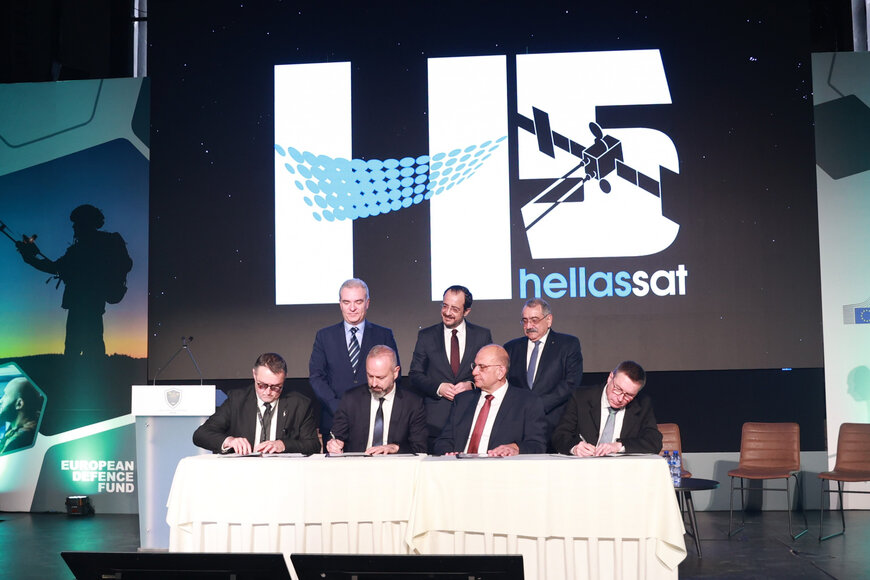
Hellas Sat, the French space agency CNES, Thales Alenia Space and Safran have signed a framework agreement to develop and host a next-generation free-space optical communications system on the future Hellas Sat 5 geostationary satellite, with a dedicated optical ground station in Cyprus.
The cooperation aims to validate very high-throughput laser communications between geostationary orbit (GEO) and ground infrastructure, targeting data rates approaching one terabit per second for secure, resilient satellite communications.
Context of the Cooperation
Hellas Sat, a regional satellite operator serving Europe, the Middle East and Africa, is preparing its Hellas Sat 5 telecommunications satellite to support high-capacity services from GEO. To address increasing demand for secure backbone connectivity and infrastructure resilience, the operator is integrating optical communications into its next-generation space segment.
The initiative builds on CNES’s SOLiS (Service Optique de Liaison Sécurisée) program under the France 2030 framework. The challenge addressed is the atmospheric transmission of high-power, multi-wavelength laser signals over GEO distances while maintaining link stability despite turbulence, absorption and pointing constraints. The cooperation combines satellite manufacturing, optical payload engineering and ground-segment expertise to manage system-level complexity and interoperability.
Technical Architecture and Responsibilities
Thales Alenia Space will supply the SOLiS flight segment and the onboard optical payload integrated into Hellas Sat 5. The system uses multi-wavelength laser transmission and advanced pointing, acquisition and tracking (PAT) subsystems to maintain alignment between the spacecraft terminal and ground receivers. Adaptive optics and signal processing techniques mitigate atmospheric distortion to sustain high data rates.
Safran will provide a prototype commercial optical ground station installed at the Hellas Sat teleport in Cyprus (CyOGS). This station will interoperate with CNES’s FROGS optical ground station at the Côte d’Azur Observatory in France, enabling bidirectional GEO-to-ground demonstrations. The architecture is designed for interoperability with other optical satellite communication systems under development, supporting future networked optical infrastructures.
Deployment and Integration
The pilot ground station will be deployed in Cyprus and connected to Hellas Sat’s existing teleport infrastructure, enabling integration with terrestrial fiber backbones and operational network management systems. Testing phases will include link budget validation, atmospheric performance characterization and service demonstration under operational conditions.
The GEO platform ensures continuous regional coverage, simplifying link scheduling compared with low Earth orbit constellations. System validation will focus on sustained throughput, link availability and secure transmission performance under varying meteorological conditions.
Applications and Expected Impact
Target applications include governmental communications, defense connectivity, intercontinental data backbone links and high-capacity enterprise services. In a context where terrestrial and subsea fiber routes face increasing vulnerability, optical GEO links provide a complementary digital infrastructure with inherent resistance to electromagnetic interference and low probability of interception.
By demonstrating terabit-class free-space optical communications through the atmosphere, the cooperation seeks to qualify operational use cases and advance industrial automation of optical ground-space links for future commercial deployment.
www.thalesaleniaspace.com
