
www.aero-defence.tech
22
'26
Written on Modified on
AI-Assisted Morphing Wing Architectures for Enhanced Aerodynamic Efficiency
The German Aerospace Center (DLR) has integrated hyperelastic materials and adaptive algorithms to develop wings capable of seamless shape-changing during flight.
www.dlr.de
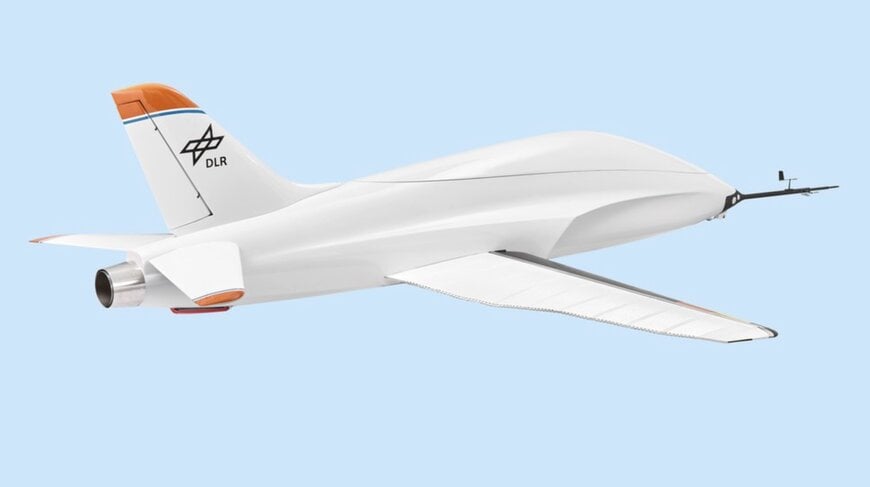
Experimental aircraft PROTEUS with morphAIR wings. Credit: DLR (CC BY-NC-ND 3.0)
The DLR morphAIR project introduces a novel wing concept designed to replace traditional mechanical flaps and ailerons with a seamless, form-variable trailing edge. Tested on the PROTEUS uncrewed experimental aircraft at the National Experimental Test Center for Unmanned Aircraft Systems in Cochstedt, this technology aims to optimize the digital supply chain of aerodynamic data by reducing profile drag and improving flight mechanics. The system is engineered for high-performance applications, with a design specification capable of reaching 300 kilometers per hour and a wing loading of 70 kilograms per square meter.
HyTEM Technology and Seamless Deformation
The core mechanical innovation is the Hyperelastic Trailing Edge Morphing (HyTEM) system. Unlike conventional control surfaces that create aerodynamic gaps and steps, HyTEM enables a continuous deformation of the wing profile. This is achieved through several key technical mechanisms:
- Distributed Actuation: A network of small actuators is distributed across the wingspan, allowing for precise profile adjustments at ten distinct points.
- Gapless Transition: The hyperelastic composite structure deforms without surface discontinuities, significantly reducing profile drag.
- Targeted Influence: The system allows for real-time control over lift and induced drag, providing a higher degree of granularity in aircraft control compared to binary flap positions.
AI-Assisted Flight Control and Fault Tolerance
To manage the complexity of the distributed actuators, the DLR Institute of Flight Systems developed an adaptive, AI-assisted flight control system. This algorithm is designed to interpret the automotive data ecosystem of the flight environment—detecting deviations between modeled behavior and actual performance.
During the 2026 flight test campaign, the system will demonstrate its ability to:
To manage the complexity of the distributed actuators, the DLR Institute of Flight Systems developed an adaptive, AI-assisted flight control system. This algorithm is designed to interpret the automotive data ecosystem of the flight environment—detecting deviations between modeled behavior and actual performance.
During the 2026 flight test campaign, the system will demonstrate its ability to:
- Continuously Adjust Internal Models: The algorithm adapts to environmental variables in real-time, optimizing the coordination of multiple actuators.
- Manage Damage Scenarios: Having been trained on simulated failure modes, the AI can recognize actuator malfunctions or structural damage and redistribute control tasks across the remaining functional units to maintain stability.
- Reconstruct Pressure Distribution: Utilizing a method developed by the DLR Institute of Aerodynamics and Flow Technology, the system reconstructs full-surface pressure fields from minimal sensor data, giving the aircraft an immediate "sense" of its current flow field.
Scalability and Future Validation
Initial flight trials successfully demonstrated the basic airworthiness and system integration of both the reference and morphing wing sets. These tests form the technical foundation for the upcoming 2026 campaign, where PROTEUS will fly with a total mass of approximately 70 kilograms to validate the scalability of the morphing architecture.
The findings from these trials will be further matured within the UAdapt (Unmanned Aircraft Wing Adaption) project. This research specifically targets the light aircraft sector, where the combination of reduced drag and improved fault tolerance offers a significant advancement in both efficiency and operational safety.
Edited by Romila DSilva, Induportals Editor, with AI assistance.
Initial flight trials successfully demonstrated the basic airworthiness and system integration of both the reference and morphing wing sets. These tests form the technical foundation for the upcoming 2026 campaign, where PROTEUS will fly with a total mass of approximately 70 kilograms to validate the scalability of the morphing architecture.
The findings from these trials will be further matured within the UAdapt (Unmanned Aircraft Wing Adaption) project. This research specifically targets the light aircraft sector, where the combination of reduced drag and improved fault tolerance offers a significant advancement in both efficiency and operational safety.
Edited by Romila DSilva, Induportals Editor, with AI assistance.
