
www.aero-defence.tech
07
'26
Written on Modified on
Open-Architecture Threat Detection for Army Aircraft
Northrop Grumman and the U.S. Army are advancing the Improved Threat Detection System to enhance rotary-aircraft survivability through multi-spectral sensing and modular integration.
www.northropgrumman.com
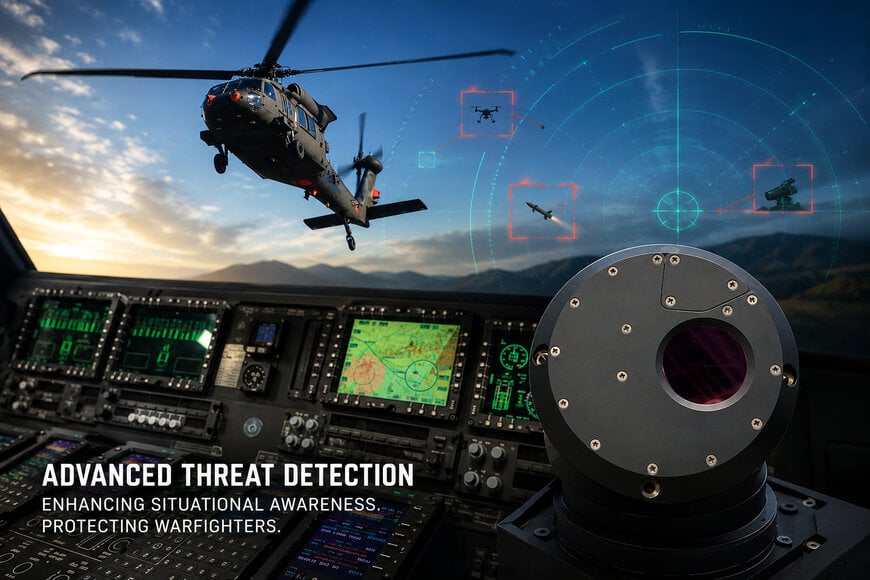
Northrop Grumman Corporation is continuing development of the U.S. Army’s Improved Threat Detection System (ITDS) under a second-phase contract focused on aircraft survivability and airborne threat awareness. The system combines multi-spectral sensing, open systems architecture, and counter-unmanned aircraft system (C-UAS) functionality for deployment on current and future Army rotary platforms.
Cooperation Scope and Operational Requirement
The cooperation combines the U.S. Army’s survivability requirements with Northrop Grumman’s electro-optical and infrared sensor development capabilities. The program addresses increasing threats to low-altitude military aircraft, including loitering munitions, guided missiles, unmanned aerial systems, and electro-optical targeting systems.
The Army selected Northrop Grumman for the second development phase following comparative flight evaluations conducted during the first phase. The program is intended to support both legacy aircraft and future platforms, including the Future Long-Range Assault Aircraft fleet.
Sensor Architecture and System Design
ITDS incorporates Northrop Grumman’s Advanced Tactical Hostile Engagement Awareness (ATHENA) sensor. The sensor provides 360-degree situational awareness using a multi-spectral detection architecture designed to identify threats outside a pilot’s direct line of sight, including below the aircraft.
The system integrates high-resolution and wide-band sensors to detect and classify multiple threat categories, including:
- Counter-UAS targets
- Man Portable Air Defense Systems (MANPADS)
- Anti-tank guided missiles
- Rocket-propelled grenades
- Small-arms and machine-gun fire
- Electro-optical and infrared targeting systems
The platform uses an open systems architecture aligned with the U.S. Department of Defense Modular Open Systems Approach (MOSA) and Future Airborne Capability Environment (FACE) standards. This allows software and sensor upgrades to be integrated without redesigning the full survivability suite, supporting faster adaptation to evolving airborne threats.
Integration and Deployment
Northrop Grumman is responsible for sensor development, systems integration, and compatibility with existing aircraft countermeasure systems. ATHENA is designed as a form-fit replacement for legacy threat-warning sensors and can interface with flare-based and directed infrared countermeasure systems, including the Common Infrared Countermeasure system already deployed on Army aircraft.
The system is intended for integration across the Army rotary-wing fleet, with priority applications identified for the MV-75 Cheyenne II and AH-64 Apache platforms.
Industrial and Technical Impact
The program demonstrates the growing role of modular defense electronics and digital infrastructure in aircraft survivability systems. By combining standardized interfaces with multi-spectral sensing, the cooperation aims to reduce integration complexity while improving response times against rapidly emerging aerial threats.
Operationally, the system is designed to improve pilot decision-making and survivability by reducing detection latency and extending threat awareness beyond visible-range observation. The open-architecture approach also supports long-term maintainability and incremental capability upgrades without full platform redesign.
Edited by an industrial journalist Sucithra Mani with AI assistance.
www.northropgrumman.com
Integration and Deployment
Northrop Grumman is responsible for sensor development, systems integration, and compatibility with existing aircraft countermeasure systems. ATHENA is designed as a form-fit replacement for legacy threat-warning sensors and can interface with flare-based and directed infrared countermeasure systems, including the Common Infrared Countermeasure system already deployed on Army aircraft.
The system is intended for integration across the Army rotary-wing fleet, with priority applications identified for the MV-75 Cheyenne II and AH-64 Apache platforms.
Industrial and Technical Impact
The program demonstrates the growing role of modular defense electronics and digital infrastructure in aircraft survivability systems. By combining standardized interfaces with multi-spectral sensing, the cooperation aims to reduce integration complexity while improving response times against rapidly emerging aerial threats.
Operationally, the system is designed to improve pilot decision-making and survivability by reducing detection latency and extending threat awareness beyond visible-range observation. The open-architecture approach also supports long-term maintainability and incremental capability upgrades without full platform redesign.
Edited by an industrial journalist Sucithra Mani with AI assistance.
www.northropgrumman.com
