
www.aero-defence.tech
19
'26
Written on Modified on
Defence Robots Expand Explosive Disposal Capability
L3Harris Technologies has delivered T4 and T7 robotic systems to strengthen Australian Defence Force explosive ordnance disposal operations.
www.l3harris.com
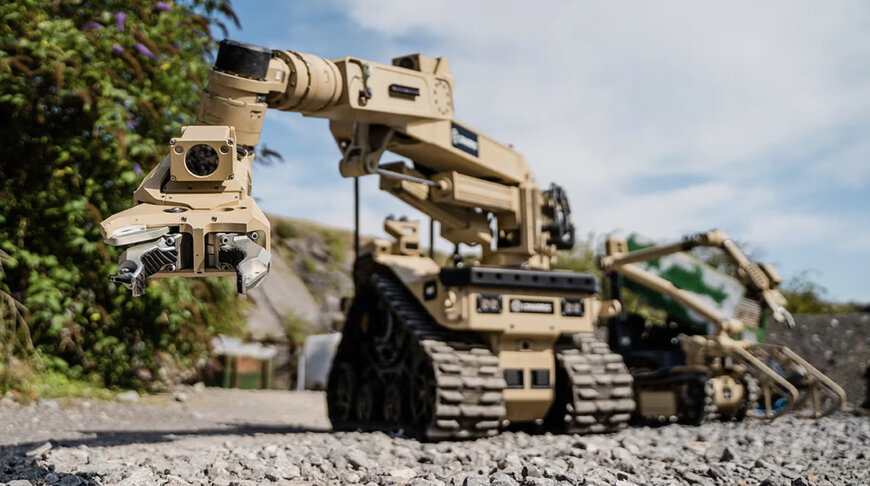
L3Harris Technologies has supplied robotic systems to the Australian Defence Force (ADF) designed for explosive ordnance disposal (EOD), hazardous materials response and route clearance operations. The delivery supports efforts to reduce direct personnel exposure during high-risk defence missions involving improvised explosive devices (IEDs) and other explosive threats.
Robotic systems for explosive ordnance disposal operations
The delivered T4 and T7 multi-mission robotic platforms enable operators to remotely detect, inspect and neutralize hazardous threats. The systems are intended for EOD and chemical, biological, radiological, nuclear and explosives (CBRNE) missions, where remote operation can reduce risks associated with manual intervention.
The deployment forms part of Australia’s DEF08101 programme, which aims to improve explosive ordnance disposal capabilities across Defence operations. Under the programme, robotic systems support IED neutralization, route clearance and exploitation missions previously requiring closer personnel involvement.
Haptic control technology reduces operator workload
Both T4 and T7 systems incorporate haptic feedback controls, allowing operators to sense resistance through robotic manipulation and perform fine motor tasks remotely. The control interface mirrors hand movement, supporting activities such as opening containers or manipulating suspicious devices while maintaining stand-off distance from threats.
This approach can reduce training complexity and improve task precision during bomb disposal operations, where manipulation accuracy directly affects mission outcomes.
Training programme prepares ADF personnel for deployment
ADF personnel completed operational training at RAAF Base Amberley in Queensland and at the Defence Explosive Ordnance Training School in Sydney before field deployment. The training focused on practical use cases involving explosive threat identification and robotic intervention procedures.
According to L3Harris, sustainment activities for the systems will be based in Brisbane, supporting maintenance and long-term operational readiness.
Remote robotics capability expands defence mission flexibility
The T7 platform has been designed for larger EOD missions and supports payload capacities exceeding 100 kg, while maintaining mobility over stairs and rough terrain. Depending on configuration, it can operate for more than eight hours and travel at approximately 7 km/h.
The smaller T4 platform weighs around 70 kg, supports payloads up to 55 kg and offers more than seven hours of runtime. Its compact design is intended for confined operational environments while retaining manipulator reach up to 2.5 metres.
These capabilities position robotic systems as part of a broader defence automation trend, where autonomous and remotely operated technologies are increasingly used to reduce exposure in explosive ordnance and hazardous materials missions.
Additional Context
Technical specifications and competitive benchmarking not included in the original announcement
Comparable EOD robotic platforms include the T7, T4 and systems such as the FLIR Kobra, used in military explosive disposal applications. Benchmark criteria commonly include payload capacity, manipulator reach, runtime, mobility and remote sensing capabilities.
Available specifications indicate:
- T7: payload capacity up to 113 kg, vertical reach approximately 3 m, runtime exceeding eight hours, speed around 7 km/h.
- T4: payload capacity up to 55 kg, vertical reach approximately 2.5 m, runtime exceeding seven hours, speed above 8 km/h.
The inclusion of haptic feedback in both systems differentiates them from many legacy EOD robots by enabling force sensing during manipulation tasks, potentially improving precision in complex disposal scenarios.
Edited by Natania Lyngdoh, Induportals editor, assisted by AI.
www.l3harris.com
Edited by Natania Lyngdoh, Induportals editor, assisted by AI.
www.l3harris.com
