
www.aero-defence.tech
16
'26
Written on Modified on
Powershift steering transmissions optimize power density in heavy tracked vehicles
ZF introduces advanced drive architectures featuring integrated by-wire electronic control layers to minimize drivetrain mechanical wear.
www.zf.com
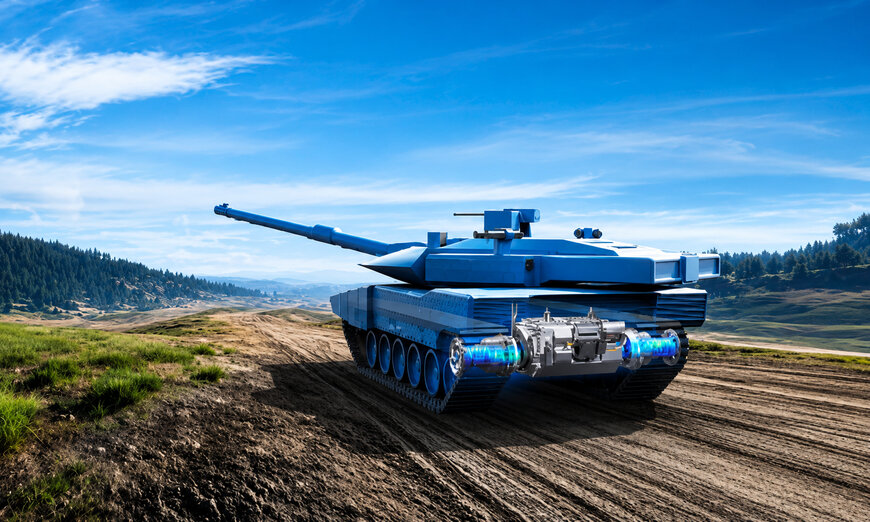
ZF has announced the expansion of its tactical tracked vehicle transmission portfolio engineered to optimize torque conversion and structural durability across low-traction terrains. This hardware deployment introduces advanced powershift steering architectures developed to sustain heavy combat platforms and tactical logistics tracks up to 70 tons operating under severe-duty mechanical stress. To demonstrate these field capabilities in a live operational scenario, the powertrain platform is being showcased at the Eurosatory exhibition held from June 15 to 19, 2026, in Paris, France.
Mechanical radius steering architectures and electronic by-wire controls
The modernization of heavy tracked armored vehicle architectures necessitates the replacement of complex hydromechanical linkages with responsive, decoupled command interfaces. Operating as a centralized torque routing layer, the newly developed transmission system unifies powershift gearing, mechanical radius steering loops, and a high-capacity hydrodynamic braking retarder into a single closed structural envelope.
By executing all driving, directional steering, and vehicle deceleration parameters via a continuous electronic by-wire control layer, the layout eliminates physical steering columns and hydraulic mechanical pass-throughs inside the vehicle cabin. The mechanical radius steering design delivers highly predictable yaw kinematics under heavy load profiles, while the integration of by-wire data buses provides a direct interface path for remote teleoperation routines and automated unmanned driving algorithms.
Furthermore, service-relevant external component placement allows field technicians to inspect modular elements from outside the main hull. This architecture limits maintenance downtime to predefined engine service intervals, mitigating field logistical bottlenecks and significantly expanding total machine operational lifecycle margins.
Electromechanical integration in eLSG 5000 systems for acoustic footprint reduction
For tactical operations requiring reduced thermal and acoustic tracking footprints, the structural layout incorporates an electrified steering transmission configuration. This electro-mechanical integration directly links high-power electric machine stators to the main powershift gear shafts, enabling hybrid-drive propulsion concepts and decentralized energy management.
By handling low-speed maneuvering through purely electrical energy paths, the layout isolates the high-decibel acoustic signature of the internal combustion engine during critical forward movements. The hybrid energy circuit absorbs peak transient loading during high-torque acceleration phases, stabilizing the main high-voltage bus bar and routing surplus kinetic energy back to onboard tactical power distribution grids. This superimposition of mechanical and electrical inputs ensures seamless steering radius adjustments and high agility metrics under hostile environmental conditions.
Additional Context: This section details technical specifications and competitive benchmarking not included in the original product announcement
Within the severe-duty tracked combat vehicle transmission market, this expanded portfolio competes directly with established lines such as the HMPT series from L3Harris or the Allison Transmission X1100 propulsion family. Objective technical benchmarking indicates that while conventional multi-radius steering transmissions rely on discrete hydraulic pump-motor combinations that suffer from flow-saturation delay—which increases response latency and shifts physical mass constraints inside the transmission bay—the ZF platform integrates native software-defined by-wire actuation blocks close to the mechanical clutch packs.
Additionally, the development framework capitalizes on extensive platform history, building on legacy engineering baselines like the LSG 1100 series for medium tracked assets from 3 to 60 tons.
However, achieving maximum power conversion efficiencies exceeding 92 percent under intense combat weight distributions demands precise synchronization with external power units, such as the mtu hybrid system developed by Rolls-Royce Power Systems. Sub-optimal calibration of the electronic clutch engagement protocols during high-speed directional changes can introduce elevated fluid shear stresses inside the integrated retarder circuit, temporarily lowering overall thermal efficiency margins compared to non-hybrid analog cross-drive networks equipped with dedicated fluid-to-air heat exchangers.
Edited by Sucithra Mani, Induportals editor – adapted by AI.
www.zf.com
