
www.aero-defence.tech
16
'26
Written on Modified on
Liebherr Showcases High Performance Propulsion and Energy Solutions for Defense
Liebherr introduces advanced internal combustion engines, modular battery systems, and intelligent control technologies engineered to deliver reliability and efficiency under extreme military operational conditions.
www.liebherr.com
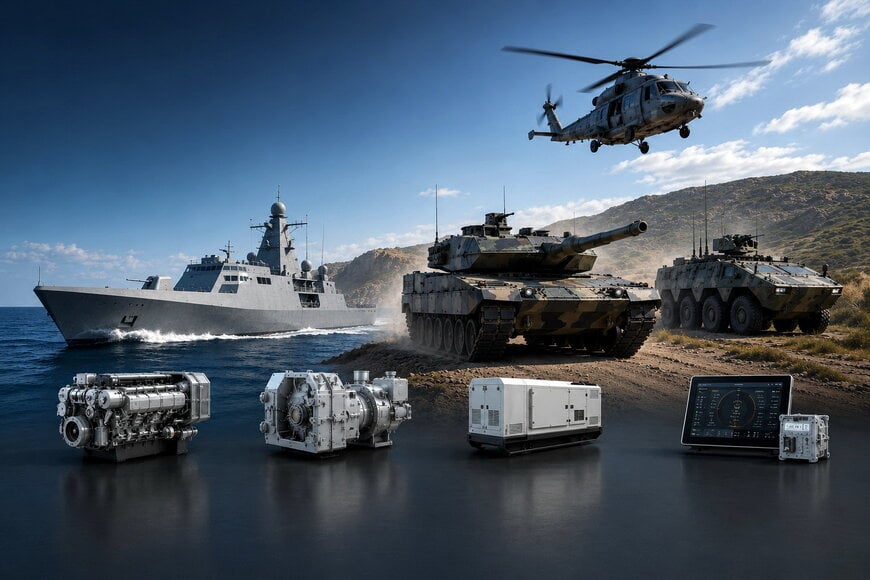
The primary propulsion solutions feature the D976 and D9612 internal combustion engines designed for heavy tactical platforms. The D976 is an inline six-cylinder engine utilizing an 18-liter displacement and a modular architecture to maximize power density and minimize fuel consumption under high-load profiles.
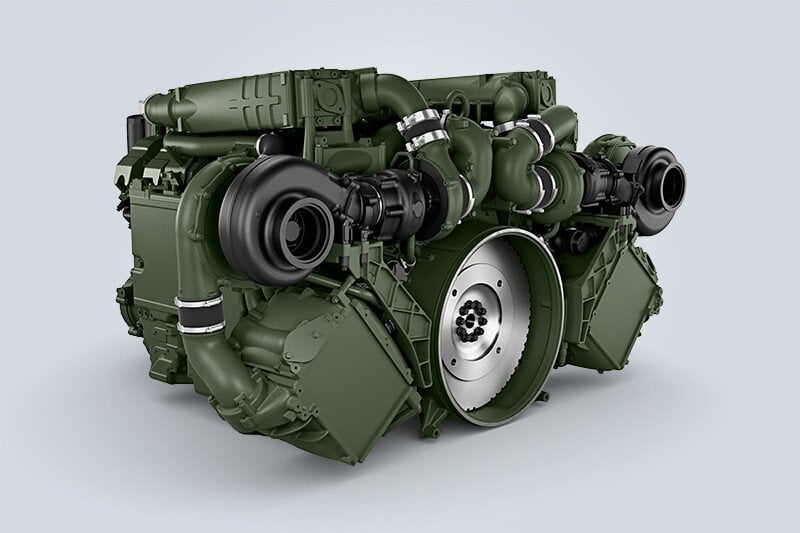
For heavier applications, the D9612 is a V12 engine configuration utilizing a proprietary injection system developed in-house to optimize the power-to-weight ratio. The engine relies on an integrated electronic management system that calibrates fuel injection parameters dynamically. This mechanism enables multi-fuel operational capability and reduces both fuel and oil consumption rates during varying mission profiles.
Scalable Energy Architecture and Intelligent Charging Management
For electrified and unmanned machinery, a customized battery concept provides scalable energy storage utilizing high-power-density cylindrical or prismatic cell technology. These modular battery packs integrate with intelligent charging solutions that execute precise charging profiles based on real-time temperature monitoring and automated safety-disconnect mechanisms.
Tactical field power generation is supported by the Liduro Power Port 600, a mobile energy storage unit engineered to provide decentralized power in environments lacking electrical infrastructure. Operating as a standalone unit or in a hybrid configuration alongside traditional diesel generators, the system mitigates peak loads to optimize generator efficiency. This hybrid mechanism reduces overall fuel consumption, which lowers acoustic and thermal signatures to minimize detection risks in tactical scenarios.
Flight Control Architecture for Autonomous Systems
Autonomous aerial operations are managed by a dedicated unmanned aerial vehicle flight controller developed under Electronic Manufacturing Services protocols. The hardware architecture is optimized for data-intensive processing, providing real-time telemetry processing and precise actuator control. The system features an open software abstraction layer, allowing integration with diverse autonomous navigation algorithms and payload command software.
Additional Context
This section details technical specifications and competitive benchmarking not included in the original product announcement.
The D976 inline-six and D9612 V12 engines compete directly with established defense propulsion units such as the MTU Series 199 and Caterpillar C18 platforms. While the MTU Series 199 ranges up to 600 kW, the Liebherr 18-liter D976 platform leverages its larger displacement to deliver higher low-end torque profiles required for armored recovery vehicles.
In the mobile energy sector, the Liduro Power Port 600 competes with tactical energy storage systems like the Raytheon Applied Signal Technology microgrids and the SFC Energy Jenny series fuel cells. The Liduro system focuses on high-capacity industrial power output, providing up to 60 kW of continuous power, which represents a higher energy density than standard containerized military battery systems, though it carries a larger physical footprint than man-portable fuel cell alternatives.
Edited by Evgeny Churilov, Induportals Media - Adapted by AI.
www.liebherr.com
