
www.aero-defence.tech
02
'26
Written on Modified on
Multi-Mission Missile Defense Interceptor Production Expands Under Multi-Year Contract
Raytheon secured a $24.4 billion award for Standard Missile-6 interceptors to eliminate naval inventory constraints across critical theaters.
www.rtx.com
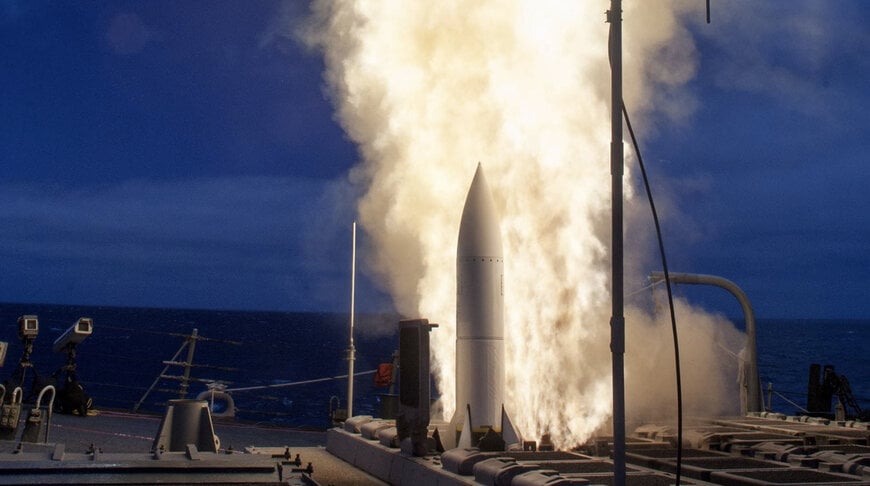
Sustained deployment of anti-ship cruise missiles, anti-ship ballistic missiles, and unmanned aerial threats in maritime operating areas has depleted operational ordnance reserves, creating an urgent military requirement for high-rate interceptor production. To address these industrial bottlenecks and ensure long-term inventory stability for fleet air defense, the U.S. Navy awarded Raytheon, an RTX business, a multi-year procurement contract valued at up to $24.4 billion to manufacture and deliver Standard Missile-6 interceptors across five base production years and two optional contract periods.
Tri-Mission Kinetic Interceptor Architecture and Naval Combat Integration
The Standard Missile-6 (SM-6) provides layered kinetic defense by consolidating three previously disparate mission profiles into a single shipboard and ground-launched missile airframe. The interceptor executes anti-air warfare against manned and unmanned aviation, terminal-phase ballistic missile defense against intermediate-range ballistic threats inside the atmosphere, and long-range anti-surface warfare strikes against maritime surface vessels.
Operationally, the munition launches from shipborne MK 41 Vertical Launching Systems installed on guided-missile cruisers and destroyers, as well as land-based mobile launcher platforms such as the U.S. Army Typhon weapon system. Target engagement relies on distributed command architecture: the missile receives midcourse updates from shipboard radar suites via datalink before transitioning to autonomous terminal guidance. This capability allows surface combatants to engage over-the-horizon threats without requiring dedicated shipboard illumination during the terminal phase of flight, enabling simultaneous engagements against saturation salvos.
Manufacturing Automation and Industrial Base Capacity Expansion
Meeting the procurement schedules outlined in the multi-year award requires scaling fabrication rates across complex sub-tier component supply chains. Missile assembly involves intricate radar cross-section calibration, high-tolerance solid-propellant motor casting, advanced guidance processor integration, and cleanroom radio-frequency transceiver validation.
To alleviate production throughput constraints, Raytheon expanded investments across its manufacturing infrastructure, focusing on automated component assembly, non-destructive automated testing, and long-lead material acquisitions. Raytheon President Phil Jasper indicated that ongoing capital allocations into specialized production facilities and skilled labor pipelines directly remove supply-chain constraints, accelerating output delivery across military inventory pipelines.
Additional Context:
This section details technical specifications and competitive benchmarking not included in the original product announcement.
The SM-6—designated militarily as the RIM-174 Standard Extended Range Active Missile (ERAM)—integrates legacy Standard Missile propulsion hardware with advanced seeker avionics. The missile utilizes the proven dual-thrust MK 72 solid rocket booster coupled with an MK 104 solid-fuel sustainer motor, propelling the airframe to terminal velocities exceeding Mach 3.5. The active radio-frequency seeker incorporates hardware and signal-processing architecture derived from the AIM-120 Advanced Medium-Range Air-to-Air Missile (AMRAAM), operating alongside a dual-mode semi-active receiver and an MK 125 blast-fragmentation warhead. The system achieves an operational intercept range of approximately 240 nautical miles (440 kilometers) and an engagement altitude exceeding 33,000 meters. Through Cooperative Engagement Capability (CEC) integration, the missile processes remote target track telemetry provided by off-board airborne early warning platforms, such as the E-2D Advanced Hawkeye, to execute launch-on-remote and engage-on-remote intercept profiles beyond the shipboard radar horizon.
In the global landscape of shipboard air defense, the SM-6 occupies an operational domain distinct from competing interceptor platforms. European naval forces primarily deploy the Aster 30 missile within the PAAMS (Principal Anti-Air Missile System) and SAMP/T batteries. While the Aster 30 features an active RF seeker and directional thruster control (PIF-PAF) delivering high lateral acceleration against maneuvering supersonic cruise missiles, its operational range is constrained to approximately 120 to 150 kilometers, and it lacks the surface-strike functionality present in the SM-6. Within the Standard Missile family, the semi-active SM-2 requires continuous target illumination from shipboard fire-control radars (such as the AN/SPG-62), which limits the number of simultaneous terminal engagements a vessel can conduct. Conversely, the exo-atmospheric SM-3 uses a kinetic hit-to-kill vehicle designed solely for midcourse ballistic missile interception outside the atmosphere, with zero capability against air-breathing cruise missiles or surface targets. The SM-6 remains a unique asset in Western naval inventories by functioning as an active-homing interceptor capable of prosecuting atmospheric aerodynamic threats, terminal ballistic trajectories, and distant naval surface combatants from identical vertical launch cells.
Edited by Natania Lyngdoh, Induportals editor, with AI assistance.
www.rtx.com
