
www.aero-defence.tech
03
'26
Written on Modified on
Advanced Manufacturing Optimization for Fighter Aircraft Production
Northrop Grumman integrates artificial intelligence into the F-35 program.
www.northropgrumman.com
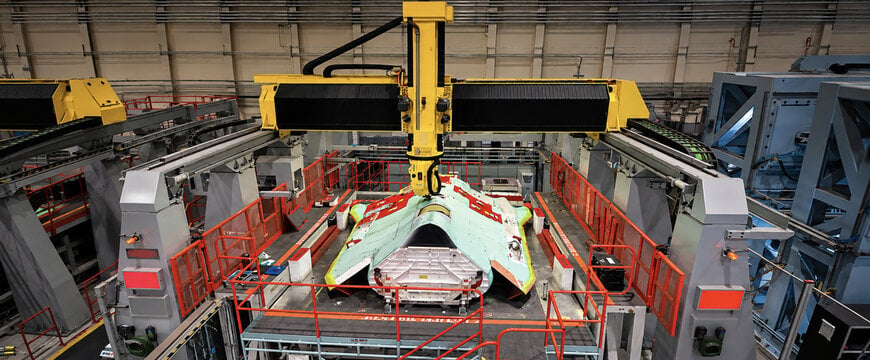
Northrop Grumman has incorporated automated tooling systems, specifically collaborative robots or co-bots, to assist technicians on the manufacturing floor. In the Communications, Navigation, and Identification production line in Palmdale, California, a co-bot was deployed to install attachment bolts on the front housing area of the CNI module.
This robotic integration reduces task completion times from several hours to minutes. By delegating repetitive mechanical tasks to automated systems, manufacturing personnel are reallocated to higher-complexity tasks, optimizing overall factory throughput.
Artificial Intelligence and Automated Quality Verification
The manufacturing process incorporates AI-driven quality control software to inspect finished hardware assemblies. These computational systems analyze modules for structural and dimensional defects prior to factory clearance.
The automated inspection framework identifies microscopic variances that could impact low-observable performance or operational reliability. This quantifiable verification method ensures adherence to military specifications across all manufactured components, including wing skins, nacelles, and center fuselages.
Production Scale and Industrial Integration
The automated infrastructure operates within an Integrated Assembly Line in Palmdale, California, which maintains a production rate of one center fuselage every 30 hours. As part of the industrial team led by Lockheed Martin, Northrop Grumman applies automated composite manufacturing and advanced tooling to sustain high-volume output for all three aircraft variants.
Additional Context:
This section details technical specifications and competitive benchmarking not included in the original product announcement
The integration of collaborative robotics and machine-learning inspection systems reflects broader manufacturing trends across the aerospace and defense industry to compress production cycles for advanced tactical aircraft. Comparable tier-one aerospace manufacturers, such as Lockheed Martin and BAE Systems, utilize similar automated fiber placement systems, digital twins, and robotic non-destructive inspection cells to maintain manufacturing repeatability.
In terms of measurable performance parameters, automated fastening systems reduce assembly variance by up to 50% compared to manual torque operations, while machine-learning optical inspection units achieve defect-detection rates exceeding 99% for surface tolerances on stealth-critical composite structures. These automated methodologies directly address the high-rate production demands mandated by global military acquisition programs, ensuring structural uniformity across composite aerostructures without increasing cycle times.
Edited by Sucithra Mani, Induportals editor – adapted by AI.
www.northropgrumman.com
