
www.aero-defence.tech
03
'26
Written on Modified on
Navy Expands Unmanned Control
U.S. Navy and Lockheed Martin deploy second MD-5C ground control station to double unmanned air warfare command capacity.
www.lockheedmartin.com
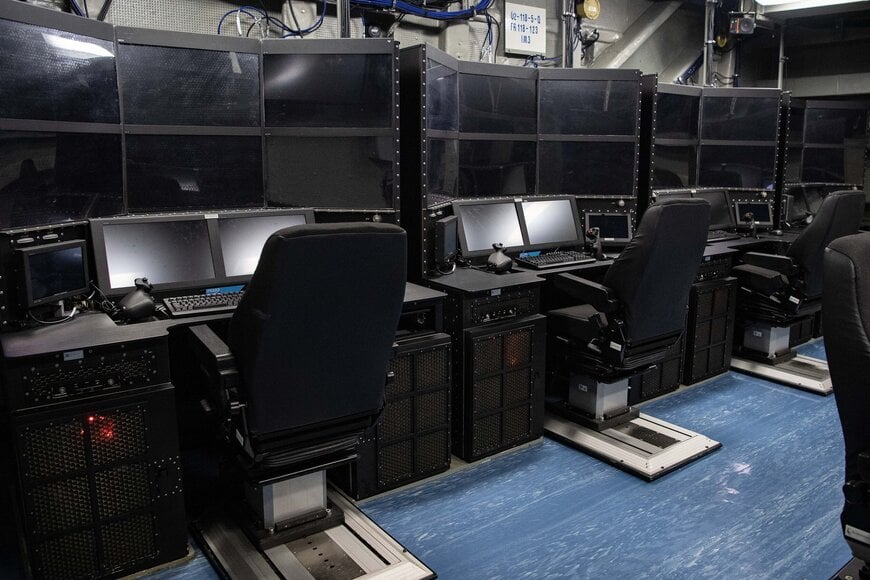
The collaboration addresses the operational challenge of integrating unmanned carrier aviation into naval strike groups. Managing autonomous assets like the MQ-25A Stingray requires robust, open-architecture command and control infrastructure capable of operating within complex naval environments. Cooperation between the U.S. Navy and Lockheed Martin was required to combine government command networks with advanced software engineering, scaling platform capacity to meet fleet readiness timelines.
Technical Solution and Division of Responsibilities
The partnership utilizes the MD-5C Ground Control Station powered by the MDCX autonomy platform. Responsibilities are divided between government entities and industry partners: Lockheed Martin Skunk Works provides the core MDCX software and hardware architecture for mission planning and execution, while the U.S. Navy integrates the system with command, control, communications, computers, and intelligence networks, alongside specialized ancillary equipment.
Implementation and Industrial Deployment
The technical solution is deployed aboard Nimitz-class aircraft carriers within dedicated Unmanned Air Warfare Centers. Deployment occurred in structured phases, with the initial operational station installed on USS Theodore Roosevelt in March 2026, followed by the second installation on USS Ronald Reagan in August 2026. This process establishes standard integration protocols across shipboard computing and communications infrastructure.
Industrial Applications and Operational Benefits
Target application areas include carrier-based aerial refueling, long-range surveillance, and unmanned logistics support. The MDCX architecture provides open-system compatibility and multi-platform control, enabling operators to command unmanned aircraft from shipboard environments. These technical capabilities extend the operational reach of the carrier air wing and preserve manned aircraft availability for high-priority missions.
Results and Performance Impact
The initiative doubled the operational command capacity for the MQ-25A Stingray across a five-month timeframe by equipping two aircraft carriers with functional ground control stations. This deployment establishes a scalable command and control backbone for future carrier air wings, maintaining platform autonomy across shipboard installations.
Edited by Sucithra Mani, Induportals editor – adapted by AI.
www.lockheedmartin.com
