
www.aero-defence.tech
06
'26
Written on Modified on
Integrated Counter-Drone System Trials
BAE Systems counter-drone trials in Scotland validate the BATS software-defined architecture for executing end-to-end sense-to-effect missions against uncrewed air threats.
www.baesystems.com
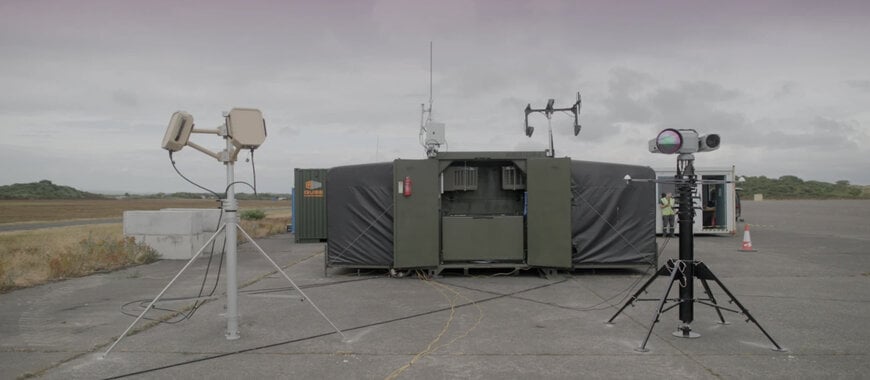
As the proliferation of low-cost uncrewed air systems alters modern tactical engagements, military forces and critical infrastructure operators face severe operational vulnerabilities when fragmented sensor data and manual command loops delay response times.
Addressing the critical need to detect and defeat rapid aerial threats at pace, BAE Systems has successfully completed a two-week series of live trials in Scotland for its Anti Threat System (BATS). The evaluation validated the software-defined architecture's ability to execute an end-to-end sense, decide, and effect mission chain against uncrewed air vehicles using a single unified command-and-control platform.
System Architecture and Software-Defined Integration
BATS functions as a modular, software-defined counter-uncrewed aircraft systems capability engineered to integrate intelligence fusion, command and control, decision support, and countermeasures within a unified framework. Rather than relying on isolated detection assets, the architecture ingests data across multiple legacy, current, and third-party sensors to construct a real-time common operational picture.
The system incorporates automated decision-support software designed to reduce operator cognitive burden during high-tempo engagements. By handling data fusion and threat prioritisation internally, the software allows human operators to focus on context-appropriate confirmation and response selection rather than raw telemetry monitoring.
Scenario Validation and Operational Workflows
During the trials in Scotland, BATS was evaluated across three distinct tactical scenarios to verify its operational utility:
- Detection and Situational Awareness: The system successfully fused multi-sensor data streams to establish tracking profiles while isolating genuine threats from background clutter.
- Non-Kinetic Response: The trials integrated electronic warfare and software-defined radio capabilities, enabling near-real-time deployment of non-kinetic countermeasures against confirmed targets.
- Complex Tactical Scenarios: Operators exercised the full workflow sequence, managing mixed threat categories and directing tailored responses through a unified interface.
Additionally, the trials explored networked operations capabilities, testing the system's capacity to securely share airspace awareness data across distributed command nodes to improve multi-site coordination.
Additional Context
This section details technical specifications and competitive benchmarking not included in the original product announcement.
The accelerated development and trial of BATS reflect broader defense procurement shifts driven by lessons from recent conflicts in Ukraine and the Middle East, where small uncrewed aerial systems have demonstrated high tactical disruption value. Comparable modular C-UAS command architectures, such as open-architecture battle management systems fielded by major defense primes, increasingly focus on electronic warfare integration and software-defined radio interoperability to counter low-signature drone threats. By emphasizing vendor-agnostic sensor integration and multi-domain data sharing, systems like BATS aim to bridge the gap between legacy tactical air defenses and the rapid evolution of autonomous aerial swarms.
Edited by Sucithra Mani, Induportals editor – adapted by AI.
www.baesystems.com
Additional Context
This section details technical specifications and competitive benchmarking not included in the original product announcement.
The accelerated development and trial of BATS reflect broader defense procurement shifts driven by lessons from recent conflicts in Ukraine and the Middle East, where small uncrewed aerial systems have demonstrated high tactical disruption value. Comparable modular C-UAS command architectures, such as open-architecture battle management systems fielded by major defense primes, increasingly focus on electronic warfare integration and software-defined radio interoperability to counter low-signature drone threats. By emphasizing vendor-agnostic sensor integration and multi-domain data sharing, systems like BATS aim to bridge the gap between legacy tactical air defenses and the rapid evolution of autonomous aerial swarms.
Edited by Sucithra Mani, Induportals editor – adapted by AI.
www.baesystems.com
