
www.aero-defence.tech
06
'26
Written on Modified on
Tactical Command and Control Software Integration
Anduril deploys Lattice software across US Army command networks to establish an interoperable common data architecture for multi-domain operational coordination.
www.anduril.com
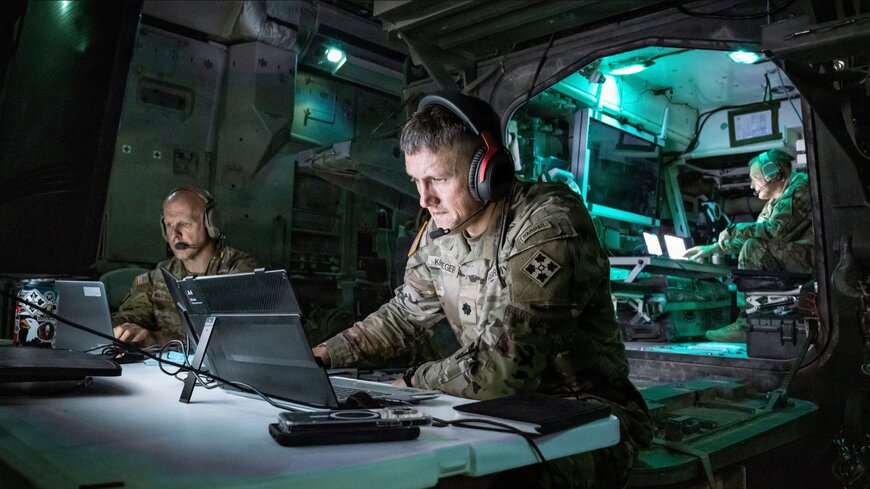
Anduril Industries to implement a common data layer baseline for its Next-Generation Command and Control (NGC2) system. The initiative standardizes digital infrastructure across multi-service defense networks to connect independent hardware, sensor suites, and tactical applications on a single software framework.
Interoperability Challenges Across Defense Systems
Defense operations historically rely on isolated systems built around vendor-specific hardware, proprietary protocols, and separate upgrade timelines. This fragmentation restricts real-time data exchange across military branches, requiring manual routing of targeting, tracking, and surveillance streams between disparate terminals.
Addressing this operational challenge requires an open architecture to bridge heterogeneous equipment. The partnership combines the US Army's operational field requirements with the software integration capabilities of Anduril Industries to deploy an open, distributed data environment.
Lattice Platform Architecture and Integration Roles
The technical core of the program is Anduril's Lattice platform, an open software layer that integrates multi-vendor sensors, uncrewed systems, artificial intelligence (AI) inference models, and weapon payloads. Within NGC2, Anduril manages the underlying data fabric, while the US Army defines system operational baselines and integrates third-party applications.
Lattice acts as an abstraction engine, translating proprietary data inputs into standardized formats. The architecture maintains synchronization across tactical edge networks through decentralized distribution, ensuring that individual network nodes process local sensor feeds and sustain mission tasks during intermittent connectivity or electronic degradation.
Validation and Field Implementation
Deployment progressed through iterative field testing during the Ivy Sting and Ivy Mass military exercises with the 4th Infantry Division. Development teams integrated real-time feedback from personnel directly into iterative software updates.
During division-scale field testing, the architecture synchronized over 2,500 end-user devices running warfighting and logistical applications. The software platform demonstrated multi-branch interoperability by streaming operational telemetry directly between US Army, US Marine Corps, and US Navy systems without manual data translation.
Operational Metrics and Operational Scope
Deployment of the software architecture demonstrated measurable operational improvements:
- Artillery fire mission timelines decreased by 90 percent compared to legacy command workflows.
- Airspace deconfliction routines accelerated via automated coordinate resolution across joint systems.
- Local command hubs maintained tracking and data execution while cut off from central communications nodes.
Following prototyping, deployment expands to corps-scale fielding with I Corps, coordinating four divisions across Pacific operational zones. The multi-tiered network connects units operating across vast geographical intervals, maintaining resilient operational decision cycles despite low-bandwidth, intermittent, or jammed communications.
The modular data baseline permits future integrations of emerging radar sensors, uncrewed aerial systems, and analytics models without restructuring underlying command-and-control software infrastructure.
Edited by Evgeny Churilov, Induportals Media - Adapted by AI.
www.anduril.com
The modular data baseline permits future integrations of emerging radar sensors, uncrewed aerial systems, and analytics models without restructuring underlying command-and-control software infrastructure.
Edited by Evgeny Churilov, Induportals Media - Adapted by AI.
www.anduril.com
