
www.aero-defence.tech
06
'26
Written on Modified on
Air Defence Surveillance Radar Systems Deployment
HENSOLDT and the Ukrainian Ministry of Defence expand sensor integration to protect critical infrastructure against ballistic and aerial threats.
www.hensoldt.net
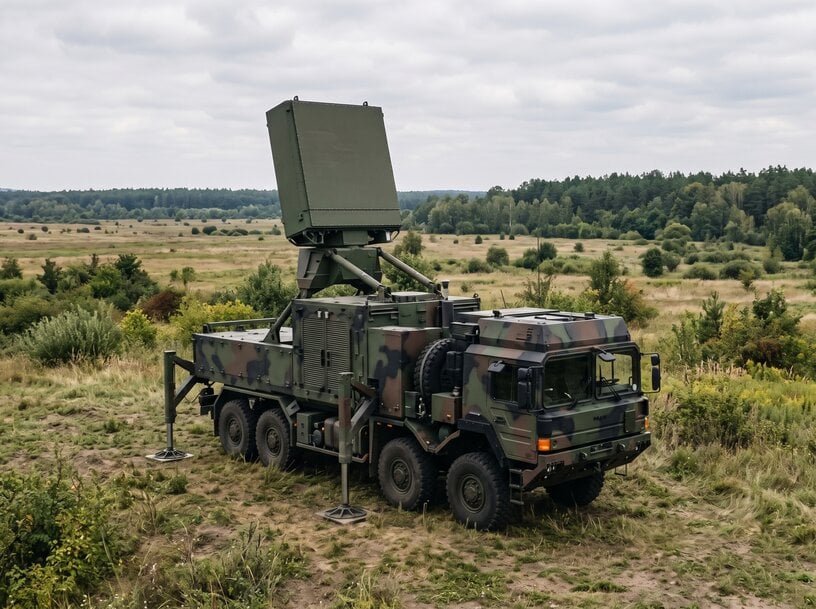
HENSOLDT and the Ministry of Defence of Ukraine have concluded a memorandum of understanding to scale the procurement, technical adaptation, and operational integration of advanced radar systems for national airspace surveillance. The agreement focuses on strengthening ground-based air defence surveillance to counter ballistic missiles, uncrewed aerial vehicles, and low-altitude cruise missiles targeting industrial and municipal infrastructure.
Operational Challenges in Airspace Monitoring
Early warning and target acquisition networks face sustained operational pressure from asymmetric aerial threats, saturation tactics, and long-range ballistic vectors. Maintaining persistent airspace awareness requires sensor nodes that deliver wide-area coverage, low latency, and high electronic counter-countermeasure resilience. Integrating multi-band radar assets allows defence operators to close coverage gaps, detect low radar cross-section objects, and pass target coordinates to surface-to-air interceptors before threats penetrate terminal defence perimeters.
Radar Systems Integration and Responsibilities
Under the partnership framework, HENSOLDT oversees system manufacturing, sensor hardware delivery, and technical engineering support. The Ukrainian Ministry of Defence manages operational deployment, site integration, and the tactical networking of units into existing command-and-control layers.
The cooperation includes the delivery of active surveillance radars and plans to examine the deployment and joint operation of the TRML-4D LR long-range radar. Operating in the C-band, these systems use active electronically scanned array (AESA) antenna technology based on solid-state gallium nitride modules. This architecture enables simultaneous three-dimensional detection, high-speed tracking of fast-moving ballistic targets, and rapid electronic beam steering across azimuth and elevation.
Field Deployment and Infrastructure Protection
Implementation plans outline phased deliveries aligned with front-line defensive requirements. Systems will interface with distributed air defence architectures to provide target track generation for interceptor batteries.
The sensor network protects static critical infrastructure, such as logistics bridges, energy distribution stations, and urban centers, from concentrated strike patterns. Real-time track data distribution across standard defence interfaces allows automated threat prioritization and reduced intercept response times.
Strategic Framework
Regarding the operational focus of the sensor deliveries, HENSOLDT CEO Oliver Dörre stated: "The Ukrainian air defence forces urgently need our high-performance radars to help protect infrastructure such as bridges. The agreement is an important step towards ensuring this support is reliable and long-term."
The initiative solidifies long-range sensor capacity and ballistic missile defence surveillance, providing the Ukrainian armed forces with sustained equipment readiness and localized technical maintenance support.
Edited by Evgeny Churilov, Induportals Media - Adapted by AI.
www.hensoldt.net
