
www.aero-defence.tech
12
'26
Written on Modified on
High-Capacity Laser Communications Link Achieved In Orbit
Astrolight has successfully commissioned the ATLAS-1 laser communication terminal aboard the ERMIS-3 nanosatellite, establishing routine space-to-ground optical links with an upgraded ground station in Greece.
astrolightspace.com
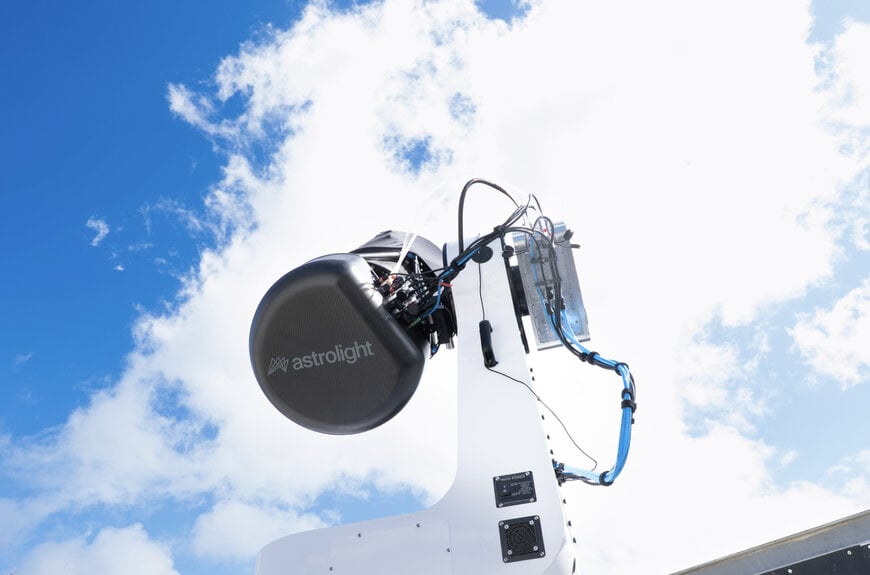
Addressing the severe bandwidth constraints and spectrum congestion of traditional radio frequency systems in Low Earth Orbit requires optical wireless communications capable of high-throughput data transfer. Satellite operators face major hurdles in deploying reliable laser links due to atmospheric turbulence, cloud attenuation, and complex pointing, acquisition, and tracking requirements. Overcoming these operational bottlenecks requires autonomous terminals that can maintain high-bandwidth connections and rapidly recover from line-of-sight interruptions.
Astrolight, a Lithuanian space and defense technology firm, collaborated with the Department of Aerospace of the National and Kapodistrian University of Athens and the Department of Physics of the Aristotle University of Thessaloniki to establish the optical link. Operating entirely remotely from Lithuania, Astrolight connected the ATLAS-1 terminal aboard the ERMIS-3 nanosatellite to HolOGS-1, an optical ground station in Holomondas upgraded to the OGS-2.5 model under ESA-supported ERMIS and PeakSat missions. Following first light during the satellite's initial active pass on October 8, 2026, the systems achieved full calibration by the third pass and transitioned to routine operations within a week, executing two autonomous links per day.
Optical Architecture And Terminal Performance
The ATLAS-1 terminal currently transmits data at a baseline rate of 1 Gbps, with link budget margins capable of supporting up to 10 Gbps. During testing, the system maintained closed-loop tracking and reliable transmission during day and night passes, including low-elevation geometries below 10 degrees and scenarios where the optical path experienced intermittent obstructions from clouds, trees, or wire fencing. Following in-orbit calibration, link availability exceeded 85 percent for orbital passes above 15 degrees of elevation. Furthermore, the terminal demonstrated rapid optical re-acquisition in under 10 milliseconds without a physical scanning step, aligning with Space Development Agency standards to mitigate temporary atmospheric or structural blockages.
Commercial Deployment And Future Development Roadmap
The capability to deploy and autonomously operate end-to-end optical connectivity from remote control centers streamlines orbital data downlinks for commercial constellations. Building upon the core technologies validated by ATLAS-1 and OGS-2.5, Astrolight is expanding its network infrastructure by constructing an additional optical ground station in Greenland in cooperation with the European Space Agency. Concurrently, the company is developing next-generation hardware variants, including the body-steered ATLAS-2 and ATLAS-X-MINI terminals designed for data rates up to 2.5 Gbps, alongside the gimbaled ATLAS-X system engineered to support up to 400 Gbps under the ESTOL standard for upcoming missions such as ESA's HydRON project.
Additional Context:
This section details technical specifications and competitive benchmarking not included in the original product announcement.
Laser communication terminals in Low Earth Orbit represent a major evolutionary step over legacy X-band and Ka-band radio frequency systems, bypassing spectrum licensing bottlenecks and offering significantly higher bandwidth density within a smaller mass and power footprint. While radio frequency downlinks typically operate at megabits per second to low gigabits per second with wide beam divergence, optical systems utilize near-infrared wavelengths with extremely narrow beam footprints, enabling secure, high-capacity transmissions exceeding 10 Gbps to 400 Gbps. However, atmospheric attenuation remains the primary operational limitation for optical ground stations, necessitating network site diversity across distinct geographical locations with favorable cloud statistics. Astrolight's implementation of sub-10-millisecond link re-acquisition without mechanical scanning addresses a critical vulnerability of space-to-ground optical links, ensuring high data availability despite transient meteorological obstructions.
Edited by Sucithra Mani, Induportals editor – adapted by AI.
www.astrolight.com
