
www.aero-defence.tech
13
'26
Written on Modified on
Modular Surface-to-Air Interceptors for Air Defense
Anduril engineered the Steelfin interceptor family around a modular architecture to resolve production bottlenecks and adverse cost-exchange ratios in integrated air defense.
www.anduril.com
Modern integrated air and missile defense faces severe inventory depletion driven by the proliferation of low-cost offensive systems, including uncrewed aerial vehicles, cruise missiles, ballistic trajectories, and maneuvering hypersonic platforms. Conventional defense batteries frequently expend high-cost interceptors against low-cost targets, creating an unfavorable cost-exchange ratio that strains defense logistics during sustained operational engagements.
Industrial Bottlenecks in Traditional Interceptor Production
Legacy surface-to-air missile designs rely on bespoke airframes, tightly integrated proprietary subcomponents, and specialized tooling for each distinct threat echelon. Modifying these systems for evolving kinematics or seeker requirements requires multi-year redesign programs, dedicated assembly facilities, and isolated supply networks. This production fragmentation limits manufacturing scalability and impedes surging output when operational expenditure outpaces industrial replenishment.
Modular Architecture and Subsystem Decoupling
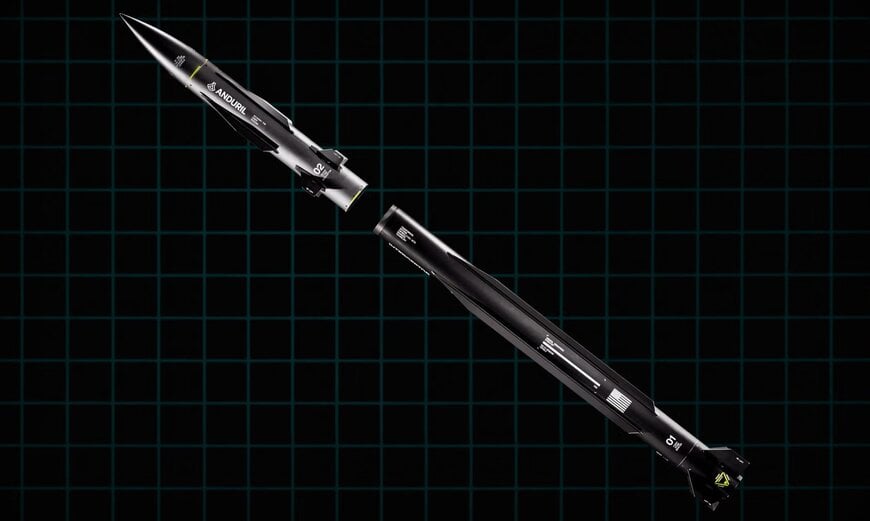
To counteract these manufacturing constraints, Anduril developed Steelfin as a modular, two-stage interceptor family built on a shared production line. The engineering architecture separates propulsion scaling from guidance and control:
- First-Stage Propulsion: The booster stage integrates variable solid rocket motor configurations to satisfy target engagement speeds, operational ranges, packing densities, and physical envelope constraints.
- Second-Stage Terminal Interceptor: The second stage employs a standardized airframe, shared avionics core, deterministic flight control systems, and common software interfaces across all variants.
- Open Systems Architecture: Subsystems within the terminal interceptor interface via open hardware and software standards. This enables rapid interchange of sensor heads, guidance units, and mission packages without structural redesign of the primary airframe.
Standardized interfaces allow the use of commercially available components alongside competitive multi-vendor sourcing. This structure reduces single-source manufacturing risks and supports planned production rates exceeding several thousand units annually using shared assembly lines, technicians, and standardized tooling.
Integration with Fielded Fire Control and Launchers
The Steelfin family integrates directly into deployed military hardware and command architectures, mitigating the need for custom battery support equipment.
Physical Launch Infrastructure: The airframes accommodate standard land- and maritime-based launchers, including the Mk 41 Vertical Launching System, M903A2 launcher platforms, Typhon mobile battery systems, and modular containerized launch mechanisms.
Battle Management Integration: Software interfaces align with standard battle management and fire control networks, interfacing with the Integrated Battle Command System (IBCS) and the Aegis Combat System for networked target engagement.
Development Status and Flight Verification
Anduril has completed initial ballistic testing utilizing representative air vehicles to validate primary aerostructures and staging separation kinematics. Operational flight test campaigns for Steelfin configurations are scheduled to begin in the subsequent testing year to validate aerodynamic control surfaces, sensor integration, and end-game engagement performance across point defense, lower-tier theater defense, and upper-tier ballistic missile envelopes.
Additional Context
This section details technical specifications and competitive benchmarking not included in the original product announcement.
Modern interceptor acquisition strategies increasingly follow modular open systems approaches (MOSA) mandated across major defense procurement frameworks, such as the United States Department of Defense modular open architecture standards. Legacy defense programs — such as the Patriot PAC-3 MSE, the Standard Missile family (SM-2, SM-6), and the Terminal High Altitude Area Defense (THAAD) — provide high-altitude kinetic protection but feature single-missile unit costs typically ranging from several million to tens of millions of dollars. These systems depend on dedicated rocket motor castings, precision-machined seeker housings, and proprietary telemetry buses that limit annual industrial throughput to several hundred rounds per year across the defense industrial base.
By contrast, modular interceptor concepts benchmark against distributed production doctrines pioneered in uncrewed systems manufacturing. Utilizing shared guidance cores coupled with mission-tailored propulsion mirrors the modular staging principles established in tiered multi-mission missile designs, while targeting significantly reduced cost baselines to rebalance the interceptor-to-threat cost curve.
Edited by Evgeny Churilov, Induportals Media - Adapted by AI.
www.anduril.com
Integration with Fielded Fire Control and Launchers
The Steelfin family integrates directly into deployed military hardware and command architectures, mitigating the need for custom battery support equipment.
Physical Launch Infrastructure: The airframes accommodate standard land- and maritime-based launchers, including the Mk 41 Vertical Launching System, M903A2 launcher platforms, Typhon mobile battery systems, and modular containerized launch mechanisms.
Battle Management Integration: Software interfaces align with standard battle management and fire control networks, interfacing with the Integrated Battle Command System (IBCS) and the Aegis Combat System for networked target engagement.
Development Status and Flight Verification
Anduril has completed initial ballistic testing utilizing representative air vehicles to validate primary aerostructures and staging separation kinematics. Operational flight test campaigns for Steelfin configurations are scheduled to begin in the subsequent testing year to validate aerodynamic control surfaces, sensor integration, and end-game engagement performance across point defense, lower-tier theater defense, and upper-tier ballistic missile envelopes.
Additional Context
This section details technical specifications and competitive benchmarking not included in the original product announcement.
Modern interceptor acquisition strategies increasingly follow modular open systems approaches (MOSA) mandated across major defense procurement frameworks, such as the United States Department of Defense modular open architecture standards. Legacy defense programs — such as the Patriot PAC-3 MSE, the Standard Missile family (SM-2, SM-6), and the Terminal High Altitude Area Defense (THAAD) — provide high-altitude kinetic protection but feature single-missile unit costs typically ranging from several million to tens of millions of dollars. These systems depend on dedicated rocket motor castings, precision-machined seeker housings, and proprietary telemetry buses that limit annual industrial throughput to several hundred rounds per year across the defense industrial base.
By contrast, modular interceptor concepts benchmark against distributed production doctrines pioneered in uncrewed systems manufacturing. Utilizing shared guidance cores coupled with mission-tailored propulsion mirrors the modular staging principles established in tiered multi-mission missile designs, while targeting significantly reduced cost baselines to rebalance the interceptor-to-threat cost curve.
Edited by Evgeny Churilov, Induportals Media - Adapted by AI.
www.anduril.com
