
www.aero-defence.tech
28
'26
Written on Modified on
Naval 3D AESA Radar Expands Air & Surface Surveillance
Saab developed the Sea Giraffe AMB D radar to overcome contested littoral tracking and electronic warfare jamming challenges.
www.saab.com
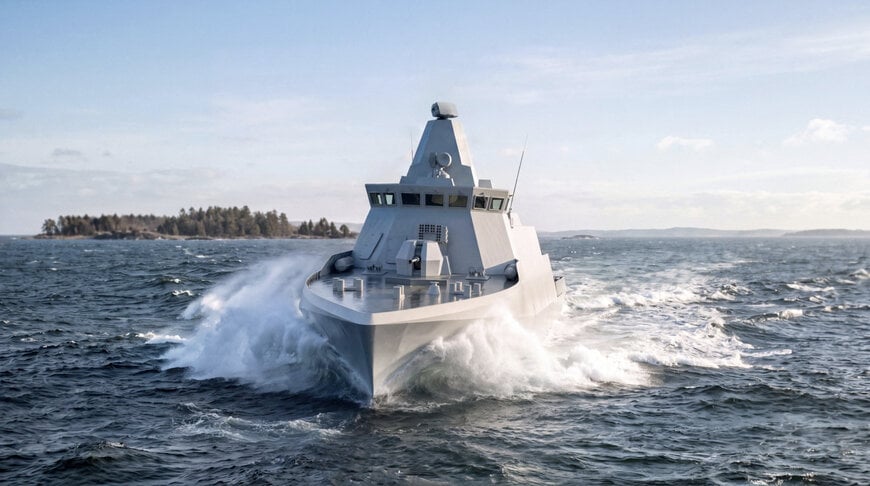
Modern maritime security environments increasingly demand sensor architectures capable of resolving saturated multi-domain attack profiles, including low-radar-cross-section drones, sea-skimming anti-ship missiles, and uncrewed surface vessels operating in cluttered coastal waters. Saab introduced the Sea Giraffe Agile Multi Beam D (AMB D), a naval three-dimensional surveillance radar that combines active electronically scanned array hardware with a software-defined signal processing suite to expand tactical threat horizons for surface combatants.
Overcoming Littoral Clutter and Saturated Threat Vectors
Naval radar operators contend with complex target environments where high-speed kinetic threats coincide with slow, low-altitude uncrewed aerial systems and small watercraft. Conventional shipboard radar systems frequently struggle to isolate low-observable targets against background sea clutter, surface ducting phenomena, and deliberate electronic noise injection. Addressing these operational demands requires agile beam control capable of maintaining high track revisit rates without compromising volume search coverage.
The Sea Giraffe AMB D addresses these conditions by providing simultaneous air and surface surveillance across multi-domain operational scenarios. The system provides instrumented detection coverage extending up to 250 kilometers for airborne targets and up to 50 kilometers for surface combatants and uncrewed surface vessels. This continuous sensor feed delivers early warning telemetry to combat management systems, accelerating threat evaluation and engagement sequencing during distributed naval engagements.
AESA Architecture and Software-Defined Signal Processing
The operating principle of the Sea Giraffe AMB D centers on Active Electronically Scanned Array (AESA) antenna hardware coupled with multi-beam receive architectures. By distributing radiofrequency generation across multiple solid-state transmit and receive modules, the radar achieves dynamic beam shaping and agile volumetric search paths. Concurrently processed digital receive beams in elevation enable accurate three-dimensional coordinate extraction for incoming aerial profiles, populating track files on fixed-wing aircraft, helicopters, ballistic threats, and loitering munitions.
To survive targeted electromagnetic interference, the radar integrates advanced Electronic Counter-Countermeasures (ECCM). These electronic protection measures combine low-sidelobe antenna design with adaptive waveform generation, frequency agility, and passive tracking modes against active electronic jammers. The software-defined digital backend decouples hardware modules from processing algorithms, allowing fleet operators to introduce updated threat classification libraries, filter profiles, and waveform adaptations through software updates without requiring top-weight hardware overhauls.
Carl-Johan Bergholm, head of Saab’s business area Surveillance, stated that the system combines increased performance with a compact topside footprint, providing naval forces with an architecture structured for continuous functional evolution as operational threat profiles expand.
Additional Context:
This section details technical specifications and competitive benchmarking not included in the original product announcement.
The Sea Giraffe AMB D represents an evolutionary leap from heritage Sea Giraffe AMB variants, which historically utilized passive electronically scanned array (PESA) transmitter architectures operating across C-band frequencies (5.4 to 5.9 GHz) with maximum instrumented air surveillance ranges of approximately 180 kilometers. The transition to gallium nitride (GaN) solid-state active elements in contemporary AESA iterations increases total radiated power, improves thermal management, and extends target acquisition range against small radar cross-section threats from 180 to 250 kilometers. Operating with an antenna rotation speed of 60 revolutions per minute, the radar delivers a 1 Hz track update rate across elevation profiles reaching above 70 degrees, mitigating blind cones directly above shipboard installations.
In the naval medium-range 3D radar segment, the Sea Giraffe AMB D competes directly with rotating active array sensors such as the Hensoldt TRS-4D (operating in C-band) and the Thales NS100/NS200 series (dual-axis multi-beam systems operating in S-band). While S-band systems prioritize extended instrumented volume search in blue-water engagements, C-band AESA configurations balance extended volume air search with superior low-altitude horizon tracking, splash spotting for naval artillery fire control, and periscope detection in dense littoral clutter. The modular construction and standardized Data Distribution Service (DDS) open interfaces facilitate mechanical and electronic integration into light frigates, corvettes, and offshore patrol vessels where mast weight and electrical power draw are constrained.
Edited by Natania Lyngdoh, Induportals editor, with AI assistance.
www.saab.com
