
www.aero-defence.tech
30
'26
Written on Modified on
New Datalinks Enable GMLRS Mid-Flight Retargeting
Lockheed Martin and U.S. Army demonstrate in-flight GMLRS redirection using Strigo datalinks and RIG-360 for dynamic battlefield engagements.
www.lockheedmartin.com
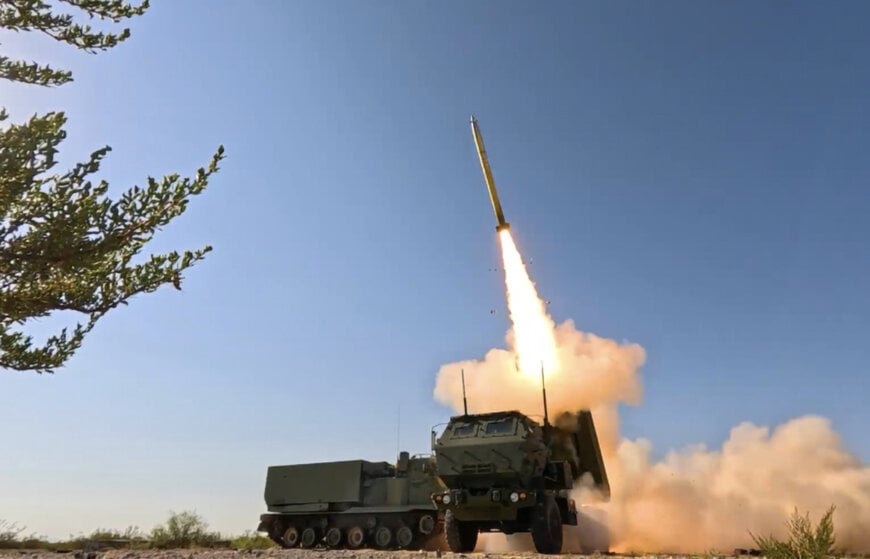
Modern military operations increasingly demand rapid adaptation to changing tactical environments, particularly when engaging mobile or time-sensitive threats on the battlefield. Traditional precision artillery rockets rely heavily on pre-programmed terminal coordinates established prior to launch, limiting a commander's ability to adjust trajectories once a munition is already in flight. To overcome this operational constraint, artillery systems must evolve toward networked, interoperable architectures that allow real-time target updates without requiring fundamental redesigns of legacy inventory.
In response to this requirement, Lockheed Martin, in partnership with the U.S. Army, successfully demonstrated an in-flight target update capability for the Guided Multiple Launch Rocket System (GMLRS). Conducted at White Sands Missile Range in New Mexico on October 28, 2026, the live-fire test evaluated the integration of existing command, control, and tracking assets to redirect a rocket after launch from a High Mobility Artillery Rocket System (HIMARS) launcher, resulting in the successful destruction of a moving target.
System Architecture and Engineering Mechanism
The technical breakthrough relies on connecting established sensors, launchers, and targeting systems into a unified operational kill chain. During the flight test, the system utilized the Strigo datalink alongside the Remote Interceptor Guidance-360 (RIG-360) radar and fire control system, which was integrated through internal Lockheed Martin funding.
The Strigo datalink serves as the communication conduit, transmitting updated telemetry and target coordinates from ground-based command nodes to the missile while it is actively in flight. Meanwhile, the RIG-360 provides persistent tracking and guidance coordination, feeding precise spatial data into the network. By bridging these systems with the GMLRS guidance package, operators can dynamically recalculate trajectories and upload new target vectors while the munition traverses its flight path, bypassing the limitations of fixed pre-programmed strikes.
Industrial Applications and Operational Benefits
This capability integration directly impacts tactical artillery workflows across land-based defense operations. By enabling mid-course corrections, tactical commanders gain heightened flexibility when responding to dynamic or mobile threats that shift position after initial launch protocols are executed.
Furthermore, the underlying architecture demonstrated during the White Sands test is not restricted to standard variant GMLRS munitions. The Strigo datalink and RIG-360 integration framework is directly applicable to other precision fires systems, including the Extended Range GMLRS and the Precision Strike Missile (PrSM). This standardization allows defense forces to extend networked precision firing capabilities across a broad array of existing and emerging munition inventories without requiring a complete overhaul of launcher platforms.
Engineering Perspective
The integration of advanced datalinks with legacy precision munitions represents a critical step in modernizing defense assets. Randy Crites, vice president of Lockheed Martin Advanced Programs, emphasized that delivering this level of integration between GMLRS, RIG-360, and Strigo equips warfighters with enhanced adaptability in complex operational scenarios. Accelerating mission integration across trusted systems ensures faster decision cycles and more effective outcomes against evolving battlefield threats.
Additional Context:
This section details technical specifications and competitive benchmarking not included in the original product announcement.
The GMLRS family of artillery rockets serves as an all-weather, precision-strike weapon deployed extensively by the U.S. Army and international allied forces. Standard GMLRS rockets utilize an inertial measurement unit (IMU) paired with Global Positioning System (GPS) receivers to achieve high positional accuracy against stationary targets. Historically, once launched, guidance corrections were constrained or impossible depending on the specific variant and block configuration.
The introduction of in-flight datalink updates aligns with broader defense industry trends toward Joint All-Domain Command and Control (JADC2) architectures. By incorporating external tracking and mid-course correction protocols—similar to those utilized in advanced air defense and tactical missile interceptors—artillery systems bridge the gap between static bombardment and responsive, network-centric warfare. Comparable precision strike developments across the defense sector emphasize resilient, jam-resistant datalinks to maintain continuous communication links in contested electromagnetic environments, ensuring that munitions can safely receive and execute updated coordinates under electronic warfare pressures.
Edited by Sucithra Mani, Induportals editor – adapted by AI.
www.lockheedmartin.com
