
www.aero-defence.tech
03
'26
Written on Modified on
Optionally Crewed Combat Boat Architecture for Distributed Littoral Warfare
Saab developed the Combat Boat 90 Capability X to provide multi-mission autonomy, surface strike, and air defence in contested littorals.
www.saab.com
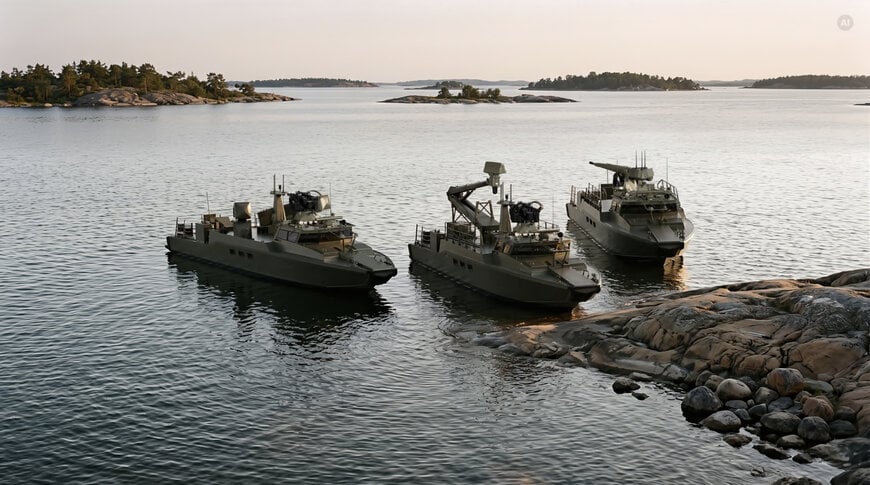
Modern littoral combat operations require dispersed maritime assets that deliver offensive strike, wide-area sensing, and organic self-defence without committing major surface combatants to high-risk coastal waters. Saab addressed this operational requirement by introducing the Combat Boat 90 Capability X, an optionally crewed fast assault platform engineered for intelligence surveillance reconnaissance, over-the-horizon surface strike, and short-range air defence.
Operational Challenges in Confined Coastal Environments
Littoral combat environments present complex operational hurdles, including confined maneuvering corridors, dense radar clutter, uncrewed aerial systems, and anti-access and area-denial threats. Traditional fast combat craft, including preceding iterations of the Combat Boat 90 design, operated primarily as troop transports and amphibious insertion vehicles. While effective for personnel insertion, asymmetric anti-ship capabilities and aerial surveillance require small platforms to execute distributed sensing and strike roles.
The Combat Boat 90 Capability X expands fast combat craft mission envelopes by functioning as a distributed sensor and weapon node. Built with an enlarged hull platform and modernized digital infrastructure, the vessel provides increased payload capacity and stability across higher sea states, allowing navies to conduct persistent sea control and interdiction missions in shallow coastal waters.
Autonomy Infrastructure and Control System Design
The vessel integrates the Autonomous Ocean Core system, an open-architecture, vessel-agnostic control suite developed by Saab. This software and hardware infrastructure provides baseline autonomy, executing automated navigation, obstacle avoidance, route execution, and dynamic positioning. The system architecture supports both crewed and uncrewed operations, allowing naval commanders to switch between human-piloted tactical missions and autonomous deployments based on risk tolerance and operational requirements.
Through its networked fleet management interface, the Autonomous Ocean Core connects the platform to remote control centers on land, at sea, or in the air. This open command framework permits the integration of mission-specific payloads and external algorithms without compromising the vessel core safety and maneuvering layers.
"The future of naval operations is not just about having more platforms; it is about distributing greater combat capability across the force. As operational realities change, so does CB90. CB90 CX reflects this evolution, moving beyond troop transport to connecting sensors and weapons and delivering combat capability directly from the boat, whether crewed or uncrewed," stated Anders Hellman, head of the Saab Docksta business unit.
Sensor, Strike, and Air Defence Payload Configurations
The platform is designed around three distinct, mission-matched configurations that operate independently or in coordinated groups.
The intelligence, surveillance, and reconnaissance configuration incorporates the Saab Sea Giraffe 1X 3D active electronically scanned array radar mounted on an elevating mast. Operating with continuous 360-degree coverage and an instrumented detection range exceeding 100 kilometers, the system simultaneously detects, classifies, and tracks air and surface targets, including small uncrewed aerial systems. For close-in protection and visual tracking, this configuration integrates the stabilized Trackfire Remote Weapon Station equipped with electro-optical and infrared sensors and integrated fire control.
The anti-ship warfare configuration provides surface engagement capabilities using MBDA Marte ER anti-ship missiles. The turbojet-powered missile utilizes active radar terminal homing and sea-skimming flight profiles to strike surface targets at over-the-horizon ranges exceeding 100 kilometers. Targeting coordinates can be ingested from organic radar sensors or offboard surveillance nodes via tactical datalinks.
The short-range air defence configuration counters proliferating aerial threats, such as loitering munitions, uncrewed aerial systems, and rotary-wing aircraft. The variant integrates the Rheinmetall SeaSnake 30 remote-controlled weapon station, which couples a stabilized 30 mm automatic cannon with electro-optical tracking and programmable airburst ammunition to engage dynamic aerial and surface targets while the craft is underway.
Fleet Integration and Industrial Deployment
Sweden serves as the launch customer for the vessel, with series production underway at Saab Docksta shipyard. The craft will co-exist alongside the smaller Combat Boat 90 Next Generation variant to fulfill requirements under Sweden disaggregated amphibious battalion procurement doctrine. Globally, Combat Boat 90 variants operate across nine navies located in Europe, the Middle East, Africa, the Asia-Pacific region, and the Americas.
Additional Context:
This section details technical specifications and competitive benchmarking not included in the original product announcement.
The Combat Boat 90 Capability X represents a structural elongation of the combat boat family. The hull measures 18.0 meters in overall length and 4.0 meters in beam, with a nominal operational draught of 1.1 to 1.4 meters. In comparison, the preceding Combat Boat 90 Next Generation measures 16.3 meters in length with a 3.85-meter beam, while the original combat boat design measures 14.9 to 15.9 meters. The vessel is classified under DNV High Speed Light Craft rules with the notation 1A HSLC Patrol (S) E0 R2.
Propulsion is supplied by twin marine diesel engines delivering a combined output of 2,200 horsepower (2 x 1,100 hp), driving mixed-flow waterjets. This propulsion configuration yields sprint velocities exceeding 40 knots at full combat displacement and an operational range of approximately 300 nautical miles. The crew complement ranges from zero in uncrewed autonomous configurations up to 10 personnel for crewed operations.
Within the high-speed littoral craft segment, the platform occupies a distinct position compared to heavier coastal patrol assets. The United States Navy 26-meter Mark VI patrol boat displaces roughly 72 metric tons and requires a permanent crew of 10 to 11 personnel to operate its remote weapon mounts, while relying on conventional planning hulls with deeper drafts. Regionally, the Finnish Marine Alutech Watercat M18 (Jehu class) fast assault craft utilizes twin 900-horsepower diesel engines for amphibious transport and coastal patrol, relying on 12.7 mm or 40 mm remote weapon stations. The Combat Boat 90 Capability X differentiates itself from these platforms by combining a shallow-draft waterjet hull with integrated autonomous naval navigation, 30 mm programmable airburst counter-uncrewed aerial system weaponry, and over-the-horizon guided missile capability within an optionally crewed architecture.
Edited by Natania Lyngdoh, Induportals editor, with AI assistance.
www.saab.com
