
www.aero-defence.tech
05
'26
Written on Modified on
General Atomics secures hypersonic weapons component production contract through 2031
GA-EMS will manufacture precision-machined parts and cable assemblies for the Army-Navy Common Hypersonic Glide Body programmes under Leidos.
www.ga.com
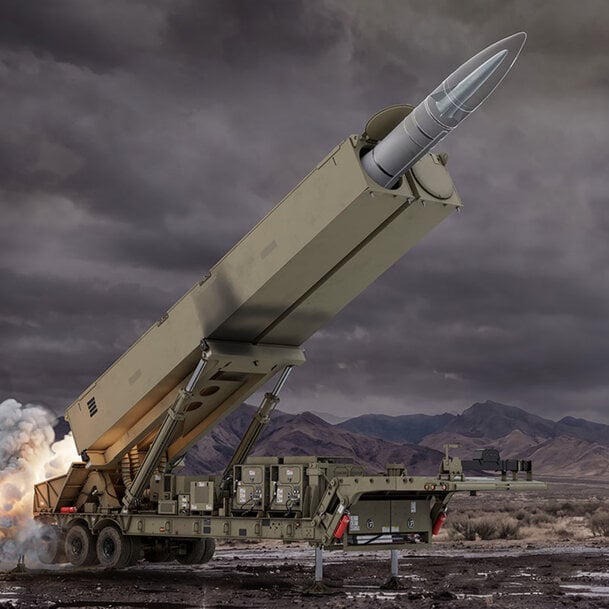
Overcoming the extreme aerothermal heating, severe mechanical vibration, and dynamic pressure of non-ballistic atmospheric flight requires high-tolerance structural and electrical flight hardware. To support this operational demand, General Atomics Electromagnetic Systems announced its selection by prime contractor Leidos under a multiyear subcontract through 2031 to manufacture critical flight components, including precision-machined structures and specialized cable harnesses, for the Common Hypersonic Glide Body. The production initiative directly feeds into the industrial base supplying the United States Army Dark Eagle long-range hypersonic weapon and the United States Navy Conventional Prompt Strike sea-based capability.
Consolidating Aerothermal Production and Industrial Scale
Hypersonic boost-glide platforms rely on specialized airframe materials and internal actuation assemblies that endure boundary layer temperatures often exceeding 2,000 degrees Celsius while executing atmospheric maneuvers at velocities greater than Mach 5. The Department of Defense acquisition strategy unites the Common Hypersonic Glide Body and the Thermal Protection System into an integrated procurement structure under Leidos. This consolidation addresses supply chain fragmentation and transitions hypersonic hardware procurement from experimental prototyping into synchronized, multi-service serial manufacturing.
Under the subcontract, General Atomics Electromagnetic Systems supplies mechanical subassemblies and electrical distribution systems that integrate directly into the common vehicle shell shared by both ground-mobile and maritime launch platforms. The hardware baseline leverages fabrication data and quality controls established during the initial prototype phase, which previously supported the successful 2020 flight demonstration of the Common Hypersonic Glide Body.
Engineering Challenges in Actuation and Harness Integration
Atmospheric maneuverability in a hypersonic glide vehicle depends on microsecond flight control inputs executed through aerodynamic surfaces. In the common glide body configuration, mechanical elevons modulate pitch and roll during the unpowered glide phase following booster separation. Fabricating components for these control mechanisms requires specialized machining processes to maintain dimensional tolerances within microns, preventing thermal-structural distortion under high dynamic pressure.
The production agreement covers specialized cable assemblies developed for the Elevon Control Module alongside primary airframe substructures. These interconnects must transmit power and command signals continuously through extreme thermal gradients and high-G acoustic environments without signal degradation or dielectric breakdown.
According to Mike Rucker, vice president of Weapons Programs at General Atomics Electromagnetic Systems, the manufacturing scope spans cable assemblies for the Elevon Control Module and the hypersonic glide body alongside precision-machined metal components and substructures. Rucker noted that maintaining dual capabilities across electrical and mechanical manufacturing under a single industrial team provides essential continuity, allowing technicians to apply established design parameters to preserve precision and geometric repeatability throughout serial production.
To fulfill volume requirements through 2031, the company is deploying computer-controlled multi-axis machining centers and qualified inspection workflows within the domestic defense industrial base. Quality assurance protocols incorporate non-destructive testing, coordinate measuring machine verification, and specialized environmental testing of wire harnesses to guarantee compliance with rigorous military flight standards.
Additional Context:
This section details technical specifications and competitive benchmarking not included in the original product announcement.
The Common Hypersonic Glide Body design originated through research led by Sandia National Laboratories and the United States Army Space and Missile Defense Command, establishing a standardized conical lifting body geometry. The glide vehicle is launched via a two-stage, 34.5-inch solid rocket booster developed collaboratively by the Army and Navy. Following boost phase burnout and exoatmospheric release, the vehicle re-enters the upper atmosphere, using its lifting body design and elevon control surfaces to glide thousands of kilometers along an unpredictable flight path.
The subcontract follows a 2.7 billion dollar prime production contract awarded by the U.S. Army to Leidos in May 2026, structured to move the Dark Eagle system from developmental testing into standardized inventory production. The industrial arrangement directly links the land-based Dark Eagle system, operated from modified heavy tactical vehicle launchers by Army Strategic Long-Range Fires battalions, and the Navy Conventional Prompt Strike program, planned for deployment aboard Zumwalt-class guided missile destroyers and Virginia-class Block V attack submarines equipped with the Virginia Payload Module.
From an architectural standpoint, boost-glide systems operate on different aerodynamic and propulsion principles than air-breathing hypersonic cruise missiles, such as the scramjet-powered Hypersonic Attack Cruise Missile program. While scramjets depend on continuous supersonic internal combustion and atmospheric oxygen capture, boost-glide vehicles convert kinetic and potential energy delivered by a rocket booster into sustained non-ballistic horizontal range. Compared to legacy ballistic missile reentry vehicles that travel along predictable parabolic trajectories, the glide body maintains atmospheric maneuverability, rendering trajectory prediction and interception by conventional surface-to-air defense systems difficult. Consequently, structural integrity and actuation reliability in assemblies like the Elevon Control Module remain the governing factors in achieving target precision.
Edited by Natania Lyngdoh, Induportals editor, with AI assistance.
www.ga.com
