
www.aero-defence.tech
18
'26
Written on Modified on
ABB to Advance Laser Spectrometer Technology for Mars Methane Detection
ABB has secured a contract from the Canadian Space Agency to develop a high-sensitivity laser spectrometer designed to monitor trace methane on the Martian surface.
global.abb
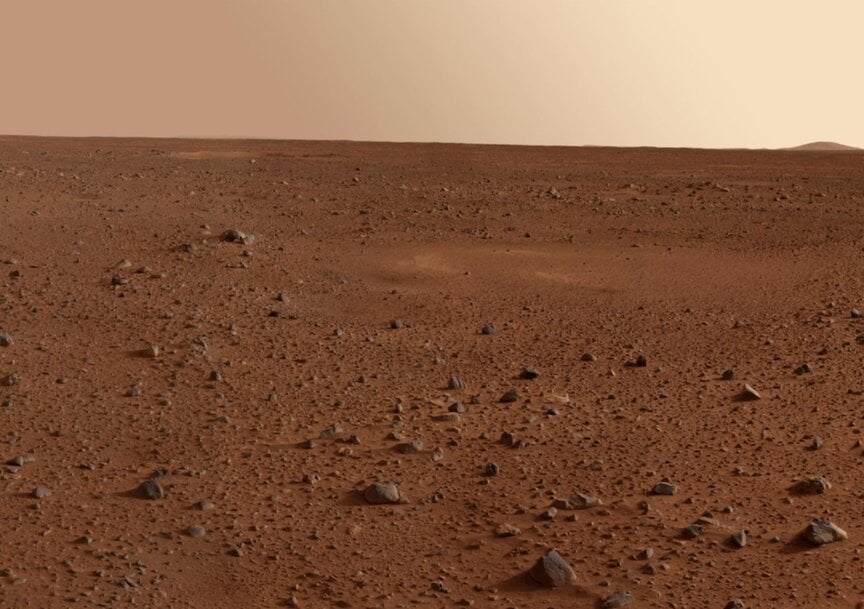
ABB has been awarded a contract by the Canadian Space Agency (CSA) under its Space Technology Development Program to advance a compact, high-sensitivity gas spectrometer for future Mars missions. Forming part of the Martian Atmospheric Gas Evolution Experiment (MAGE), the project is designed to detect and quantify near-surface trace gases, primarily methane, directly on the Martian surface.
Optical Spectroscopy and Prototype Refinement
Building on prior CSA-funded initiatives, ABB will adapt and test a Mars-tuned iteration of its Off-Axis Integrated Cavity Output Spectroscopy (OA-ICOS™) technology. Originally engineered for terrestrial gas leak detection—where the infrared laser and highly reflective mirror cavity design achieves sensitivity over 1,000 times higher and detection speeds 10 times faster than conventional sensors at single parts-per-billion (ppb) levels—the instrument will be optimized for planetary conditions.
Engineering and scientific work will focus on developing and testing a functional prototype capable of operating under low atmospheric pressures and Martian gas mixtures. Specific development goals include:
- Noise Reduction and Sensitivity: Minimizing measurement noise to detect ultra-low methane concentrations of approximately 1 part per billion.
- Temporal Resolution: Conducting continuous hourly surface monitoring to capture temporal fluctuations and narrow down potential gas sources.
- Multi-Gas Compatibility: Maturing the instrument architecture to support future measurements of oxygen, hydrogen chloride, and water vapor.
Because methane naturally degrades when exposed to sunlight, its sustained presence near the Martian surface suggests an active replenishment mechanism, such as subsurface microbial activity or geological trapping. Continuous surface monitoring aims to expand the effective searchable area compared to previous orbital observations or localized single-point sampling.
The MAGE mission concept is developed in collaboration with the Lassonde School of Engineering at York University in Toronto, led by Dr. John Moores. The instrument development builds upon terrestrial analogue field campaigns conducted on Axel Heiberg Island in Nunavut, Canada, where researchers demonstrated methane detection and spatial variability analysis under Mars-like environmental conditions.
"What makes this technology exciting is that it allows us to search for trace gases in a completely different way. Rather than examining a small sample collected from a single location, we can monitor gases originating from a much larger area. If successful, this capability could help us identify the processes responsible for methane’s presence on Mars, one possibility being that methane is generated by microbes buried underground in the same way shale gas is trapped on Earth." — Frederic Pelletier, Business Development Manager for Space & Defense, ABB Measurement & Analytics Canada.
Edited by Romila DSilva, Induportals Editor, with AI assistance.
www.abb.com
