
www.aero-defence.tech
20
'26
Written on Modified on
Textron Systems Awarded DARPA Carbon-Carbon Rapid Densification Contract
Textron Systems has secured a Phase 1 contract under the DARPA Carbon Crunch program to accelerate the manufacturing of high-temperature hypersonic composite materials.
www.textron.com
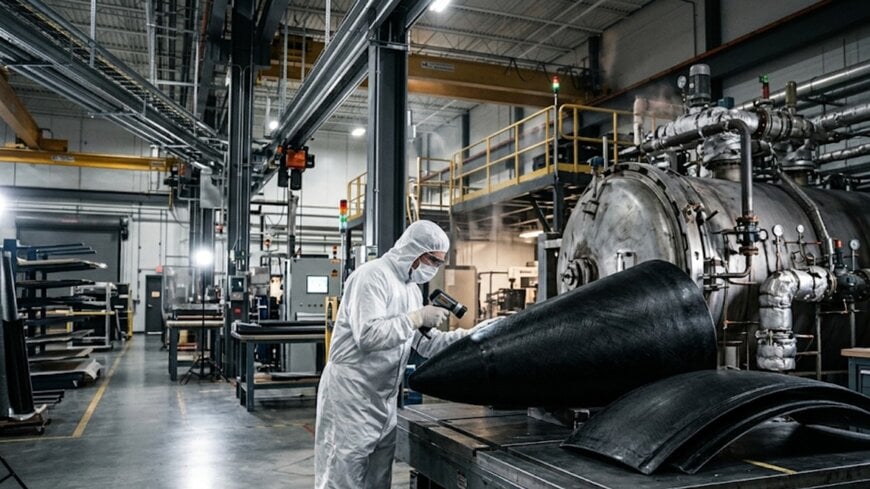
Textron has been awarded a Phase 1 contract for the Defense Advanced Research Projects Agency (DARPA) Carbon Crunch program. The program is structured to accelerate the production of carbon-carbon composites by developing manufacturing technologies that are faster and more scalable than conventional methods.
Phase 1 Scope and Technical Objectives
Textron Systems' rapid densification carbon-carbon manufacturing solution is designed to reduce production timelines for a variety of aeroshell components. With performance anticipated to begin in late 2026, the Phase 1 contract spans an 18-month period. During this phase, the company will manufacture representative densified carbon-carbon composite samples for government evaluation.
"This Carbon Crunch program represents a bold step toward accelerating the production of high-temperature materials for hypersonic systems. Our team brings decades of knowledge, having invested heavily in carbon-carbon technology through heat shield and nose tip development, and are ready to deliver on Phase 1 of this program." — Henry Finneral, Senior Vice President, Weapon Systems, Textron Systems.
Manufacturing Infrastructure and Investment
To support the execution of the Carbon Crunch program, Textron Systems has established a dedicated manufacturing facility in Wilmington, Massachusetts, focused on the rapid densification of hypersonic materials. The facility was developed through a combination of independent research and development (IR&D), capital equipment investments, and workforce expansion.
Additional Context
This section details technical specifications and competitive benchmarking not included in the original product announcement.
This section details technical specifications and competitive benchmarking not included in the original product announcement.
In hypersonic thermal protection system (TPS) engineering, carbon-carbon composites consist of woven or multi-directional continuous carbon fiber preforms embedded within a pure carbonaceous matrix. Historically, manufacturing dense, low-porosity C-C structures required either isothermal Chemical Vapor Infiltration (CVI)—where hydrocarbon gases such as methane or propane diffuse slowly into a heated fibrous preform over 600 to 1,200 hours to deposit pyrolytic carbon—or multiple repetitive cycles of liquid phenolic or pitch Polymer Infiltration and Pyrolysis (PIP) under high-pressure hot isostatic pressing (HIP), often requiring five to eight consecutive impregnation, carbonization, and graphitization cycles spanning several months to eliminate internal voids. Rapid densification architectures pursued under DARPA’s Carbon Crunch (solicitation DARPA-PS-26-15) replace slow diffusion-limited ovens with accelerated thermal-gradient CVI, inductively heated rapid vapor infiltration, or advanced high-char-yield liquid resin infusion techniques that collapse densification timelines from months to days or hours while achieving target bulk densities above 1.75 g/cm³ and open porosity below 8 percent.
Within the U.S. defense carbon-carbon and high-temperature composite manufacturing sector, Textron Systems benchmarks directly against specialized aerospace TPS suppliers and defense primes, including Northrop Grumman (operating major carbon-carbon manufacturing facilities in Elkton, Maryland, and Promontory, Utah), Lockheed Martin, RTX / Raytheon, General Dynamics Ordnance and Tactical Systems, Carbon-Carbon Advanced Technologies (C-CAT), and Materials Sciences LLC (a subsidiary of Karman Space & Defense). While legacy suppliers have largely relied on parallelizing conventional multi-furnace CVI and PIP lines to expand capacity—an approach requiring massive capital expenditure and cleanroom floor space—DARPA explicitly structured Carbon Crunch to avoid mere parallelization of legacy touch-labor workflows. By investing IR&D capital into a dedicated Wilmington, Massachusetts rapid-densification facility and leveraging its long-standing Strategic Systems and reentry nose-tip heritage, Textron Systems positions itself as an agile, high-throughput supplier for next-generation U.S. Department of Defense hypersonic strike and interceptor programs.
Edited by Romila DSilva, Induportals Editor, with AI assistance.
www.textronsystems.com
