
www.aero-defence.tech
23
'26
Written on Modified on
Unmanned Systems and Hybrid Propulsion for Military Vehicles
Rheinmetall and the Dutch Ministry of Defence signed a Letter of Intent to jointly develop unmanned, hybrid-propulsion and advanced-material technologies for land systems.
www.rheinmetall.com
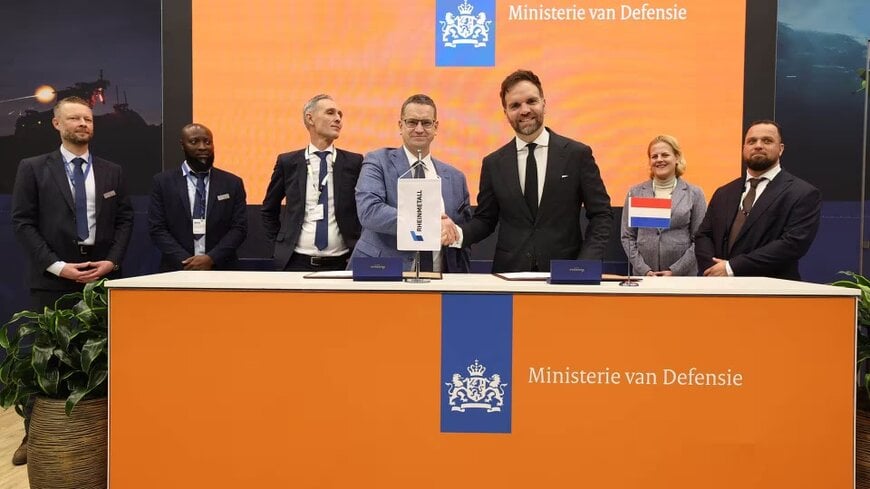
The Ministry of Defence of the Kingdom of the Netherlands and Rheinmetall have agreed to jointly advance future technologies for military vehicle systems. A Letter of Intent (LoI) covering unmanned systems, hybrid propulsion, man-unmanned teaming and advanced materials was signed on 19 November 2026 at the NEDS 2026 defence and security exhibition at Ahoy Rotterdam, Netherlands.
Partners and Responsibilities
The document was signed by Derk Boswijk, Dutch Secretary of State for Arms Procurement and Personnel, together with Dr Björn Bernhard, Head of Rheinmetall's Vehicle Systems Division, and Coen van Leuwwen, Managing Director of Rheinmetall Defence Nederland B.V. (RDNL). RDNL, based in Ede, is a wholly owned subsidiary of Rheinmetall Landsysteme GmbH within the Vehicle Systems division and is part of the ARTEC consortium behind the Boxer wheeled armoured vehicle.
Technology Focus Areas for Military Land Systems
With the LoI, the partners commit to strengthening German-Dutch defence cooperation and to identifying new technologies relevant to the security of both countries. The scope concentrates on land systems and military vehicles. Topics identified include unmanned systems, the hybridisation of propulsion systems, man-unmanned teaming, and advanced materials and production technologies.
Each area addresses a recognised engineering requirement in modern armoured vehicles. Hybrid propulsion combines a combustion engine with electric drive components and energy storage, an architecture that can support silent watch and low-signature movement while supplying rising onboard electrical loads from sensors, communications and mission systems. Man-unmanned teaming connects crewed vehicles with uncrewed platforms carrying sensors or payloads, extending reconnaissance reach while reducing crew exposure. Advanced materials and production methods target the balance between protection, vehicle weight and manufacturing throughput.
Rationale for the Cooperation
According to Secretary of State Derk Boswijk, the signing formalises an existing working relationship: "We formalize our fruitful collaboration, in order to create relevant innovation projects and connect the German and Netherlands Technological and Industrial Base more strongly. In these times, there is a great need to explore how we can boost innovation speed and stimulate rapid adoption."
Dr Björn Bernhard described the technological dimension: "In doing so, we are not only strengthening German-Dutch cooperation but also driving innovation in technology for land systems. The latter helps both nations in equal measure to achieve their strategic objectives."
Expected Impact
The LoI establishes a framework rather than a procurement contract, and no specific programmes, budgets or timelines have been published. Its practical effect lies in creating a structured channel for defining joint innovation projects and in linking the German and Dutch defence technological and industrial bases. For military vehicle development, such coordination can shorten the path from technology identification to testing and adoption, an objective both partners explicitly named.
Edited by Sucithra Mani, Induportals editor – adapted by AI.
www.rheinmetall.com
