
www.aero-defence.tech
19
'26
Written on Modified on
Vertical Launch Missile System Expands C-UAS Defense
Lockheed Martin validated a 90-degree vertical launch of JAGM to address emerging drone and multidomain threats across land and maritime platforms.
www.lockheedmartin.com
Modern armed forces face a growing number of asymmetric threats, particularly from unmanned aerial systems (UAS) and unmanned surface vehicles operating in complex, multidomain environments. Naval vessels and expeditionary land platforms require defensive systems that provide full-azimuth coverage without extensive mechanical repositioning, while remaining compatible with existing launch architectures.
To address these requirements, Lockheed Martin evaluated a vertical-launch configuration of its Joint Air-to-Ground Missile to expand its role beyond traditional air-launched missions.
Technical challenge and objectives
The main challenge was to validate whether a missile originally designed for air-to-ground engagements could be safely and effectively launched vertically from a compact, multimissile launcher. The objectives included:
- Achieving a true 360-degree defensive envelope
- Demonstrating counter-UAS engagement capability
- Ensuring compatibility with land and maritime platforms
- Preserving guidance performance after vertical egress
Selected solution: vertical launch with quad-missile architecture
The solution combined the Joint Air-to-Ground Missile with the JAGM Quad Launcher, a compact launcher designed to support rapid, multi-round engagements. The missile’s dual-mode seeker, integrating semi-active laser and millimeter-wave radar guidance, was a key selection factor, as it enables target acquisition and tracking across diverse threat profiles and environmental conditions.
Vertical launch capability allows missiles to be fired without launcher slewing, reducing reaction time and mechanical complexity while increasing survivability for the host platform.
Demonstration and deployment setup
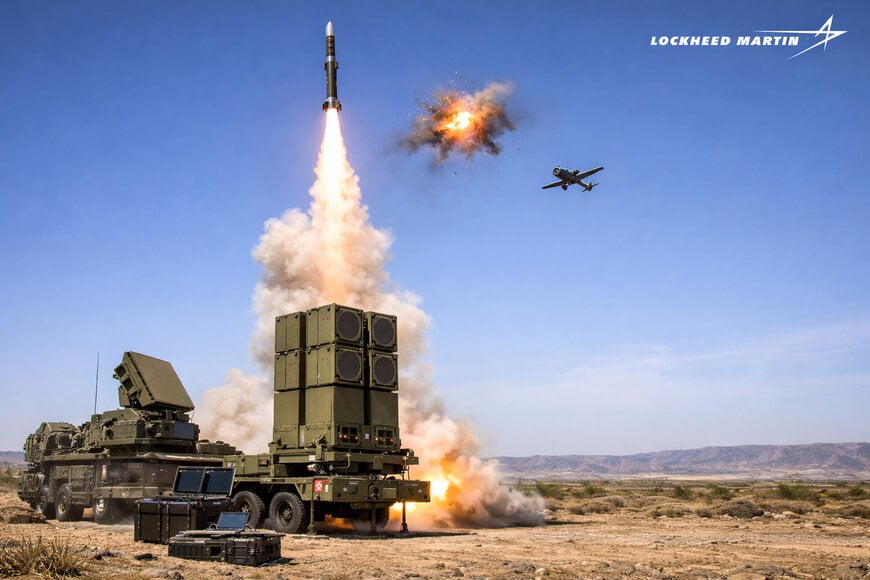
The live demonstration took place at China Lake in January 2026. The quad launcher was mounted on a 6×6 ground vehicle to replicate a mobile, surface-based deployment scenario. During the test, a JAGM was launched at a full 90-degree angle and successfully engaged a representative UAS target.
This configuration also reflects potential future integration on surface-combatant vessels, where deck space and firing arcs are constrained.
Performance outcomes and operational implications
The test validated that JAGM can transition from vertical launch to target engagement without degradation in guidance or control. It also confirmed the launcher’s ability to support multidomain missions, enabling operators to tailor engagement envelopes depending on platform and threat type.
By demonstrating reliable counter-UAS performance from a vertical launcher, the system addresses a critical gap in short- to medium-range defensive coverage for naval forces, including the United States Navy and allied operators.
Technical perspective
According to program representatives, the demonstration confirmed that a single missile architecture can be adapted across air, land, and sea domains while maintaining network-centric integration requirements. From a system-engineering standpoint, the result supports a modular approach to missile and launcher design, reducing integration risk and logistics complexity for future deployments.
Conclusion
The successful vertical-launch demonstration shows how an existing missile system can be adapted to meet evolving counter-UAS and multidomain defense needs. By validating full-azimuth coverage and launcher flexibility, the JAGM and quad-launcher configuration provides a technically proven option for forces seeking scalable, platform-agnostic defensive capabilities without developing an entirely new missile class.
www.lockheedmartin.com
The solution combined the Joint Air-to-Ground Missile with the JAGM Quad Launcher, a compact launcher designed to support rapid, multi-round engagements. The missile’s dual-mode seeker, integrating semi-active laser and millimeter-wave radar guidance, was a key selection factor, as it enables target acquisition and tracking across diverse threat profiles and environmental conditions.
Vertical launch capability allows missiles to be fired without launcher slewing, reducing reaction time and mechanical complexity while increasing survivability for the host platform.
Demonstration and deployment setup
The live demonstration took place at China Lake in January 2026. The quad launcher was mounted on a 6×6 ground vehicle to replicate a mobile, surface-based deployment scenario. During the test, a JAGM was launched at a full 90-degree angle and successfully engaged a representative UAS target.
This configuration also reflects potential future integration on surface-combatant vessels, where deck space and firing arcs are constrained.
Performance outcomes and operational implications
The test validated that JAGM can transition from vertical launch to target engagement without degradation in guidance or control. It also confirmed the launcher’s ability to support multidomain missions, enabling operators to tailor engagement envelopes depending on platform and threat type.
By demonstrating reliable counter-UAS performance from a vertical launcher, the system addresses a critical gap in short- to medium-range defensive coverage for naval forces, including the United States Navy and allied operators.
Technical perspective
According to program representatives, the demonstration confirmed that a single missile architecture can be adapted across air, land, and sea domains while maintaining network-centric integration requirements. From a system-engineering standpoint, the result supports a modular approach to missile and launcher design, reducing integration risk and logistics complexity for future deployments.
Conclusion
The successful vertical-launch demonstration shows how an existing missile system can be adapted to meet evolving counter-UAS and multidomain defense needs. By validating full-azimuth coverage and launcher flexibility, the JAGM and quad-launcher configuration provides a technically proven option for forces seeking scalable, platform-agnostic defensive capabilities without developing an entirely new missile class.
www.lockheedmartin.com
