
www.aero-defence.tech
28
'26
Written on Modified on
Carrier UAV Control System Demonstrated in Flight
Lockheed Martin and Boeing integrate command system for U.S. Navy MQ-25A carrier-based unmanned aviation operations.
www.lockheedmartin.com
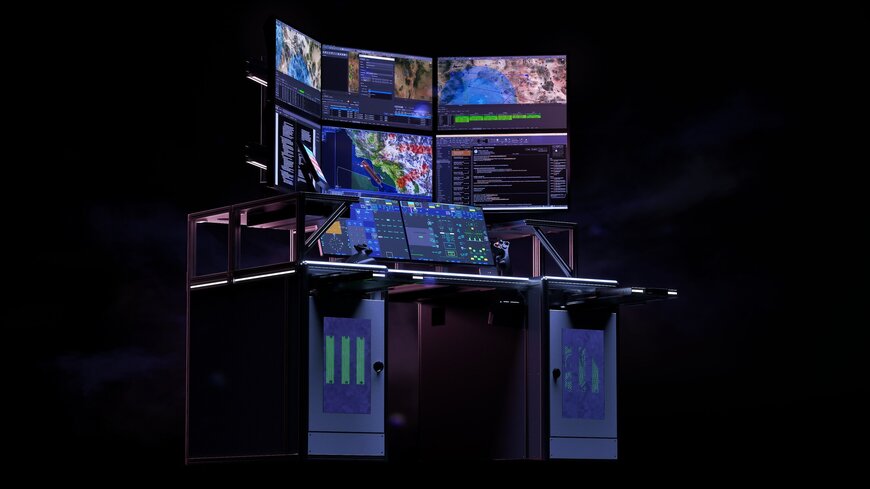
The U.S. Navy, in cooperation with Lockheed Martin and Boeing, has demonstrated a carrier-relevant unmanned aviation control architecture during the first flight of the MQ-25A Stingray using a ground-based command-and-control system.
Context of the Cooperation
The cooperation involves Lockheed Martin, Boeing, and the United States Navy. The MQ-25A Stingray unmanned aerial refueling aircraft is developed by Boeing, while Lockheed Martin’s Skunk Works division provides the command-and-control (C2) software infrastructure.
The operational challenge addressed is the safe and coordinated control of carrier-based unmanned aircraft within complex naval aviation environments. This includes interoperability with existing air wing systems, secure communications, and scalability for multiple unmanned platforms. Cooperation is required due to the integration of air vehicle design, mission systems, and ground control infrastructure across different contractors and Navy operational requirements.
Technical Solution and Responsibilities
The system demonstrated is the MDCX command-and-control platform, developed by Lockheed Martin, which serves as the software backbone of the Navy’s Unmanned Carrier Aviation Mission Control System (UMCS) MD-5 Ground Control Station.
MDCX is based on an open architecture approach, enabling modular integration with different unmanned aerial vehicles and mission systems. Its functions include:
- Secure data link management between ground station and aircraft
- Command execution and flight control supervision
- Integration with mission planning and autonomy systems
- Support for multi-vehicle control from a single operator interface
Boeing’s MQ-25A provides the airborne platform, including flight control systems, communications interfaces, and refueling mission capability. The integration relies on standardized interfaces and secure communication protocols to ensure interoperability between the aircraft and the ground control system.
Deployment and Implementation
The system was validated during the MQ-25A’s first flight at MidAmerica St. Louis Airport. The MD-5 Ground Control Station, running the MDCX platform, was used to command and monitor the aircraft throughout the operation.
This test represents an early operational step in deploying a scalable unmanned aviation control system for carrier environments. The architecture is designed to integrate with existing naval aviation infrastructure and evolve toward distributed and networked control systems aligned with digital infrastructure strategies.
Applications and Use Cases
The primary application is carrier-based unmanned aviation, particularly for aerial refueling missions conducted by the MQ-25A. Additional use cases include:
Deployment and Implementation
The system was validated during the MQ-25A’s first flight at MidAmerica St. Louis Airport. The MD-5 Ground Control Station, running the MDCX platform, was used to command and monitor the aircraft throughout the operation.
This test represents an early operational step in deploying a scalable unmanned aviation control system for carrier environments. The architecture is designed to integrate with existing naval aviation infrastructure and evolve toward distributed and networked control systems aligned with digital infrastructure strategies.
Applications and Use Cases
The primary application is carrier-based unmanned aviation, particularly for aerial refueling missions conducted by the MQ-25A. Additional use cases include:
- Coordinated control of multiple unmanned aircraft from a single station
- Integration into carrier air wing operations alongside crewed aircraft
- Extension to other naval unmanned systems requiring centralized or distributed control
These capabilities support broader industrial automation principles in defense aviation, including system interoperability, modular software integration, and scalable control architectures.
Results and Expected Impact
The successful flight demonstrates functional interoperability between the ground control system and the unmanned aircraft under operational conditions. The open architecture of MDCX enables future expansion to additional platforms without redesigning the core system.
From a technical perspective, the approach supports reduced integration complexity, improved system maintainability, and the ability to scale command-and-control operations as the number of unmanned systems increases.
Edited by an industrial journalist Sucithra Mani with AI assistance.
www.lockheedmartin.com
Results and Expected Impact
The successful flight demonstrates functional interoperability between the ground control system and the unmanned aircraft under operational conditions. The open architecture of MDCX enables future expansion to additional platforms without redesigning the core system.
From a technical perspective, the approach supports reduced integration complexity, improved system maintainability, and the ability to scale command-and-control operations as the number of unmanned systems increases.
Edited by an industrial journalist Sucithra Mani with AI assistance.
www.lockheedmartin.com
