
www.aero-defence.tech
01
'26
Written on Modified on
Sener begins flight trials of Razor under the SIROCO programme
The first tests were carried out in mid-May, providing valuable insight for the next steps of a demanding validation campaign.
www.sener-group.com
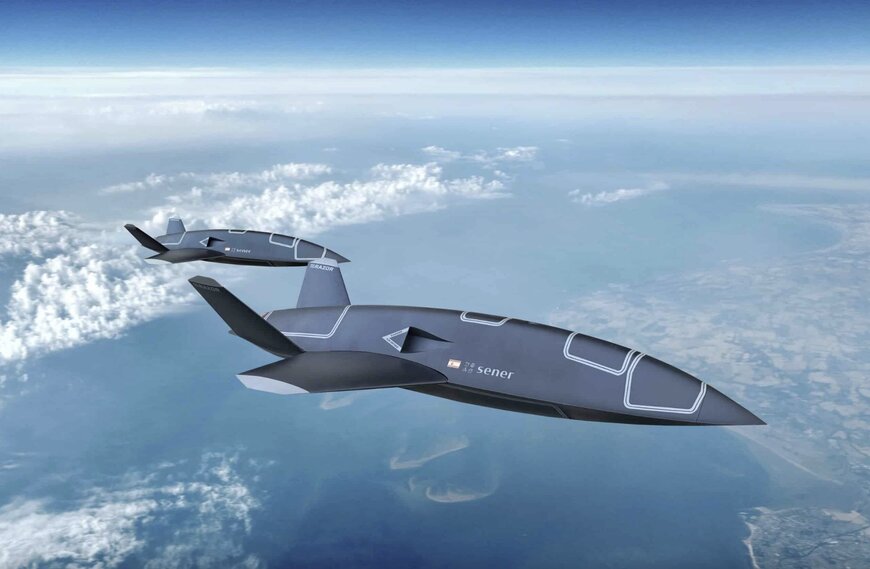
In mid-May, Sener began the flight test campaign of Razor (SRC-100 Razor) as an aerial target, as part of the development of a new-generation multipurpose autonomous platform under the company’s SIROCO programme. The first tests, conducted at the El Arenosillo Experimentation Centre (CEDEA) of the National Institute for Aerospace Technology (INTA), mark the start of an extensive test campaign.
Through this campaign, Sener aims to explore the flight envelope of this new platform, validate its high performance and new functionalities and, in short, continue advancing the maturation of Razor while at the same time obtaining relevant information for the development of subsequent platforms within the SIROCO programme.
Evaluation and calibration of air defence systems
Sener conceives SIROCO as a fast-development project that brings together, under a single technological vision, a family of aircraft designed to serve as targets for the evaluation and calibration of air defence systems, with the capability to evolve into operational platforms. Within this programme, Sener is developing several platforms that will share a design philosophy based on high autonomy, high speed, low observability and interoperability.
Within this context, the start of flight trials of the first Razor prototype represents a key step in the progressive validation of the platform and in consolidating the knowledge required for the evolution of the product.
A new-generation multipurpose autonomous platform
Presented internationally in February at the World Defense Show in Riyadh, Razor is a multipurpose autonomous platform designed to meet current operational needs. Manufactured entirely in Spain and weighing 160 kilograms, it represents a new generation of high-performance recoverable aerial vehicles.
The platform combines advanced engineering with robust and secure communications, ensuring reliable connectivity in highly demanding environments. In addition, it will be able to operate autonomously even in GNSS-denied environments. Thanks to its low-observability design, Razor stands out both as an advanced aerial target and as a platform capable of carrying out ISR (intelligence, surveillance and reconnaissance) missions and precision strike operations.
With a contained cost, it incorporates a parachute recovery system, making it a suitable option for high-risk operations and modern attritable strategies, as it can be deployed even on missions where there is a high risk of loss.
Additional Context
This section details technical specifications and competitive benchmarking not included in the original news release.
High-performance target drones and attritable unmanned aerial systems are technically evaluated using performance metrics governed by international military standards, focusing on maximum airspeed limits, altitude ceilings, and radar cross-section reduction factors. Conventional subscale target drones, such as the Kratos MQM-178 Firejet or the legacy Meggitt Banshee series, typically rely on standard aluminum or simple fiberglass fuselages that produce a passive radar cross-section larger than 0.5 square meters, restricting their ability to replicate modern low-observable threats without complex, active radar augmentation subsystems.
The SRC-100 Razor alters this traditional performance standard by combining a lightweight 160-kilogram carbon-fiber composite structure with a signature-managed skin design. This structural integration drops the clean, passive radar cross-section across standard tracking spectra, allowing the airframe to mimic advanced low-observable threats natively. The propulsion system utilizes an advanced micro-turbojet configuration that enables sustained level flight speeds exceeding 800 kilometers per hour (approximately Mach 0.65) with an operational envelope spanning from ultra-low sea-skimming altitudes of 15 meters up to a maximum service ceiling of 10,000 meters (32,800 feet).
A comparative evaluation with alternative high-performance target drone frameworks highlights distinct engineering characteristics across this domain:
- Kratos MQM-178 Firejet: The Firejet provides an excellent high-payload configuration reaching speeds up to 430 knots with a maximum takeoff weight of approximately 145 kilograms. However, its baseline structural frame uses conventional manufacturing layouts that require a larger logistical footprint for pneumatic rail launching, and it lacks the built-in internal architecture optimization to transition seamlessly into autonomous GNSS-denied agentic navigation tasks without extensive third-party autopilot modifications.
- Airbus Do-DT25 Target Drone: This twin-turbine platform delivers exceptional speed and high-G maneuverability to challenge modern air defense crews. However, its high dry weight and complex multi-engine fuel control systems lead to high operational and maintenance costs per launch cycle, making it less economically viable for modern large-scale attritable deployment strategies where high asset loss rates are expected.
The unified guidance layer on the SRC-100 Razor manages these operational constraints by utilizing a miniature micro-electromechanical inertial measurement unit paired with an optical terrain-referencing processor. This internal sensor suite compresses guidance loop update times, keeping precise path control intact despite complete satellite signal loss. Combined with the integrated mechanical parachute pack that allows multi-cycle recovery on raw terrain, this framework delivers a highly competitive, energy-dense performance standard, establishing a stable, versatile baseline for next-generation autonomous defense and reconnaissance networks.
Edited by Romila DSilva, Induportals Editor, with AI assistance.
Edited by Romila DSilva, Induportals Editor, with AI assistance.
