
www.aero-defence.tech
21
'26
Written on Modified on
Military Rotorcraft Open System Architecture Engineering
Airbus Helicopters and Leonardo lead the European Next Generation Rotorcraft project to establish digital infrastructure and modular avionics for contested air operations.
www.airbus.com
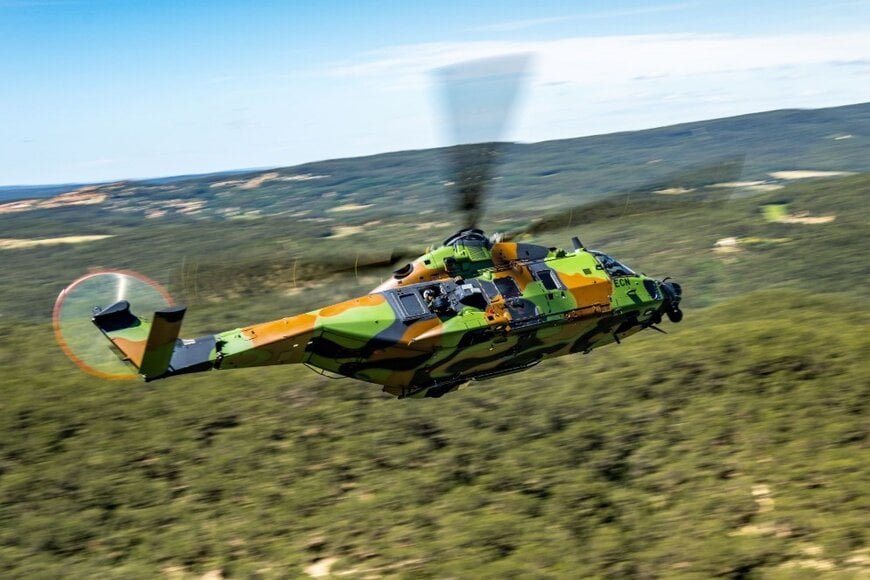
Airbus Helicopters and Leonardo have initiated the second development phase of the European Next Generation Rotorcraft (ENGRT II) project, coordinating a 53-member consortium across 12 European Union member states. The defense initiative establishes system-level specifications for future military rotorcraft capable of multi-domain operations and tactical flight in contested environments.
Operational Requirements and Consortial Roles
Modern combat theaters require vertical lift platforms engineered for low-altitude survivability, reduced pilot workload, and contested-logistics resilience. Tactical flight profiles specify night maneuvers at 30 feet above ground level at airspeeds of 130 knots under single-pilot conditions. To address these operational constraints, the industrial consortium is structured around cross-border co-leadership:
- Airbus Helicopters: Project coordinator directing system integration, digital test environments, and airframe architecture.
- Leonardo: Co-lead managing mission avionics integration, sensor fusion suites, and collaborative subsystem engineering.
- Specialized Consortium Partners: Industrial suppliers and research entities delivering electronic warfare, self-protection suites, and uncrewed interfaces.
Modular Avionics and Digital Infrastructure
The technical foundation of the ENGRT II architecture relies on open system architecture (OSA). Deploying modular digital systems standardizes data communication buses and decouples hardware lifecycles from software refresh cycles. This architecture enables continuous software upgrades, rapid reconfiguration of mission equipment, and direct communication across satellite, ground, and airborne networks.
Advanced mission avionics automate complex processing tasks, allowing the pilot to transition from flight management to mission execution. The architecture directly integrates crewed-uncrewed teaming (MUM-T) protocols, enabling a single helicopter to supervise and direct swarms of uncrewed aerial systems for forward reconnaissance and electronic attack.
Development Phases and Test Integration
Phase I established technology readiness levels (TRL) for candidate rotorcraft technologies, completing initial feasibility baselines. Phase II marks the transition from basic research to applied research and development.
Engineering teams are constructing a dedicated open system architecture hardware-in-the-loop test bench. This facility validates interoperability among distributed sensors, mission computers, and data links before physical airframe installation, ensuring technical standard compliance across all consortium modules.
Logistical Metrics and Operational Impact
A primary metric for the platform is an operational maintenance reduction:
"Our objective is to reduce the maintenance burden for this next-generation machine by 50% compared to existing machines, and really maintain it with standard tools and as small a logistical footprint as possible," explains Ralf Weber, Campaign Manager at Airbus Helicopters.
Standardizing ground tooling and maximizing component access reduces forward operating base logistical requirements by half compared to legacy platforms. By combining reduced maintenance cycles with open system architecture and multi-drone command networks, the ENGRT platform provides European armed forces with interoperable digital infrastructure designed for persistent availability in contested multi-domain operations.
Edited by Evgeny Churilov, Induportals Media - Adapted by AI.
www.airbus.com
