
www.aero-defence.tech
17
'26
Written on Modified on
Integrating Acoustic and Seismic Sensors with Multi-Domain Software Platforms
HENSOLDT and Project Q signed a memorandum of understanding to combine edge computing and sensor systems for defense and critical infrastructure applications.
www.hensoldt.net
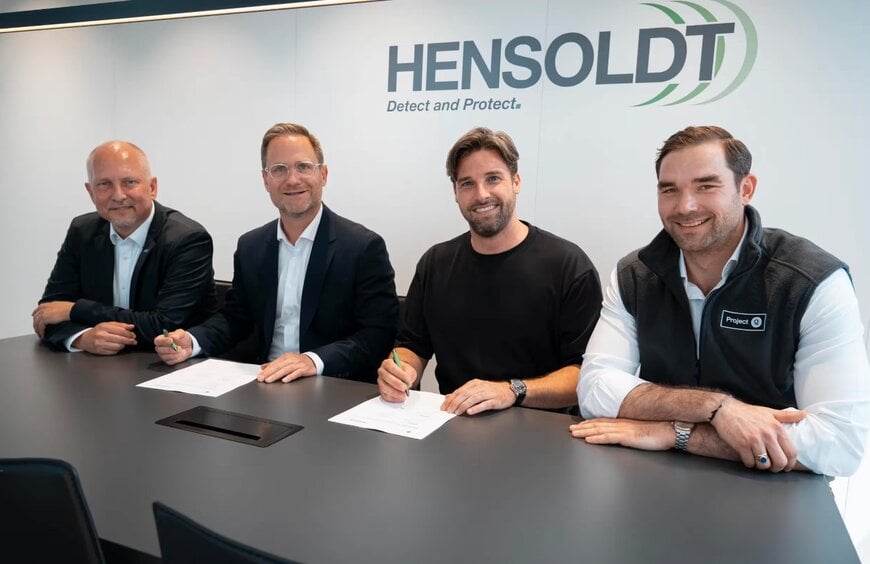
HENSOLDT and Project Q entered into a Memorandum of Understanding at the Eurosatory trade show on June 17, 2024, in Paris, France. The collaboration addresses the challenge of integrating heterogeneous sensors, commercial off-the-shelf components, and legacy installations into a unified digital infrastructure. By combining complementary portfolios, the companies aim to develop architecture capable of distributed, multi-domain operations at the tactical edge.
Architecture and Technical Responsibilities
The integrated technical solution leverages both software platforms and field hardware. Project Q utilizes HYDRIS, an open-core orchestration system designed to process data streams via open standards. This software tier operates alongside the Q-Box, an industrial hardware unit designed for edge computing and wireless mesh networking.
HENSOLDT integrates its existing sensor-proximate artificial intelligence algorithms, edge technologies, and MDOcore software layer, which serves as the central integration platform.
The responsibilities are partitioned as follows:
- HENSOLDT: Supplies primary sensor technology, tactical edge processing hardware, and core multi-domain integration software.
- Project Q: Manages the orchestration software abstraction layer, deployment of mesh network nodes, and high-volume tactical sensor development.
Sensor Integration and Operational Function
A major technical focus of the partnership involves the co-development of acoustic and seismic ground sensors. These arrays are manufactured as modular mission kits designed to operate on a decentralized plug-and-fight principle. The physical hardware consists of localized ground nodes that detect vibrational and acoustic signatures generated by heavy vehicles, personnel, and low-altitude unmanned aerial vehicles.
Data captured by these field sensors is processed locally at the edge node using AI-supported algorithms to reduce bandwidth requirements before transmitting targeted alerts through the mesh network. This decentralized processing model provides high systemic resilience and operational sovereignty, ensuring the system functions even if primary network uplinks are disrupted.
Deployment Sectors and Systems Impact
The technology targets two primary operational fields: the defense sector for tactical field intelligence and civil security operations protecting critical industrial infrastructure or restricted properties.
Sven Heursch, Chief Digital Officer at HENSOLDT, stated: "With HYDRIS, Project Q addresses a capability that is becoming increasingly crucial for modern defence architectures: the seamless orchestration of heterogeneous systems at the tactical level in real time. Together with Project Q, we aim to integrate this strength into our multi-domain architecture whilst simultaneously tapping into new capabilities in the field of acoustic and seismic sensor technology. This would allow us to expand our portfolio with cost-effective sensors available in high volumes."
Leonard Wessendorf, CEO of Project Q, confirmed that the platform retains a vendor-neutral stance, allowing the open architecture to interface with third-party hardware components alongside HENSOLDT systems.
Edited by Evgeny Churilov, Induportals Media - Adapted by AI.
www.hensoldt.net
A major technical focus of the partnership involves the co-development of acoustic and seismic ground sensors. These arrays are manufactured as modular mission kits designed to operate on a decentralized plug-and-fight principle. The physical hardware consists of localized ground nodes that detect vibrational and acoustic signatures generated by heavy vehicles, personnel, and low-altitude unmanned aerial vehicles.
Data captured by these field sensors is processed locally at the edge node using AI-supported algorithms to reduce bandwidth requirements before transmitting targeted alerts through the mesh network. This decentralized processing model provides high systemic resilience and operational sovereignty, ensuring the system functions even if primary network uplinks are disrupted.
Deployment Sectors and Systems Impact
The technology targets two primary operational fields: the defense sector for tactical field intelligence and civil security operations protecting critical industrial infrastructure or restricted properties.
Sven Heursch, Chief Digital Officer at HENSOLDT, stated: "With HYDRIS, Project Q addresses a capability that is becoming increasingly crucial for modern defence architectures: the seamless orchestration of heterogeneous systems at the tactical level in real time. Together with Project Q, we aim to integrate this strength into our multi-domain architecture whilst simultaneously tapping into new capabilities in the field of acoustic and seismic sensor technology. This would allow us to expand our portfolio with cost-effective sensors available in high volumes."
Leonard Wessendorf, CEO of Project Q, confirmed that the platform retains a vendor-neutral stance, allowing the open architecture to interface with third-party hardware components alongside HENSOLDT systems.
Edited by Evgeny Churilov, Induportals Media - Adapted by AI.
www.hensoldt.net
