
www.aero-defence.tech
18
'26
Written on Modified on
HENSOLDT Unveils SkyBarrier Mobile Navigation Signal Jammer
New system disrupts GPS, Galileo, GLONASS and BeiDou signals while enabling rapid deployment and future upgrades.
www.hensoldt.net
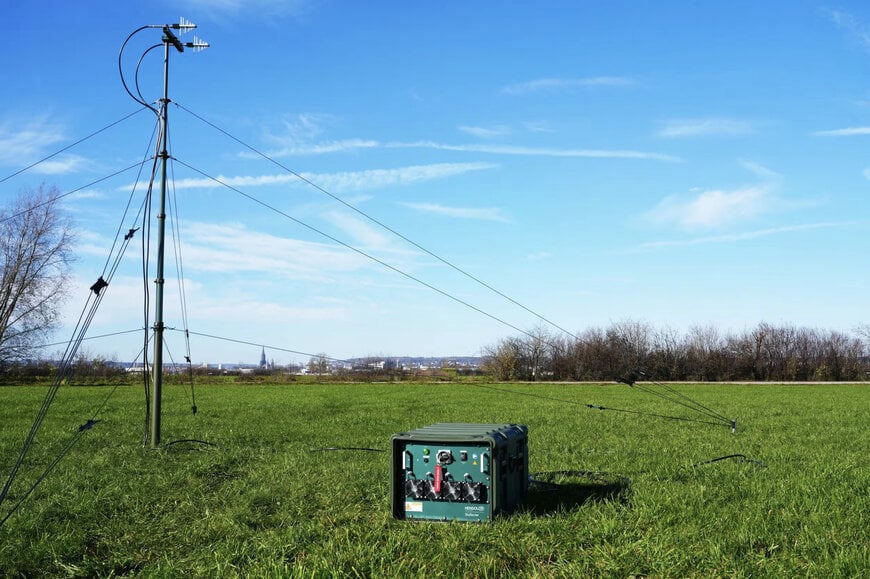
HENSOLDT has unveiled its SkyBarrier mobile broadband jamming system, an electronic countermeasure designed to disrupt satellite-based navigation signals for military forces and government security agencies. Operating as a tactical defensive asset, the system shields personnel and strategic land-based infrastructure from threats utilizing enemy position, navigation, and timing data. The technology addresses operational vulnerabilities by denying access to multiple global navigation satellite networks simultaneously within the active defensive perimeter.
Multi-Band Signal Disruption Across Global Constellations
Modern defensive perimeters require electronic warfare systems capable of neutralizing multi-constellation guidance mechanisms. The SkyBarrier platform provides localized denial of service across all globally deployed satellite navigation frameworks. This broad-spectrum capability encompasses the United States Global Positioning System (GPS), the Russian GLONASS network, the European Galileo system, and the Chinese BeiDou constellation.
The transmission architecture suppresses both public civil bands and restricted military signals. By generating localized broadband electromagnetic interference, the system masks the weak orbital transmissions from satellite constellations, rendering encrypted and unencrypted frequency variants unreadable to recipient devices. This simultaneous deployment across multiple frequency bands prevents localized positioning, navigation, and timing systems from establishing a reliable carrier-to-noise ratio.
Rapid Deployment Mechanics and Hardware Architecture
Field deployment constraints demand electronic countermeasure equipment that minimizes setup latency and operational complexity. The physical configuration of the system allows a deployment team of two personnel to complete mechanical assembly, including telescopic mast erection and line cabling, within a few minutes.
The control interface omits software-defined configuration menus, utilizing a single physical mechanical switch on the front panel for immediate system activation. This hardware design eliminates boot-up delays and reduces training overhead for operators under tactical conditions. The complete physical footprint is constrained to a single portable electronic enclosure, a collapsible vertical mast, and localized connection accessories, allowing transport in standard utility vehicles.
Component Adaptability and Physical Security Interfaces
To accommodate changing signal environments in the digital supply chain, the hardware uses a modular upgrade path. The internal architecture allows engineers to swap individual RF components to counter new signal waveforms or altered frequency allocations without requiring the wholesale replacement of the core electronic enclosure.
Data security is maintained through strict physical isolation. The electronic assembly features only three physical interfaces, completely eliminating external network communication paths or wireless data links. This air-gapped configuration protects the internal firmware from external data exploitation, unauthorized monitoring, or cyber-focused signal injection attacks.
Additional Context:
This section details technical specifications and competitive benchmarking not included in the original product announcement
The system operates in a competitive segment alongside established tactical counter-unmanned aerial vehicle and electronic warfare systems, such as the man-portable variants within the HENSOLDT GMJ9500 family and comparable multi-band vehicular jammers. While broad-spectrum communications jammers typically sweep expansive ranges from 20 MHz to 6,000 MHz to counter remote-controlled improvised explosive devices, specialized satellite navigation jammers target concentrated allocations within the L-band spectrum.
A key structural differentiator between SkyBarrier and software-defined architectures lies in the processing control layer. Many contemporary electronic warfare systems rely on ruggedized laptops or digital tablets running Android-based control software to adjust emission sectors and waveform parameters. SkyBarrier relies entirely on fixed analog-to-digital hardware paths activated by mechanical switching, trading dynamic sector customization for instantaneous power output and vulnerability reduction against cyber exploitation. Additionally, the integration of flat-field power distribution allows uniform signal density across targeted horizons, matching or exceeding the standard continuous wave emission requirements utilized by traditional electronic countermeasure assets.
Edited by Natania Lyngdoh, Induportals editor, assisted by AI.
www.hensoldt.com
