
www.aero-defence.tech
22
'26
Written on Modified on
ComAp Expands Marine Electric Propulsion Control
ComAp introduces Electric Propulsion Control System for marine vessels, providing a pre-engineered control solution for electric and hybrid-electric propulsion systems.
www.comap-control.com
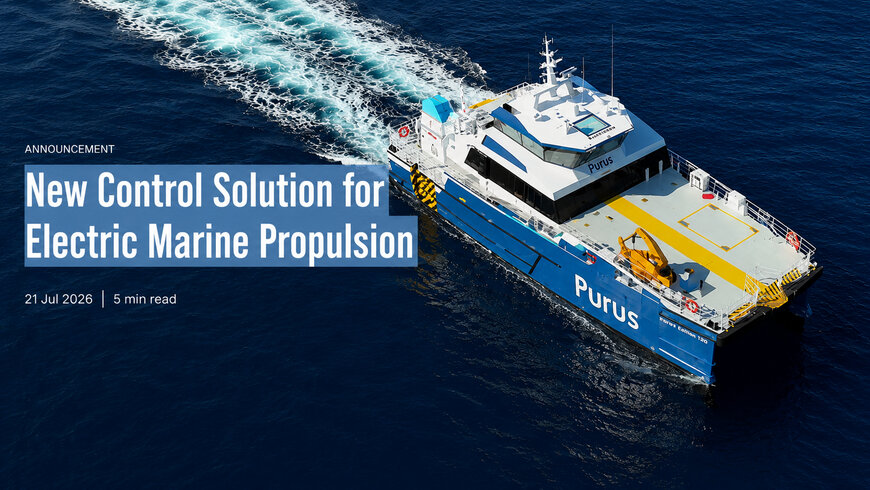
As electric and hybrid-electric propulsion gains momentum across commercial marine applications, automation requirements are becoming increasingly complex. ComAp has expanded its marine automation portfolio with the Electric Propulsion Control System (PCS), a new application for the InteliMains 1010 Marine controller that delivers embedded propulsion control for variable frequency drives (VFDs). The solution is designed to simplify propulsion system integration while reducing engineering effort for shipbuilders and marine system integrators.
Embedded propulsion control for electric marine systems
Electric PCS operates on ComAp's existing InteliMains 1010 Marine hardware, allowing users to combine propulsion control and power management within a single controller platform. Instead of developing custom programmable logic controller (PLC) software for each project, system integrators can deploy a pre-engineered application with built-in propulsion functions.
The system supports both AC-bus and DC-bus electrical architectures commonly used in modern electric and hybrid-electric vessels. This enables deployment across a wide range of applications, including ferries, tugboats, offshore support vessels, workboats, and battery-hybrid or diesel-electric ships.
Preconfigured functions reduce engineering complexity
Electric PCS incorporates several integrated propulsion control functions that eliminate the need for extensive custom software development.
The controller supports both speed and torque referencing, allowing compatibility with variable frequency drives that either regulate speed internally or require the controller to manage the speed control loop.
Automated start and stop sequencing manages the complete VFD state-machine process, including breaker control and DC-link or bus pre-charge operations. These functions help standardize propulsion commissioning while reducing manual configuration requirements.
Integrated power management protects onboard electrical systems
A key feature of Electric PCS is its native integration with ComAp's marine power management system. The controller continuously evaluates available generating capacity and automatically limits propulsion speed references when required to prevent generator overloading.
Because propulsion motors often represent the largest electrical load onboard an electrically propelled vessel, coordinated management between propulsion control and power generation helps improve overall power system stability.
Marine operating modes and protection features
Electric PCS includes marine-specific operational modes and protection functions suitable for commercial vessel applications. These include Shutdown and Slow Stop sequences, together with Semi-automatic, Automatic, and Switchboard operating modes that support both local and automated vessel operation.
Additional functionality includes Troll mode for fine manoeuvring, four-stage Power Limitation, and Power Derating capabilities to support different operating conditions.
Completing ComAp's marine propulsion portfolio
The new Electric Propulsion Control System complements ComAp's existing InteliDrive 700 Marine solution, which supervises propulsion systems powered by high-speed and medium-speed combustion engines, including both conventional mechanical engines and electronically controlled engine platforms.
Together, the two product families enable ComAp to support a broad range of propulsion architectures, from conventional diesel-mechanical shaft systems to fully electric propulsion systems driven by variable frequency drives.
Benefits for shipbuilders and marine integrators
By providing a pre-engineered propulsion control application, Electric PCS enables marine system integrators to configure propulsion functions rather than develop custom PLC software. This can reduce engineering effort, shorten commissioning schedules, simplify maintenance, and lower project implementation risk.
Integration with the vessel's power management system also enables coordinated control of propulsion alongside other major electrical loads, supporting more efficient onboard energy management.
Electric PCS is available with InteliMains 1010 Marine firmware version 1.8.0 and can be activated using a software license key.
Additional Context:This section details technical specifications and competitive benchmarking not included in the original product announcement
The marine industry is experiencing rapid adoption of electric and hybrid-electric propulsion, particularly in ferries, offshore support vessels, harbour tugs, research vessels, and workboats, driven by stricter emissions regulations and fuel-efficiency targets. Most electric propulsion systems rely on variable frequency drives to control propulsion motors, making integrated automation and power management increasingly important.
Competing marine automation suppliers such as ABB, Kongsberg Maritime, Wärtsilä, and Schneider Electric also provide integrated propulsion and power management platforms. ComAp differentiates its approach by offering propulsion control as an embedded application running on the same InteliMains 1010 Marine controller already used for onboard power management, reducing the need for dedicated PLC-based propulsion control systems.
Edited by Sucithra Mani, Induportals editor – adapted by AI.
www.comap-control.com
