
www.aero-defence.tech
04
'26
Written on Modified on
140-Metre Frigate Integrates Air, Missile and Submarine Defence
Rheinmetall has developed a 6,000-plus-tonne guided-missile frigate combining integrated missile defence, anti-submarine warfare and long-range strike capabilities for NATO and allied navies.
www.rheinmetall.com
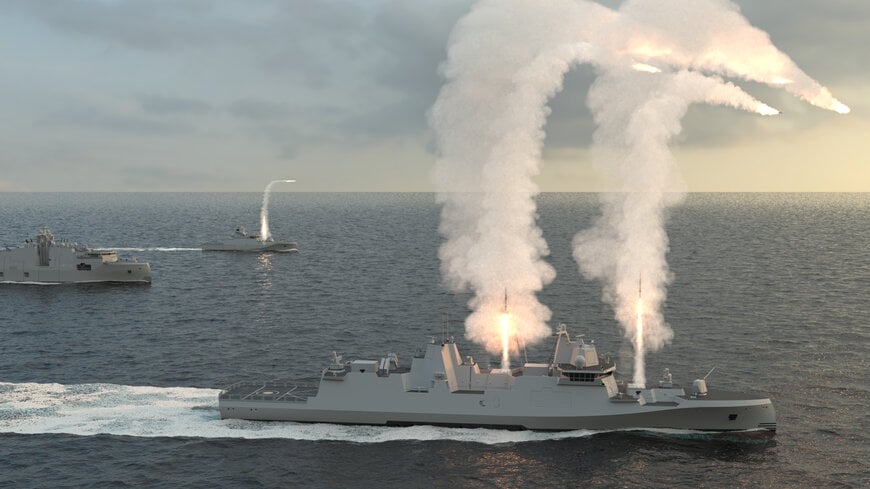
Rheinmetall has introduced the GMF140, a 140-metre guided-missile frigate designed as a multi-mission surface combatant for blue-water, expeditionary, littoral and coalition operations. The design combines air and ballistic missile defence, anti-submarine warfare and long-range strike functions within a digitally integrated platform intended for reduced crewing.
The company is targeting international naval procurement programmes and plans to offer the design initially for a campaign in North America. The platform is aimed at NATO and allied fleets modernising surface combatant capabilities across Europe, the North Atlantic and Indo-Pacific regions.
Integrated Air and Ballistic Missile Defence
The frigate is designed to integrate US-sourced primary radar options for detecting and tracking conventional airborne targets, ballistic missiles and hypersonic threats. Radar configuration can be adapted according to customer requirements, including configurations supporting ballistic missile defence tracking.
Sensor and weapon functions are centred on the AEGIS Combat System. AEGIS integrates sensors, command-and-control functions and weapons within a common combat architecture, allowing detection, tracking and engagement processes to be coordinated across integrated air and missile defence missions.
The ship is designed around 64 strike-length Vertical Launch System (VLS) cells. Strike-length launchers provide the physical volume required for larger missile classes used for missions including long-range strike and sea-based ballistic missile defence.
The planned missile compatibility covers air-defence, ballistic-missile-defence and land-attack weapons, although the specific missile load would depend on the combat-system configuration selected by the customer.
Open Combat Management Architecture
Rheinmetall also proposes integration of the Lockheed Martin CMS 330 Combat Management System where required. CMS 330 was originally developed for the Royal Canadian Navy and uses an open architecture to integrate ship sensors, information systems and effectors.
For the GMF140, this architecture is intended to support integration of European sensors and weapon systems alongside US-origin combat-system components. Such an approach is relevant for NATO fleets operating equipment from multiple suppliers because the combat management layer must exchange targeting, sensor and weapon-control information between otherwise separate subsystems.
Open architecture also provides a pathway for introducing additional sensors, effectors and software capabilities during the ship's service life without requiring replacement of the complete combat-system architecture.
Anti-Submarine Warfare and Acoustic Management
Anti-submarine warfare (ASW) forms another primary mission area. The ship incorporates a low-signature hull, integrated acoustic management and both hull-mounted and towed sonar systems.
Combining hull-mounted and towed sensors provides different mechanisms for underwater detection. Hull-mounted sonar supports detection around the vessel, while a towed sonar can operate away from noise generated by the ship and can be positioned at different depths according to acoustic conditions.
The aviation facilities are intended to support US or European maritime helicopters as well as unmanned systems. Embarked aircraft can extend submarine-search and surveillance coverage beyond the detection range of the ship's own sensors.
Multi-Mission Weapon Configuration
Beyond its 64 VLS cells, the proposed weapon and sensor configuration supports anti-ship missiles, torpedo launchers and a 5-inch main gun. Secondary armament, close-in weapon systems (CIWS), electro-optical sensors, electronic warfare equipment and decoy systems can also be integrated.
The design additionally provides for laser-based systems. Rheinmetall has not specified the power level, engagement range or configuration of a directed-energy weapon for the platform, so its operational role would depend on the system ultimately selected.
This combination allows the frigate to be configured for anti-air warfare (AAW), ballistic missile defence (BMD), anti-submarine warfare (ASW), surface warfare and long-range strike rather than being optimised around a single mission.
Survivability and Future System Growth
The ship has an approximate displacement exceeding 6,000 tonnes and a length of 140 metres. Its design philosophy emphasises survivability, NATO interoperability and capacity for future system growth.
Digital integration and reduced crewing are also central design objectives. Rheinmetall describes the vessel as a minimum-manned platform, although it has not published a planned crew complement. Consequently, a quantitative comparison of personnel requirements with existing frigates cannot yet be made.
The design is intended primarily for sustained blue-water operations while retaining the ability to participate in littoral, expeditionary and multinational missions. This gives potential operators a common platform for air defence, submarine detection, surface warfare and land-attack missions.
Additional Context:
This section details technical specifications and competitive benchmarking not included in the original product announcement
The GMF140 occupies the upper end of the contemporary frigate displacement range and is comparable in physical size to several European multi-mission surface combatants.
Italian FREMM frigates built by Fincantieri are approximately 144 metres long and displace about 6,700 tonnes at full load. They are configured for multi-mission operations, with variants specialising in general-purpose and anti-submarine warfare roles. This places the GMF140's announced 140-metre length and 6,000-plus-tonne displacement in a broadly similar hull-size category.
The Dutch-Belgian Anti-Submarine Warfare Frigate under development with Damen is also similar in physical scale, measuring approximately 145 metres with a displacement of about 6,400 tonnes. Its design places stronger emphasis on underwater warfare and includes an Under Water Warfare Suite, underwater decoys, Mk54 torpedoes and provisions for unmanned air and maritime systems.
A smaller comparison is Naval Group's FDI frigate, which measures approximately 122 metres and displaces around 4,500 tonnes. The Hellenic Navy configuration carries 32 Aster surface-to-air missiles as well as eight Exocet MM40 Block 3C anti-ship missiles, RAM missiles, MU90 torpedoes and a 76 mm gun.
Against these examples, the most notable published characteristic of the GMF140 is its 64 strike-length VLS cells. The Mk 41 VLS architecture, for example, uses eight-cell modules and its strike-length configuration is approximately 7.6 metres long. Existing integrated weapons include ESSM, Tomahawk, SM-2, SM-3, SM-6 and Vertical Launch ASROC, although actual missile availability on any GMF140 configuration would depend on procurement approval, combat-system integration and national export requirements.
AEGIS provides an established architecture for integrated air and missile defence by connecting sensors, command-and-control functions and interceptors. Its ballistic missile defence architecture combines sensors, interceptors and command-and-control capabilities. This makes the proposed combination of AEGIS, a ballistic-missile-capable radar and strike-length VLS a technically significant part of the GMF140 concept, particularly for navies seeking missile-defence capability from a frigate-sized hull.
Edited by Sucithra Mani, Induportals editor – adapted by AI.
www.rheinmetall.com
