
www.aero-defence.tech
13
'26
Written on Modified on
Lockheed Martin Demonstrates AI-Enabled NetSense Airspace Awareness System
In collaboration with Verizon, Keysight, ODC and Astris AI, Lockheed Martin demonstrates technology for public airspace protection with NVIDIA technology.
www.lockheedmartin.com
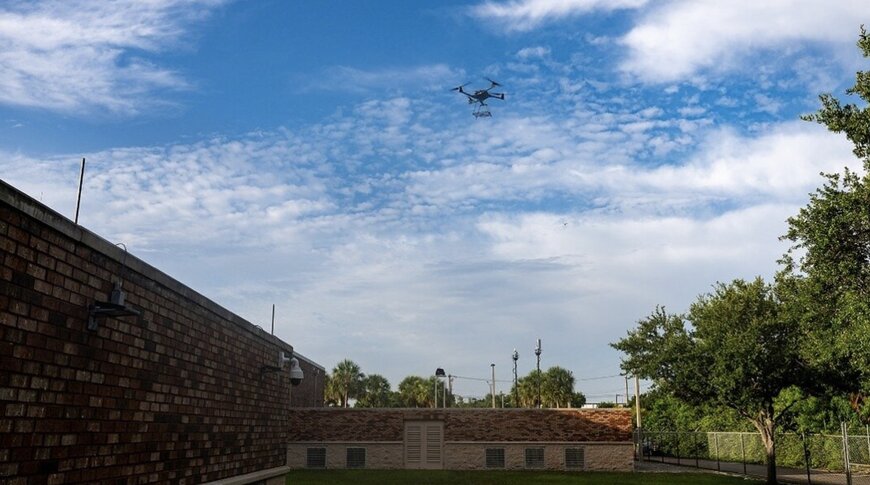
Lockheed Martin, alongside industry partners including Verizon, NVIDIA, Keysight Technologies, ODC, and Astris AI, has demonstrated the NetSense Airspace Awareness-as-a-Service platform for tracking unmanned aircraft systems using existing 5G infrastructure.
Lockheed Martin and its technology partners completed a field demonstration of NetSense Airspace Awareness-as-a-Service in July 2026 in the Miami area. The platform uses commercial off-the-shelf hardware and artificial intelligence to identify, track, and monitor unmanned aircraft systems (UAS) across urban environments without requiring dedicated modifications to cellular network deployments.
Urban 5G Sensing Demonstration
During the trial, the NetSense solution operated over Verizon's commercial 5G spectrum, incorporating ODC's AI-native Radio Access Network (RAN) software, NVIDIA's AI Aerial platform, and Keysight's radio frequency (RF) simulation tools. The integrated architecture detected drone presence by monitoring ambient RF disturbances, maintaining target tracking across the flight path, and issuing real-time alerts.
The software-based approach enables sensing capabilities over operational cellular infrastructure prior to the standard availability of 6G Integrated Sensing and Communication (ISAC) frameworks. System algorithms are designed to operate concurrently with future 6G ISAC protocols.
System Architecture and Open Standards
NetSense links Lockheed Martin's detection and tracking software with NVIDIA AI Aerial signal processing algorithms. The platform relies on open architecture standards, enabling the integration of third-party interceptors and sensory inputs without requiring hardware overhauls.
Deployment scale ranges from stationary single-site coverage to mobile command-and-control operational units. The technology targets applications across critical infrastructure, utility plants, public event venues, transportation hubs, educational facilities, and government installations.
Operational Deployment Timeline
The NetSense architecture will be commercialized under a subscription model designed to interface with existing security operation centers. Pilot deployments are scheduled for the second half of 2026 through early 2027 for select enterprise and government clients, with general commercial release slated for 2027.
Additional Context
This section details technical specifications not included in the original news release.
The NetSense architecture utilizes passive RF sensing methods, analyzing physical-layer signal reflections and micro-Doppler variations imposed on ambient 5G New Radio (NR) sub-6 GHz and mmWave carrier frequencies. By deploying software-defined network (SDN) hooks within the Open RAN (O-RAN) infrastructure, the system extracts channel state information (CSI) and received signal strength indicators (RSSI) directly from baseband processing units. NVIDIA AI Aerial software processes these high-throughput IQ data streams on GPU-accelerated edge nodes using deep neural networks trained to distinguish small-radar-cross-section (RCS) objects—such as micro and mini UAS—from background clutter like birds or atmospheric noise.
The open architecture aligns with standard C4ISR (Command, Control, Communications, Computers, Intelligence, Surveillance, and Reconnaissance) data exchange protocols, including Cursor-on-Target (CoT) and STANAG 4586 formats, facilitating direct feed ingestion into existing physical security information management (PSIM) platforms.
Edited by Romila DSilva, Induportals Editor, with AI assistance.
www.lockheedmartin.com
