
www.aero-defence.tech
18
'26
Written on Modified on
Thales unveils AI-powered sovereign command and control
Built on an open, interoperable architecture co-designed with armed forces, HexaForce was successfully tested during NATO CWIX 2026.
www.thalesgroup.com
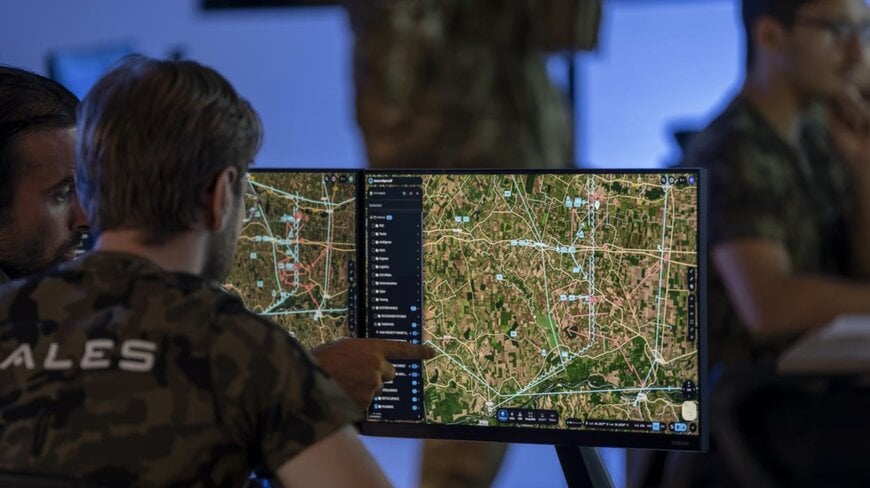
Thales has announced the commercial launch of HexaForce, an AI-enhanced multi-domain command and control (C2) software platform designed to manage the high volume of operational battlefield data and accelerate command tempo. Purpose-built to maintain national digital sovereignty, the distributed platform coordinates disparate defense systems across armed services and multinational coalition alliances, synchronizing operations across land, maritime, air, space, cyber, electromagnetic spectrum, and cognitive information environments.
cortAIx Integration and Agentic AI Architecture
HexaForce incorporates advanced artificial intelligence developed through cortAIx, Thales’ internal AI development accelerator uniting 800 engineers and data science specialists. Integrating large language models (LLMs) alongside autonomous agentic AI pipelines, the platform shortens joint operational planning cycles, automates multi-source target prioritization, and optimizes field maintenance and effector allocation.
Automated correlation and analysis engines ingest multi-spectral streams spanning military intelligence feeds, commercial remote sensing, and open-source data. Operational software maturity draws upon frontline field data from the Artemis.IA big-data platform deployed with the French Ministry of Armed Forces since 2023. Current live operational trials are targeting a tenfold expansion in daily target processing throughput, scaling baseline target classification capacity from 100 to 1,000 targets per day.
Hierarchical Integration and Disconnected Battle Management
Connecting command echelons from strategic headquarters down to frontline tactical units, HexaForce utilizes a distributed data backbone engineered to maintain data synchronization across contested, communications-denied environments. Localized nodes preserve autonomous tactical execution even when long-range wide-area network links are disrupted by adversary electronic attack.
Interoperability Standards and Data-Centric Security
Platform software combines a modular core infrastructure with interchangeable domain-specific mission applications. Built upon open architecture frameworks, HexaForce completed coalition verification testing during the NATO CWIX 2026 exercise, validating vendor-agnostic integration with existing allied legacy systems.
The system implements Data-Centric Security (DCS) protocols and complies with Federated Mission Networking (FMN) standards, permitting sovereign defense agencies to set granular security governance over outgoing data without exposing classified raw intelligence. Development followed agile design cycles executed directly with military end-users to iteratively integrate evolving tactical requirements.
Additional Context
This section details technical specifications not included in the original news release.
Multi-Domain Operations (MDO) command frameworks rely heavily on Zero Trust Architecture (ZTA) and Data-Centric Security (DCS) to manage cross-domain security boundaries between allied nations. In DCS implementations compliant with NATO STANAG 4774 (Confidentiality Metadata Label Syntax) and STANAG 4778 (Metadata Binding Mechanism), cryptographic labels are bound directly to individual data payloads at ingest, enforcing Attribute-Based Access Control (ABAC) policies across distributed military clouds regardless of network path routing. Agentic artificial intelligence pipelines operating within C2 environments utilize retrieval-augmented generation (RAG) coupled to high-performance vector databases to parse unstructured military message formats—such as NATO STANAG 5516 (Link 16), STANAG 5522 (Link 22), and United States Message Text Format (USMTF)—into structured Common Operational Pictures (COP). To support edge tactical resiliency during electronic warfare and communications-denied intervals (DDIL environments: Disconnected, Degraded, Intermittent, Limited-Bandwidth), distributed multi-master databases use Conflict-free Replicated Data Types (CRDTs) to reconcile split-brain data states across deployed vehicle computers and tactical command posts upon datalink reconnection.
Edited by Romila DSilva, Induportals Editor, with AI assistance.
www.thalesgroup.com
