
www.aero-defence.tech
22
'26
Written on Modified on
Networked Command Architecture for Unmanned Maritime Systems
Rheinmetall demonstrates an open integration middleware designed to synchronize multidimensional underwater and surface sensors for port security and coastal defense operations.
www.rheinmetall.com
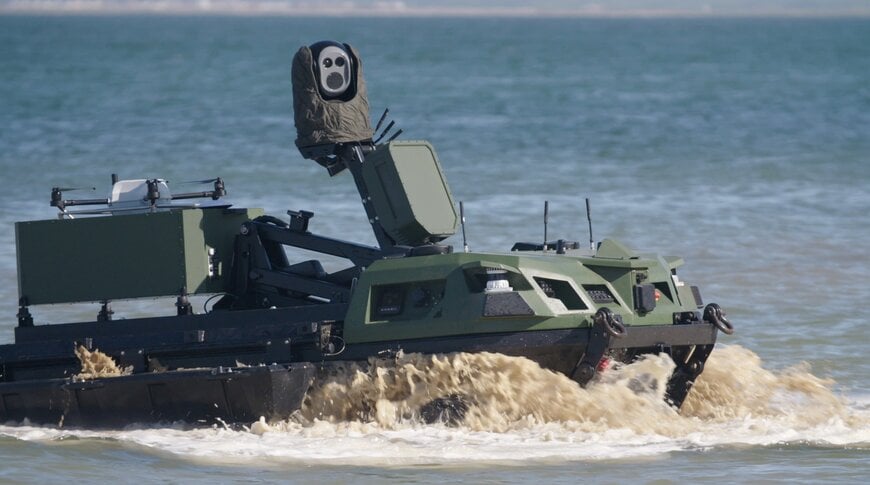
Rheinmetall is deploying its Battlesuite software within a containerized mobile command center to integrate diverse maritime unmanned platforms at the REPMUS26 proving exercise. This modular architecture provides naval forces and coastal authorities with a centralized operational network to manage underwater, surface, and aerial sensor data across a unified maritime data ecosystem.
Open Architecture for Sensor Interoperability
The technological foundation of this integration relies on the Rheinmetall Battlesuite, which operates using Tactical Core Middleware developed by blackned GmbH. This architecture functions as a hardware-agnostic platform, enabling the application-specific integration of sensors, effectors, and mission modules from various third-party manufacturers. By bypassing proprietary data silos, the system synthesizes incoming intelligence from across the multidimensional maritime systems landscape into a single operational picture, which allows human operators to evaluate threats and initiate graded, precise tactical responses.
Multidimensional Port Security Applications
The practical deployment of these interconnected systems is taking place at the REPMUS26 (Robotic Experimentation and Prototyping with Maritime Unmanned Systems) exercise on the Troia Peninsula and surrounding Portuguese waters from August 31 to September 25, 2026. The trial connects naval forces, research institutions, and industry to test autonomous platform behaviors in a realistic marine environment. The strategic focus of the system configuration is the protection of critical port infrastructure and coastal waters, which requires the continuous networking of platforms ranging from seabed sensors to space-based surveillance assets.
Consolidating Underwater Sensor Interfaces
A primary technical objective of the operational trials involves testing graded unmanned underwater sensors. The middleware allows operators to command multiple autonomous underwater vehicles and remote sensors of different classifications through a common user interface, establishing persistent subsurface monitoring. Gregor Mannherz, Head of the Rheinmetall Delegation, stated that collaborating directly with naval operators during these realistic scenarios allows engineers to validate collaborative operational concepts and efficiently refine system architectures based on strict tactical requirements.
Additional Context
This section details technical specifications and competitive benchmarking not included in the original news release.
In the domain of maritime unmanned systems integration, command and control middleware is benchmarked by its capacity to achieve multi-domain interoperability without hardware lock-in. Technologies comparable to the Rheinmetall Battlesuite include Kongsberg’s Vanguard architecture and L3Harris’s ASView control system, which also utilize open architectures to manage autonomous maritime vehicles. The accepted industry standard for such interoperability is compliance with NATO STANAG requirements, specifically those governing unmanned vehicle control interfaces and data exchange architectures. The measurable advantage of hardware-agnostic middleware lies in its ability to bridge high-latency acoustic underwater communications with high-bandwidth surface radio frequency networks, allowing disparate legacy sensors and modern autonomous drones to populate a shared operational interface without signal fragmentation.
Edited by Aishwarya Mambet, Induportals Editor, with AI assistance.
www.rheinmetall.com
