
www.aero-defence.tech
01
'26
Written on Modified on
Lunar Orbit AI Computing Payload Deployment
Firefly Aerospace and Starcloud deploy the SC-1L processor onboard the Elytra vehicle to solve lunar data transmission bottlenecks using orbital edge computing.
fireflyspace.com
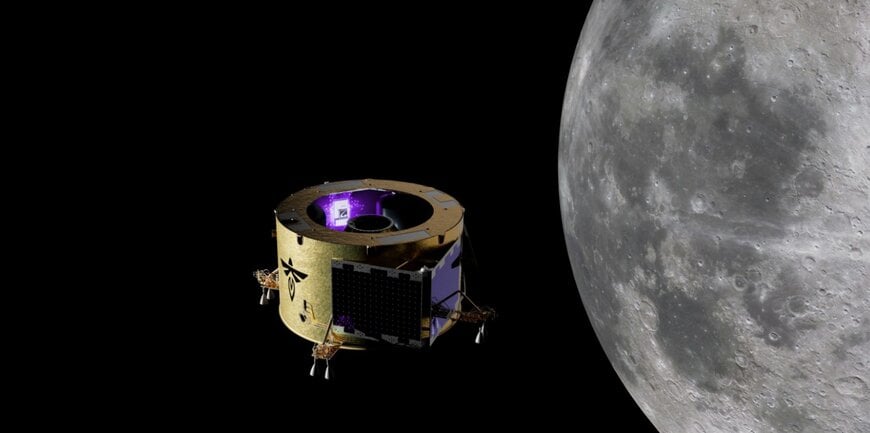
Firefly Aerospace and Starcloud have entered into a commercial payload agreement to deploy the SC-1L computing system in lunar orbit. The mission integrates high-performance computing hardware into an orbital space vehicle to process optical and navigational telemetry locally, mitigating data transmission bottlenecks between lunar space and ground stations.
Technical Challenge and System Integration
Operating remote imaging systems, autonomous guidance packages, and surface sensors around the Moon generates high volumes of raw visual and telemetry data. Downlinking unfiltered high-resolution data streams directly to Earth is constrained by deep-space radio-frequency bandwidth, transmission latency, and restricted ground-station contact windows.
To overcome these communications limits, orbital infrastructure requires edge-computing architectures capable of ingesting raw sensor streams, running local inference models, and transmitting compressed, actionable datasets back to Earth. Implementing this capability requires pairing space-qualified orbital vehicles with enterprise-grade compute platforms capable of managing sustained computational thermal dissipation and radiation in cislunar space.
Architecture and Partner Responsibilities
Under the agreement, Firefly Aerospace provides the host spacecraft platform and primary sensor inputs, while Starcloud delivers the orbital computing hardware.
Starcloud’s SC-1L processor will be physically integrated onboard Firefly’s Elytra orbital vehicle. The SC-1L payload is engineered to run high-throughput machine learning workloads, building on earlier demonstrations validating enterprise-grade GPU architectures in low Earth orbit.
Firefly’s Elytra vehicle hosts the Solux vision system (formerly Sol3) and high-resolution optical instruments for the Ocula lunar imaging service. The Solux system processes visual feature tracking to support autonomous navigation and orientation in GPS-denied lunar environments. In operation, Starcloud’s SC-1L processor directly ingests raw image feeds from the Solux hardware, executes AI models onboard the vehicle, and prepares processed telemetry for transmission.
Regarding the technical mechanics of the architecture, Ray Allensworth, Vice President of Spacecraft at Firefly Aerospace, stated: "By pairing Starcloud’s AI computing payload with our Elytra vehicle and Solux vision system, we’re demonstrating how data can be captured, processed, and delivered from lunar orbit, laying the groundwork for the computing infrastructure future lunar operations will depend on."
Ezra Feilden, Cofounder and CTO at Starcloud, noted: "We successfully validated our ability to run and train AI models on enterprise grade GPUs in low Earth orbit, and now we’re taking this proven technology to lunar orbit. Onboard Firefly’s Elytra vehicle, we’ll demonstrate high-power AI computing and further prove we can process massive volumes of data right where it’s generated..."
Deployment Schedule and Operational Parameters
The SC-1L payload is scheduled to launch as part of Firefly’s third lunar mission, planned for no earlier than 2028.
During the initial flight phase, the Elytra vehicle will serve as a transfer stage and communications relay for the Blue Ghost lander during operations at the Gruithuisen Domes under NASA’s Commercial Lunar Payload Services initiative. After lander deployment, Elytra enters an independent orbital operational phase designed to last up to five years, supporting multi-year customer payload testing, local AI model execution, and low-latency surface reconnaissance.
Edited by Evgeny Churilov, Induportals Media - Adapted by AI.
www.fireflyspace.com
