
www.aero-defence.tech
14
'26
Written on Modified on
Liquefied Hydrogen Loading Arm Commercial Marine Transfer
Kawasaki Heavy Industries and TB Global Technologies finalized a certified marine loading arm enabling high-volume cryogenic transfer between ship and shore.
www.kawasakirobotics.com
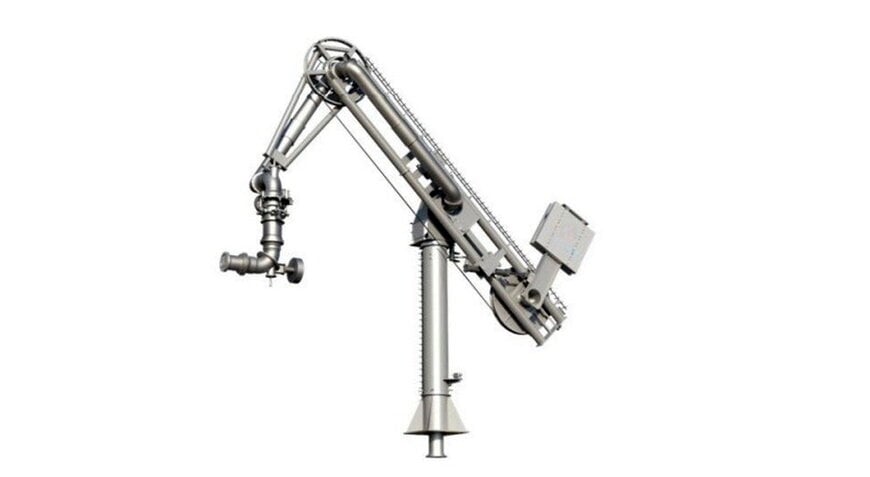
Large-scale maritime transport of cryogenic energy vectors requires infrastructure capable of safely handling bulk liquid transfer under extreme thermal and mechanical conditions. To establish a commercial liquefied hydrogen supply chain, Kawasaki Heavy Industries, Ltd. and TB Global Technologies Ltd. have finalized the development of a 6-inch marine loading arm engineered for ship-to-shore liquefied hydrogen transfer.
Engineering Challenges in Cryogenic Marine Fluid Transfer
Bulk maritime transfer of liquefied hydrogen presents distinct mechanical, thermal, and material engineering hurdles. Maintaining hydrogen in a liquid state requires an operating temperature of minus 253 degrees Celsius at atmospheric pressure. At this deep cryogenic threshold, structural metals risk embrittlement, seal materials can lose elasticity, and any thermal ingress leads to rapid boil-off gas generation.
Standard liquefied natural gas marine transfer infrastructure operates at minus 162 degrees Celsius, which is insufficient for the thermal tolerances demanded by liquid hydrogen. Furthermore, ship-to-shore fluid interfaces must simultaneously absorb dynamic vessel movements caused by tides, waves, and wind, while preserving absolute gas tightness to prevent hazardous leaks or air ingress that could form combustible mixtures.
Architecture and Mechanical Subsystems of the 6-Inch Transfer Arm
The commercial-specification equipment builds on a pilot unit originally fabricated in 2018, which completed ship-to-shore handling operations in 2022 at the Hy touch Kobe receiving terminal. The upgraded transfer system incorporates several redesigned sub-assemblies to satisfy ISO 24132 standards for marine transfer arms handling liquefied hydrogen.
Structural Geometry and Articulation
The redesigned arm assembly extends working reach, allowing terminal operators to service larger transport vessels with increased deck heights and broader drift envelopes. Articulation relies on specialized swivel joints featuring an upgraded seal design and a revised seal gas purging system. This architecture lowers consumption of purge helium gas while preserving the continuous internal joint pressure required for dynamic sealing integrity.
Safety and Emergency Separation Systems
Cryogenic loading lines incorporate an emergency release system designed to instantly decouple the vessel during off-spec drift or terminal emergencies without rupturing piping. The commercial unit replaces hydraulic drip pan actuators with a passive gravity-drop collection mechanism for liquid oxygen condensate that forms on ultra-cold surfaces. In addition, the emergency clamp assembly uses a simplified mechanical configuration that improves long-term maintainability and release reliability.
Terminal Coupling Interface
The ship-to-shore coupler utilizes a non-insertion flange-type connection. Eliminating insertion guides reduces physical weight, minimizes the footprint on ship manifolds, and reduces the manual labor required during hookup. The coupler meets technical certification standards set by classification society ClassNK.
Terminal Integration and Commercial Demonstration
The equipment completed cryogenic verification testing between August 2025 and July 2026 using liquid hydrogen at the JAXA Noshiro Rocket Testing Center, confirming operational behavior during full-flow cryogenic cycles.
Following this testing, three units will be deployed at the Kawasaki LH2 Terminal, which Japan Suiso Energy, Ltd. is constructing on Ogishima in Kawasaki City, Kanagawa Prefecture. The terminal forms part of the New Energy and Industrial Technology Development Organization Green Innovation Fund project aimed at establishing large-scale liquefied hydrogen supply chains. Operating at the Kawasaki terminal, the arms will manage commercial-scale transfer for a 40,000-cubic-meter liquefied hydrogen carrier.
Additional Context
This section details technical specifications and competitive benchmarking not included in the original product announcement.
Marine liquid hydrogen logistics marks a transition from pilot-scale international shipping—demonstrated by the 1,250-cubic-meter Suiso Frontier carrier—to commercial scale. In standard LNG transfer, flexible cryogenic hoses or 16-to-20-inch rigid loading arms handle fluid transfer at minus 162 degrees Celsius. By contrast, 6-inch rigid vacuum-insulated transfer arms are currently the emerging benchmark for liquid hydrogen due to the severe insulating constraints of minus 253 degrees Celsius service, where vacuum jacket thickness and structural heat bridges strictly dictate line diameter.
Vacuum-insulated piping and rigid swivel configurations remain the preferred technical approach over flexible composite hoses for commercial marine liquid hydrogen bunkering and transfer. Rigid arms eliminate cyclic fatigue across composite layers, reduce the risk of micro-fracturing in inner polymeric barriers, and facilitate continuous monitoring of vacuum insulation performance during high-throughput maritime bunkering.
Edited by Evgeny Churilov, Induportals Media - Adapted by AI.
www.global.kawasaki.com
