
www.aero-defence.tech
19
'26
Written on Modified on
Strategic Airborne Command Platform for Defense Communications
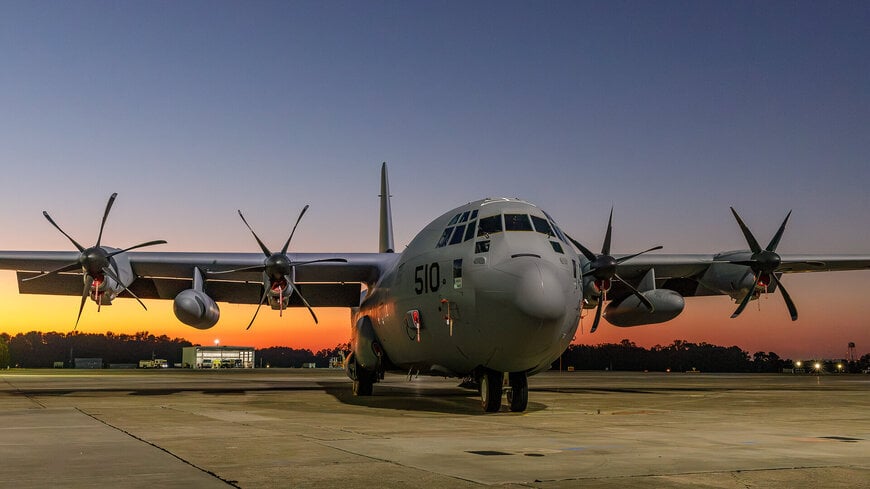
Lockheed Martin delivers a C-130J-30 Super Hercules to begin conversion into the E-130J Phoenix II for survivable naval communications.
www.lockheedmartin.com
National defense architectures rely on uninterrupted, survivable strategic communications to maintain command and control links with nuclear deterrence assets under extreme operational disruption. Submerged ballistic missile submarines, operating across vast ocean expanses, require continuous command connectivity without exposing their positions. Legacy airborne command-and-control fleets face escalating maintenance burdens, airframe fatigue, and obsolete communications suites that complicate sustained operations. Addressing these critical operational requirements demands high-endurance, four-engine turboprop platforms capable of deploying specialized trailing-wire antennas while operating reliably from austere runways.
Airframe Delivery and Conversion Architecture
Lockheed Martin delivered the first C-130J-30 Super Hercules destined for the Take Charge and Move Out (TACAMO) mission at its production facility in Marietta, Georgia, on October 15. The stretched variant airframe provides the physical baseline for the United States Navy's next-generation strategic airborne nuclear command-and-control platform, officially designated the E-130J Phoenix II.
Following delivery from Lockheed Martin, the aircraft transfers to Northrop Grumman, which serves as the primary mission systems integrator. The E-130J TACAMO industry team will execute the complete airframe conversion, integrating specialized survivable mission avionics, secure cryptographic suites, and trailing-wire antenna reels before entering formal operational service.
Engineering Capabilities and Mission Provenance
The C-130J-30 configuration delivers increased payload volume, upgraded propulsion efficiency, and expanded loiter endurance required for uninterrupted airborne command coverage. Advanced digital glass cockpit avionics reduce pilot workload, while increased power margins from modernized turboprop engines accommodate the heavy electrical power generation and thermal dissipation demands of continuous high-power radio frequency transmission.
The platform transition re-establishes the historical alignment between the naval TACAMO mission and the Hercules airframe family. For three decades, from 1963 through 1993, the United States Navy deployed the EC-130Q variant to maintain secure links with deployed ballistic missile fleets. The E-130J builds upon that operating concept, replacing older structures with a contemporary airframe reinforced for nuclear electromagnetic pulse resilience, extended range, and expanded mission hardware survivability.
According to United States Navy Captain Roger Davis, Airborne Strategic Command, Control and Communications program manager (PMA-271), the airframe delivery provides the structural and performance foundation necessary to progress into full mission systems integration and field the completed E-130J Phoenix II weapon system.
Additional Context
This section details technical specifications and competitive benchmarking not included in the original product announcement.
The TACAMO modernization initiative addresses the pending recapitalization of the United States Navy's fleet of sixteen E-6B Mercury aircraft, which operate on Boeing 707 airframes originally procured in the late 1980s. A primary engineering driver behind selecting the C-130J-30 platform over larger commercial widebody passenger jets is its capability to operate from dispersed, unpaved, or shortened runways (under 5,000 feet), significantly expanding geographic survivability and dispersed basing options during crisis scenarios. The C-130J-30 stretches the standard Hercules fuselage by 15 feet (4.57 meters), expanding usable internal cargo floor space to accommodate specialized server racks, mission consoles, and power converters.
The core mission system relies on Very Low Frequency (VLF) communications to penetrate deep seawater layers and transmit Emergency Action Messages (EAMs) to submerged Ohio-class and future Columbia-class ballistic missile submarines (SSBNs). During VLF broadcasting, the aircraft executes tight orbital bank maneuvers while deploying a dual trailing-wire antenna system—consisting of a short wire and a long wire extending up to 5 miles (approximately 8 kilometers)—to achieve a vertical antenna orientation. In military aircraft benchmarking, transitioning from four aging CFM56-2A turbofan engines on the E-6B to modern Rolls-Royce AE 2100D3 turboprops with six-bladed Dowty composite propellers reduces per-flight-hour maintenance costs, minimizes fuel burn during prolonged low-altitude loiter orbits, and provides independent electrical generation capacity exceeding 200 kVA to power primary VLF amplifiers.
Edited by Romila DSilva, Induportals Editor, with AI assistance.
www.lockheedmartin.com
