
www.aero-defence.tech
22
'26
Written on Modified on
Lunar Transit Spacecraft Preliminary Design Review Complete
NASA Jet Propulsion Laboratory and Firefly Aerospace validate the Elytra spacecraft architecture to transport autonomous survey drones to the lunar south pole.
fireflyspace.com
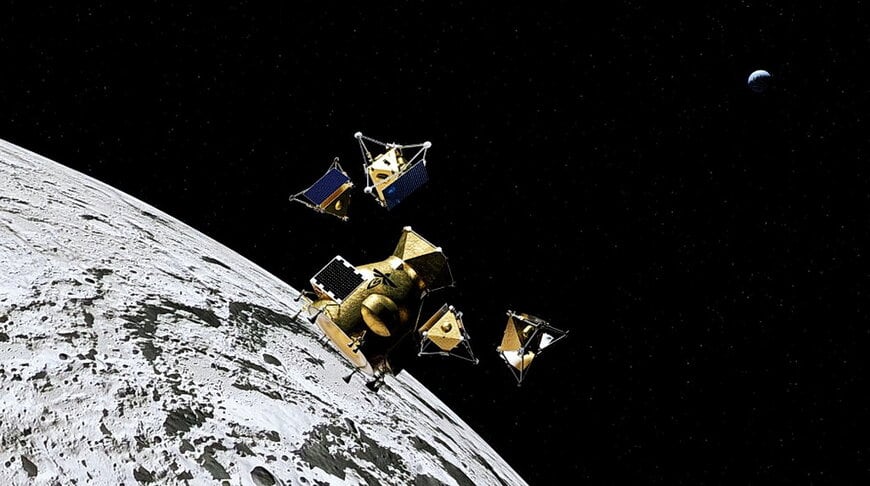
Firefly Aerospace and NASA Jet Propulsion Laboratory have advanced the development of the MoonFall mission payload delivery system following the completion of the preliminary design review for the Elytra spacecraft. This cooperation provides orbital transit and precise deployment infrastructure for autonomous exploration systems targeting the lunar south pole.
System Architecture and Engineering Review
The preliminary design review evaluated the core subsystems of the Elytra vehicle to verify structural and environmental compatibility with payload requirements. Joint engineering teams examined thermal management, propulsion systems, structural interfaces, avionics, trajectory planning, and guidance, navigation, and control architectures. Testing protocols confirmed that the qualification and environmental test plans comply with operational flight standards for translunar insertion and orbital insertion profiles. With this validation, the spacecraft design transitions toward the final critical design review ahead of structural assembly and hardware integration.
Operational Division and Spacecraft Integration
The mission allocates responsibilities between industrial manufacturing and scientific payload operations. NASA Jet Propulsion Laboratory manages overall mission architecture and manufactures the autonomous drones. Firefly Aerospace engineers the Elytra transit vehicle, leveraging orbital mechanics subsystems, flight operations architecture, and avionics derived from its prior lunar platforms.
Following launch aboard an agency-procured launch vehicle, Elytra will execute orbital transit from low Earth orbit to a dedicated lunar orbit. The spacecraft acts as the carrier platform, maintaining power distribution, thermal regulation, and telemetry links until orbital insertion above the lunar south pole. Upon reaching target coordinates, Elytra will execute the mechanical separation sequence to deploy the drones into their operational trajectories.
Payload Mission and South Pole Mapping
The autonomous drones serve as high-resolution reconnaissance platforms for lunar surface infrastructure development. Operating above the lunar south pole, the systems use integrated high-definition optical sensors and scientific instrumentation to conduct topographic surveys. These instruments generate high-resolution terrain mapping data to identify volatile resource concentrations and calculate safe landing trajectories for future surface infrastructure assets.
“As NASA accelerates its Moon Base Program, we’re rapidly scaling spacecraft production to support MoonFall and a growing manifest of lunar surface missions, utilizing proven systems, hardware, and operations from our first successful Blue Ghost mission,” said Ray Allensworth, Vice President of Spacecraft at Firefly Aerospace.
Technical Roadmap for Deployment
The project represents a baseline phase in establishing orbital and surface logistics for long-term presence at the lunar south pole. Hardware fabrication and assembly will commence following critical design sign-off, targeting complete integration and launch readiness by late 2028.
Edited by Evgeny Churilov, Induportals Media - Adapted by AI.
www.fireflyspace.com
