
www.aero-defence.tech
10
'26
Written on Modified on
RTX's Raytheon advances Joint Reduced Range Rocket
The latest test reinforces the system's reliability, affordability and readiness to meet the U.S. Army's growing training requirements.
www.rtx.com
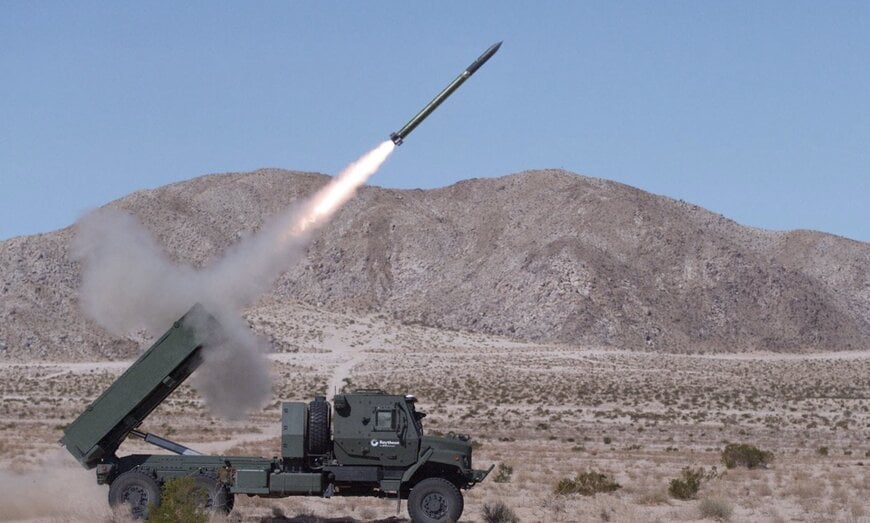
Field artillery units operating precision-strike rocket artillery systems face substantial logistical costs and severe range-safety constraints during domestic and international live-fire qualification exercises. Standard Guided Multiple Launch Rocket System (GMLRS) tactical rounds are built for operational surface-to-surface engagements reaching beyond 70 kilometers, carrying high unit acquisition costs and requiring vast geographical safety envelopes that exceed the physical range boundaries of most military training grounds. To conduct live-fire training without expending high-value tactical munitions or overflying safety boundaries, the military historically relied on the Low-Cost Reduced Range Practice Rocket (RRPR). However, legacy training munitions utilize single-use, non-reloadable six-round composite pod containers that must be discarded after every salvo, driving up ongoing life-cycle training costs and generating substantial industrial waste. Moreover, outdated blunt-impact training warheads often lack consistent visible spotting signatures, complicating real-time observation by forward observers and range safety officers. Replacing these legacy practice rounds requires an affordable, trajectory-consistent training rocket housed inside a rugged, reusable launch pod that integrates seamlessly with existing artillery launchers without requiring launcher-cab modifications.
Rapid-Fire Proving Trials and Reusable Pod Container Architecture
To modernize live-fire training infrastructure while reducing operational training expenditure, Raytheon, an RTX business, conducted its third consecutive successful flight test of the DeepStrike JR3 solution under the U.S. Army's Joint Reduced Range Rocket initiative. Executed at Yuma Proving Ground in Arizona, the demonstration involved the rapid sequential firing of multiple JR3 rockets under dynamic operational profiles.
The trial validated several core system attributes, confirming ballistic trajectory consistency, minimum and maximum range adherence, terminal accuracy, and the high visibility of the impact-marking pyrotechnic solution utilized for immediate visual score confirmation. A central engineering focus of the test was validating the mechanical reusability and field maintainability of the specialized launch pod container. Unlike tactical pods that are discarded following missile exhaust exposure, Raytheon’s launch enclosure is engineered to endure repeated thermal and pressure cycles from live motor ignitions, allowing ordnance personnel to reload new rounds directly into the canister. Developed through a rapid prototyping methodology, the JR3 solution houses 24 rockets within a single Multiple Launch Rocket System Family of Munitions (MFOM) form-factor pod—quadrupling the round count of standard six-rocket tactical containers.
Brian Burton, Vice President of Precision Fires & Maneuver at Raytheon, noted that DeepStrike JR3 meets Army operational training standards while driving down unit cost and system complexity by pairing an economical rocket motor with an inherently reloadable pod structure.
Industrial Base Integration and Program Roadmap
To achieve low-cost production targets and meet accelerated qualification schedules ahead of scheduled Army production decisions, Raytheon established a hybrid industrial consortium combining non-traditional defense suppliers, established aerospace contractors, and government manufacturing facilities. The program team incorporates Combined Systems Inc., Corvid Technologies, L3Harris Technologies, Northrop Grumman, and the Army's Letterkenny Munitions Center. By incorporating commercial manufacturing processes and off-the-shelf tooling across supplier tiers, the consortium aims to scale production output rapidly while shielding the defense training budget from specialized supply-chain bottlenecks. Raytheon is currently preparing the DeepStrike JR3 system for additional developmental flight tests to finalize design maturity ahead of formal U.S. Army qualification.
Additional Context
This section details technical specifications and competitive benchmarking not included in the original product announcement.
In tactical surface-to-surface artillery training managed under U.S. Army Short and Medium Range Artillery (STORM) Project Management Office requirements, the Joint Reduced Range Rocket program establishes stringent operational boundaries designed to keep training trajectories entirely within standard domestic impact areas. The JR3 munition specification mandates an operational engagement range restricted between 7.5 kilometers and 15 kilometers, ensuring the rocket flies a representative high-angle ballistic arc over friendly troops while preventing overflight beyond a compressed surface danger zone. System requirements stipulate a munition reliability threshold of 95 percent or greater and a ten-year minimum storage shelf life, with terminal impact precision required within 25 to 30 meters of target coordinates. By packaging 24 rockets into an MFOM envelope—compared to the standard six-tube configuration used for M30/M31 GMLRS—the design must maintain identical physical center-of-gravity boundaries, total loaded mass profiles, and mechanical hoist interfaces so that crane-loading operations on the tracked M270A2 launcher (which holds two pods) and the wheeled M142 HIMARS (which holds one pod) mirror tactical ammunition handling operations. Electrically, the pod utilizes a MIL-STD-1760 interface and emulates standard tactical digital bus protocols, allowing fire-control software within the Advanced Field Artillery Tactical Data System (AFATDS) to target, initialize, and fire training rockets without requiring costly hardware rewiring or software alterations on operational combat launchers.
Within the precision fires and rocket artillery training sector, Raytheon’s DeepStrike JR3 benchmarks directly against rival proposals from primary artillery prime contractor Lockheed Martin, which originally developed the legacy M26-derived Reduced Range Practice Rocket (RRPR) as well as the M142 and M270 launchers. While Lockheed Martin’s legacy RRPR utilizes a shortened solid-propellant motor with blunt, non-explosive warheads packaged into single-use six-round pods, its recurring hardware procurement costs have placed a persistent strain on military training budgets. Furthermore, while competing modular training approaches explore sub-caliber inserts or purely digital simulation solutions, sub-caliber rockets do not properly replicate launcher recoil, vehicle stabilization dynamics, and realistic reloading logistics for crew qualifications. By scaling pod capacity to 24 rounds, engineering a reloadable structural container, and integrating Letterkenny Munitions Center for government-owned depot reloading, Raytheon challenges Lockheed Martin's proprietary pod monopoly. This approach offers the U.S. Army and foreign military sales (FMS) partners an open-architecture, high-volume live-fire training munition that drastically reduces per-shot costs while maximizing live gunnery repetitions for artillery crews.
Edited by Romila DSilva, Induportals Editor, with AI assistance.
www.rtx.com
