
Thales supplies GM200 MM/C radars for Belgium’s Blue Dome defense network
The highly mobile AESA radar integrates into the NASAMS architecture, linking sensors and effectors for rapid threat neutralization.
www.thalesgroup.com
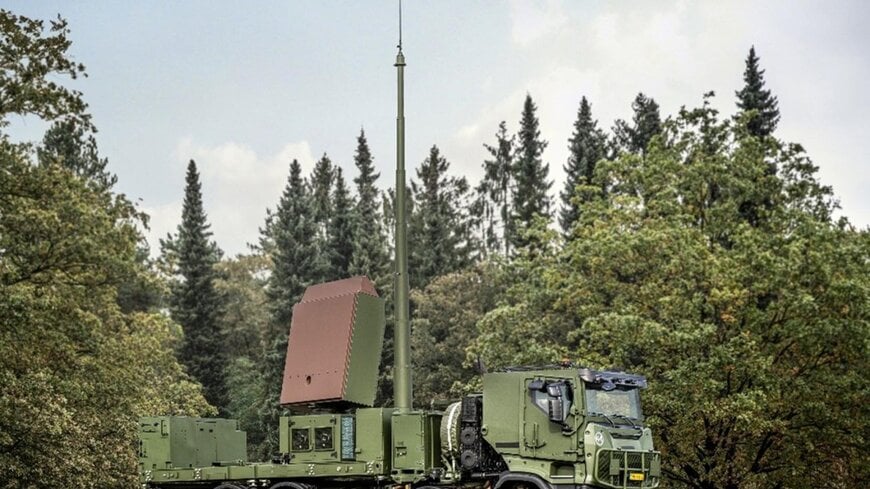
Thales has secured a contract to deliver its Ground Master 200 Multi-Mission Compact (GM200 MM/C) radars to the Belgian Armed Forces, serving as the sensor backbone for the nation’s new "Blue Dome" layered air-defense network. The highly mobile system will be fully integrated into the NASAMS (National Advanced Surface-to-Air Missile System) architecture, pairing the radar's advanced detection capabilities directly with Kongsberg’s Fire Distribution Centre and Raytheon’s AIM-9X AMRAAM missiles to create a seamless sensor-to-shooter loop. The procurement builds upon an existing strategic cooperation with the Netherlands, fostering interoperability and shared maintenance protocols across Benelux and NATO forces.
Multi-mission AESA technology and rapid deployment
Engineered in the Netherlands, the GM200 MM/C is designed to simultaneously execute air surveillance, ground-based air defense (GBAD), and counter-battery missions. Utilizing Thales’ 4D Active Electronically Scanned Array (AESA) technology, the radar provides real-time detection, tracking, and classification of a wide spectrum of modern threats—ranging from low-flying aircraft and tactical ballistic missiles to highly asymmetric threats like small drones, loitering munitions, rockets, artillery, and mortar (RAM) fire.
To ensure survivability on the modern battlefield, the radar prioritizes extreme tactical mobility. Transportable within a standard 20-foot ISO container footprint, the system can be fully deployed and operational in under 60 seconds. Furthermore, its ability to be operated remotely allows military personnel to remain safely decoupled from the emitting sensor array while maintaining continuous network coverage in highly dynamic environments.
Additional Context: 4D AESA Radar, C-RAM, and NASAMS Architecture
This section details the electronic principles of phased array radar and networked air defense not included in the original press release.
Traditional mechanically steered radars rotate a physical antenna to scan the horizon, resulting in slow update rates (often several seconds per sweep) that are insufficient for tracking hypersonic missiles or fast-maneuvering drones. The GM200 MM/C utilizes Active Electronically Scanned Array (AESA) technology. Instead of a single powerful transmitter, an AESA radar features thousands of microscopic, solid-state Transmit/Receive Modules (TRMs) spread across the antenna face. By shifting the phase of the radio waves emitted by each module, the radar beam can be steered electronically in microseconds without physically moving the antenna. Thales refers to this as "4D" radar because it measures azimuth, elevation, and range (the 3 spatial dimensions) while utilizing the Doppler effect to measure the target's precise radial velocity (the 4th dimension).
This extreme processing speed makes the GM200 MM/C highly effective for Counter-Rocket, Artillery, and Mortar (C-RAM) missions. Because artillery shells are small and travel at high ballistic trajectories, traditional radars struggle to detect them. The GM200 MM/C can instantly track the incoming projectile, calculate its ballistic trajectory in real-time, determine the exact Point of Origin (to direct counter-battery counter-fire), and predict the Point of Impact to sound alarms for friendly troops.
Integrating this radar into NASAMS transforms how it engages threats. NASAMS is a highly distributed, open-architecture network rather than a single monolithic weapon system. In this configuration, the GM200 MM/C acts as the "eyes," feeding raw tracking data via encrypted datalinks to the Kongsberg Fire Distribution Centre (the "brain"). The FDC evaluates the threat and assigns it to a remote Raytheon AMRAAM missile launcher (the "muscle"). Because the radar, command center, and missile launchers can be separated by kilometers, an enemy anti-radiation missile targeting the radar's emissions cannot easily destroy the missile launchers or the command crew.
Edited by an industrial journalist, Lekshman Ramdas, with AI assistance.
www.thalesgroup.com
