
www.aero-defence.tech
23
'26
Written on Modified on
Carrier Suitability Testing of Fifth-Generation Fighters on EMALS
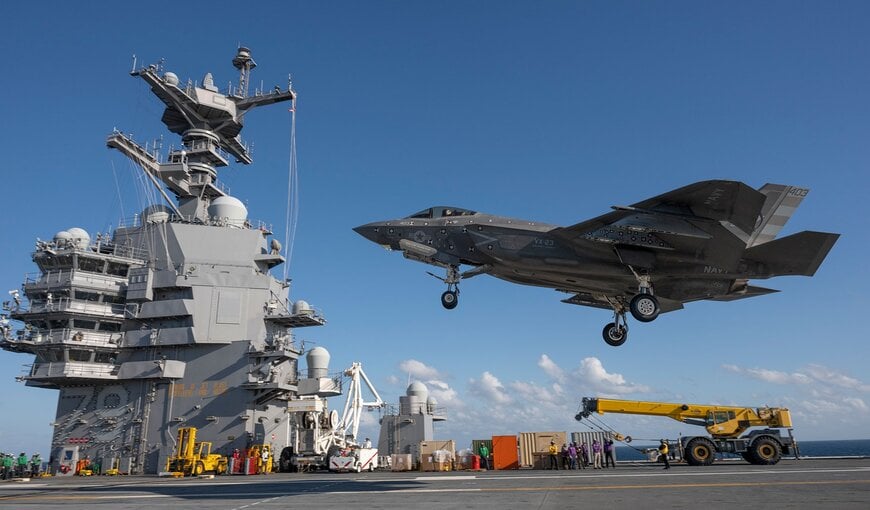
Lockheed Martin's F-35C performed 122 EMALS launches and 122 arrested landings aboard the U.S. Navy's Ford-class carrier John F. Kennedy in compatibility trials.
www.lockheedmartin.com
Application Area: Naval aviation, carrier-based fixed-wing aircraft operations.
Industry Sector: Defence and Aerospace / Naval Aviation.
The U.S. Navy has completed the first shipboard compatibility testing of the Lockheed Martin F-35C Lightning II aboard a Gerald R. Ford-class aircraft carrier. Over 11 days at sea aboard PCU John F. Kennedy (CVN 79), two F-35Cs from Naval Air Station Patuxent River, Maryland, completed 34 flights, 122 catapult launches and 122 arrested landings, with the first recovery taking place on 13 October 2026, the Navy's 251st birthday.
A Different Carrier Operating Environment
Ford-class carriers replace the steam catapults and hydraulic arresting gear of earlier carrier classes with the Electromagnetic Aircraft Launch System (EMALS) and Advanced Arresting Gear (AAG). EMALS uses linear induction motors to accelerate aircraft, allowing more precisely controlled launch profiles, while AAG is designed to support a broader range of aircraft recovery conditions. The ships also feature a redesigned flight deck and island, which alter airflow, exhaust dynamics and deck operations. Each of these changes must be verified with every aircraft type before routine fleet use.
Test Objectives and Data Collection
The sea trials followed shore-based testing conducted between January 2024 and May 2025. At sea, the integrated test team gathered data to verify EMALS and AAG software and shipboard installations, validate the F-35C loads and structural models for launch and recovery, and develop Aircraft Launch Bulletins and Aircraft Recovery Bulletins for Ford-class carriers. The trials also confirmed mission-systems software stability during initial use of Block 4 software in a carrier environment and assessed aircraft supportability aboard the new ship.
Launch and recovery bulletins define the permissible launch settings, aircraft configurations and conditions for a specific aircraft on a specific carrier class, which makes them a prerequisite for operational deployment.
Results and Fleet Clearance
The test campaign provided the data required to integrate a fifth-generation fighter with electromagnetic launch and advanced arresting technology. Sean Jackson, vice president of Lockheed Martin's F-35 Development Program, summarised the outcome: "With the completion of this test phase, the Navy has now cleared the F-35C for operations across its entire fleet of aircraft carriers."
Implications for Carrier Air Wings
The F-35C combines stealth, advanced sensors and data-sharing capabilities that support maritime and joint-force operations. Validating its compatibility with EMALS and AAG removes a key integration step for operating fifth-generation fighters from the Navy's newest carriers and moves the programme closer to full operational integration aboard the Ford-class fleet.
Edited by Sucithra Mani, Induportals editor – adapted by AI.
www.lockheedmartin.com
