
www.aero-defence.tech
23
'26
Written on Modified on
Underwater Battlespace Mission Network Architecture for NATO
Saab-led MANGROVE consortium completes Phase 1 of the Allied Underwater Battlespace Mission Network, defining common standards for integrating crewed and uncrewed naval systems.
www.saab.com
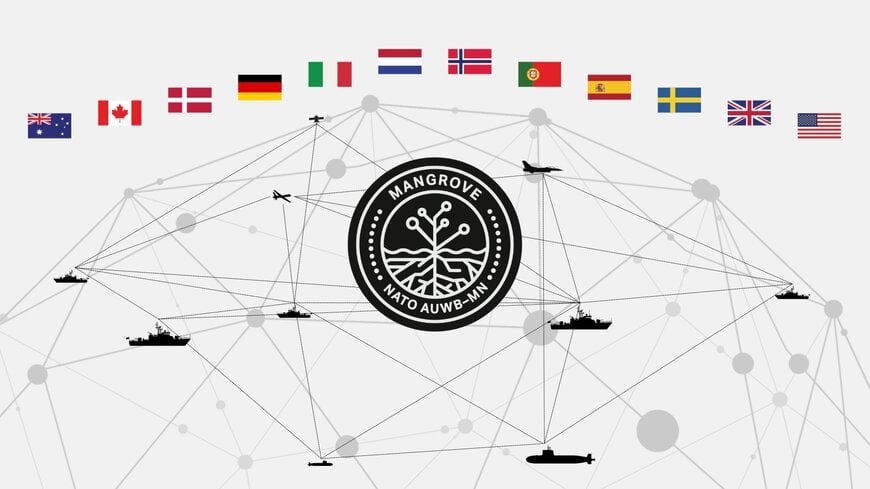
The MANGROVE consortium, led by Saab, has completed Phase 1 of the Allied Underwater Battlespace Mission Network (AUWB-MN), a NATO programme to create a secure, interoperable and resilient mission network for multinational underwater operations.
Why a common underwater mission network is needed
The underwater domain is gaining strategic importance for Allied security. Navies increasingly operate crewed submarines and surface vessels alongside uncrewed underwater vehicles and sensor systems from different manufacturers and nations. Connecting these assets has so far relied on bespoke, point-to-point integrations between individual systems, which are slow to implement and difficult to scale across a multinational force.
AUWB-MN addresses this by defining common standards and security principles. Nations can then share information, coordinate assets and maintain situational awareness as an integrated force, regardless of the specific technology each platform uses.
Consortium partners and roles
The consortium is led by Saab's business area Naval. Its members are CETENA and IDS of the Fincantieri Group, FlySight, GraalTech, Miraya, Saab UK, S2IX and the University of Plymouth. Over the past year, the group combined expertise from industry, academia and defence specialists to develop the architectural, technical and governance foundations for the network.
Technical approach
Rather than prescribing specific hardware, the network architecture sets out shared interfaces, data exchange rules and security requirements. This technology-agnostic approach is intended to shorten integration time for new systems and allow the network to scale as additional platforms and nations join.
David Burton, Project Director, NATO Antisubmarine Warfare Barrier Smart Defence Initiative, said: "As the underwater battlespace becomes increasingly critical to Allied security, NATO must be able to connect platforms, systems and nations through a common operational framework. The delivery of Phase 1 by the MANGROVE consortium is a significant achievement, establishing the architectural foundations for a future mission network that will enhance interoperability, accelerate innovation and strengthen collective maritime capability across the Alliance."
Dr Frida Lindberg, Co-Chair of the MANGROVE consortium and a Business Director at Saab, said: "We have laid the groundwork for a future underwater battlespace mission network that is resilient, scalable and technology-agnostic, creating the foundations for enhanced situational awareness, greater operational agility and more effective multinational cooperation beneath the surface."
Next phase: test and reference environment
Phase 1 also laid the groundwork for a future Test and Reference Environment, which will form the basis of the next project stage. It is intended to support experimentation, capability development, compliance assessment and operational exercises, giving participating nations a common environment to verify that systems meet the network's standards before deployment.
Expected impact on naval interoperability
By replacing individual integrations with shared standards, AUWB-MN is designed to reduce the engineering effort needed to connect new crewed and uncrewed systems, improve information sharing between national forces and support coordinated anti-submarine and underwater surveillance operations across the Alliance.
Edited by Evgeny Churilov, Induportals Media - Adapted by AI.
www.saab.com
