
www.aero-defence.tech
27
'26
Written on Modified on
Counter-UAS Drone Defence Adds Non-Kinetic Net Interception Capability
HENSOLDT integrates ARGUS Interception's net-based drone interception into its Elysion C-UAS system to protect critical infrastructure and military sites.
www.hensoldt.net
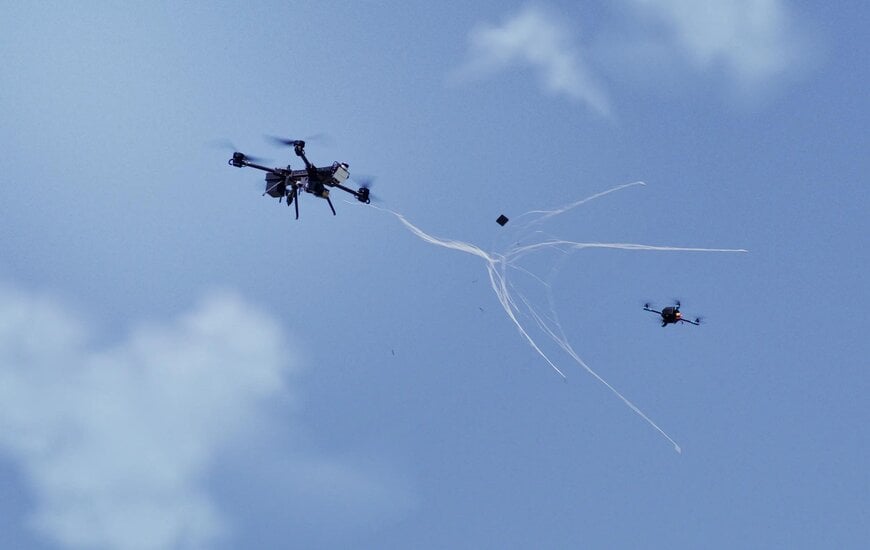
HENSOLDT and ARGUS Interception GmbH are expanding their cooperation in counter-unmanned aircraft systems (C-UAS) by integrating ARGUS's net-based, non-kinetic drone interception technology into HENSOLDT's Elysion C-UAS solution. The combined system targets the protection of critical infrastructure, civilian facilities and military sites in Germany and abroad.
The Challenge of Defending Sensitive Sites Against Drones
Small uncooperative drones pose a growing threat to airports, energy facilities, public events and military installations. Detecting and tracking them is only part of the task; operators also need a means of stopping a drone that is proportionate to the environment. In urban areas or near sensitive infrastructure, kinetic effectors or jamming may be restricted or unsuitable because of collateral damage, falling debris or interference with other systems. A complete counter-drone chain therefore requires several effector options that can be selected according to the situation.
Roles of the Partners
HENSOLDT, headquartered in Taufkirchen, contributes its expertise in sensors, command and control (C2) and system integration. ARGUS Interception, based in Rotenburg (Wümme), contributes specialised interception technology, including the A1-Falke interception drone, which captures target drones with a net. According to the partners, the ARGUS technology is already in operational use. Together they cover the full chain of effects, from early detection and identification through situational awareness, C2 and decision support to controlled interception.
How the Integrated C-UAS Architecture Works
Elysion is a modular multi-sensor, multi-effector platform that combines sensors, effectors and the Elysion Mission Core software to create a unified situational picture. It is designed for stationary, mobile and deployable operations and supports the networking of different sensor and effector systems. HENSOLDT states that Elysion has already been deployed in various military and police operational scenarios. Integrating the ARGUS interceptor adds a controlled, net-based and non-kinetic effector to this architecture, giving operators an additional option in environments where kinetic solutions cannot be used or can only be used to a limited extent.
"Together with ARGUS Interception, we are expanding our modular range of capabilities for customised multi-sensor, multi-effector drone defence to include a non-kinetic C-UAS capability that is already in operational use," said Christian Jaeger, Vice President of the Land Business Unit at HENSOLDT.
"Modern counter-UAS operations require more than just high-performance individual systems. What is crucial is the seamless interplay between detection, situational awareness and decision support, right through to controlled intervention," said Sven Steingräber, CSO and co-founder of ARGUS Interception GmbH.
Deployment and Expected Impact
Initial joint demonstrations and customer projects are already in preparation. The partners aim to further integrate their capabilities into a scalable, interoperable C-UAS solution developed in Germany. For operators of critical infrastructure (KRITIS) and armed forces, a non-kinetic net interception option combined with an established C2 and sensor architecture allows drone threats to be defeated with controlled, proportionate measures while reducing the risk to people and assets on the ground.
Edited by Natania Lyngdoh, Induportals editor, with AI assistance.
www.hensoldt.com
